

Home
Class 12
PHYSICS
Let a star be much brighter than our sun...

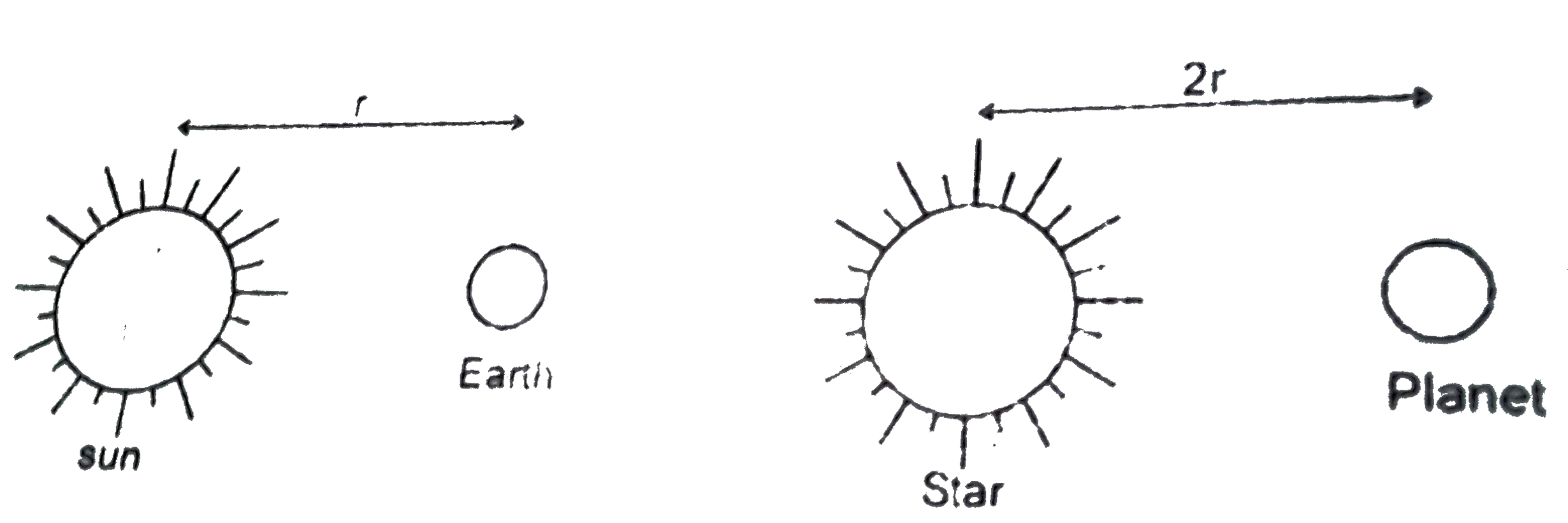
Let a star be much brighter than our sun but its mass is same as that of sun If our earth has average lift span of man as `70 years` In the earth like planet of this star system having double the distance from our star find the average lift span of a man on this planet in terms of our year
.

Promotional Banner

Similar Questions

Explore conceptually related problems

In an imaginary planetary system, the central star has the same mass as our sun, but is much brighter so that only a planet twice the distance between the earth and the sun can support life. Assuming biological evolution ( including aging process etc.) on that is similar to ours, what would be the average life span of a 'human' on that planet in terms of its natural year? The average life span of a human on the earth may be taken to be 70 years.

In an imaginary planetary systam, the centrel star has the same mass as our sun, but is much brighter so that only a planet twice the distance between the Earth and sun can support life. According to bilogical evolution (including aging processes etc.) on that planet similar to ours, what would be the average life span of a 'human' on that planet in terms of its natural life ? The average life span of a human on the Earth may be taken to be 70 years.

In an imaginary planetary system, the central star has the same mass as our sun, but is brighter so that only a planet twice the distance between the earth and the sun can support life. Assuming biological evolution (inculuding aging process etc.) on that planet similar to ours, what would be the average life span of a 'human' on that planet in terms of its natural year ? The average life span of a human on the earth may be taken ot be 70 years.

Average distance of the earth from the sun is L_(1) . If one year of the earth =D days, one year of another planet whose average distance from the sun is L_(2) will be

Average distance of the earth from the sun is L_(1) . If one year of the earth =D days, one year of another planet whose average distance from the sun is L_(2) will be

The nearest star to our solar system is 4.29 light years away. How mcuh is this distance in terms of par sec ? How mcuh parallax would this star show when viewed from two locations of the earth six months apart in its orbit around the sun?

The planet Egabbac (in another solar system) has a radius twice that of the earth's but an average mass density which is the same as the earth. Would the weight of an object on Egabbac's surface to be the same as on the earth's greater than on the earth's or less than on the earth's ? If greater or less than on the earth's then by how much?