

Home
Class 12
PHYSICS
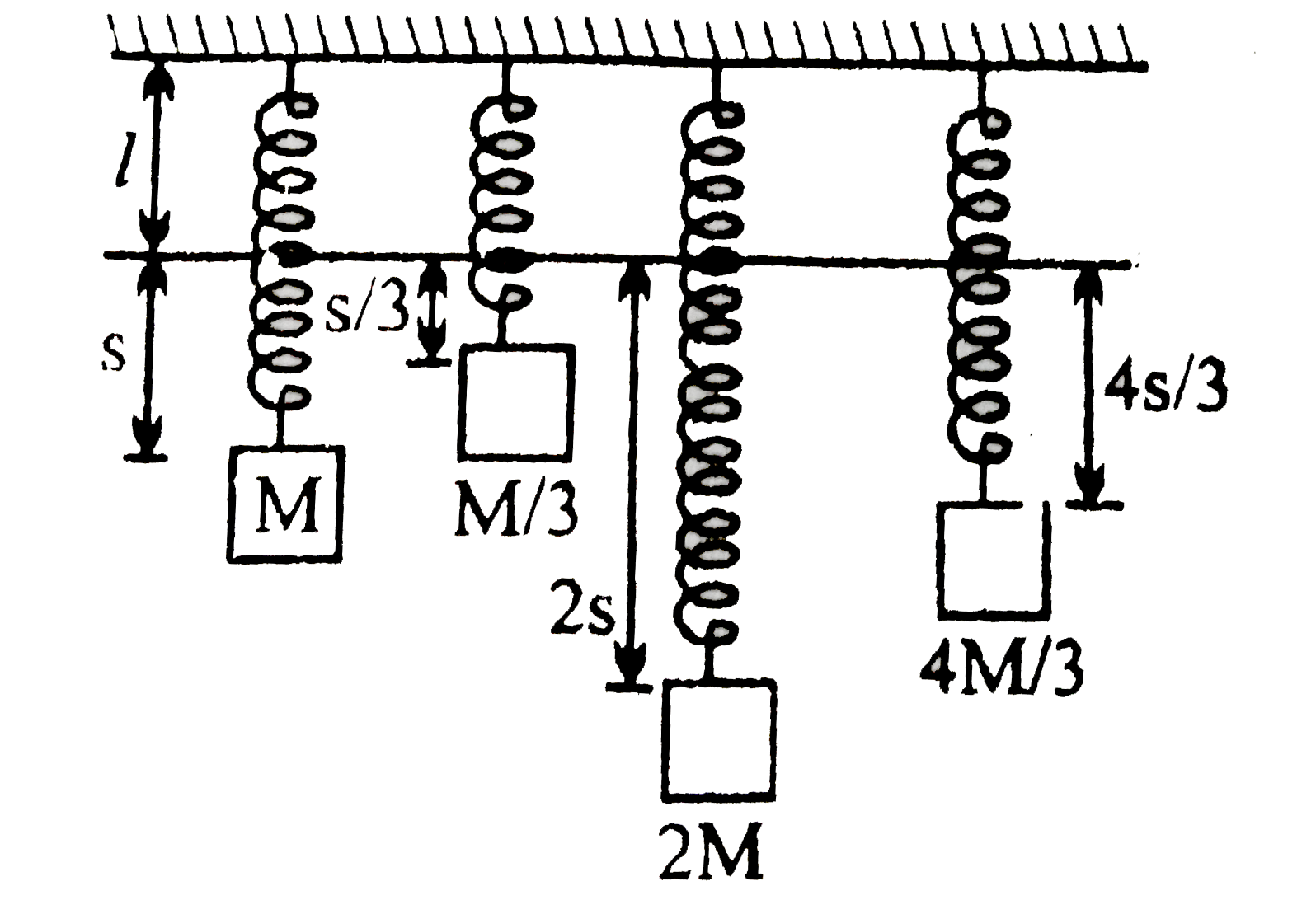
In the equilibrium conditions shown in t...

In the equilibrium conditions shown in the figure all the springs have unstretched length l

Promotional Banner

Similar Questions

Explore conceptually related problems

Consider the situation shown in figure. Initially the spring is unstretched when the system is released from rest. Assuming no friction in the puley, find the maximum eleongation of the spring.

Consider the situation shown in figure. Initially the spring is unstretched when the system is released from rest. Assuming no friction in the pulley, find the maximum elongation of the spring?

Consider the situation shown in figure. Initially the spring is unstretched when the system is released from rest. Assuming no friction in the puley, find the maximum eleongation of the spring.

A block is placed on a rough horizontal plane attached with an elastic spring as shown in the figure. Initially spring is unstretched. If the plane is now gradually lifted from 0^(@) to 90^(@) , then the graph showing extension in the spring (x) versus angle (theta) is

A block of mass m having charge q is attached to a spring of spring constant k . This arrangement is placed in uniform electric field E on smooth horizontal surface as shown in the figure. Initially spring in unstretched. Find the extension of spring in equilibrium position and maximum extension of spring.

A block of mass m having charge q is attached to a spring of spring constant k . This arrangement is placed in uniform electric field E on smooth horizontal surface as shown in the figure. Initially spring in unstretched. Find the extension of spring in equilibrium position and maximum extension of spring.

A block of mass m is pressed against a wall by a spring as shown in the figure. The spring has natural length , l (l gt L) , and the coefficient of friction between the block and the wall is mu . The minimum spring constant K necessary for equilibrium is:

A block of mass m is pressed against a wall by a spring as shown in the figure. The spring has natural length , l (l gt L) , and the coefficient of friction between the block and the wall is mu . The minimum spring constant K necessary for equilibrium is:

A uniform thin cylindrical disk of mass M and radius R is attaached to two identical massless springs of spring constatn k which are fixed to the wall as shown in the figure. The springs are attached to the axle of the disk symmetrically on either side at a distance d from its centre. The axle is massless and both the springs and the axle are in horizontal plane. the unstretched length of each spring is L. The disk is initially at its equilibrium position with its centre of mass (CM) at a distance L from the wall. The disk rolls without slipping with velocity vecV_0 = vacV_0hati. The coefficinet of friction is mu. The maximum value of V_0 for whic the disk will roll without slipping is-