

Home
Class 12
PHYSICS
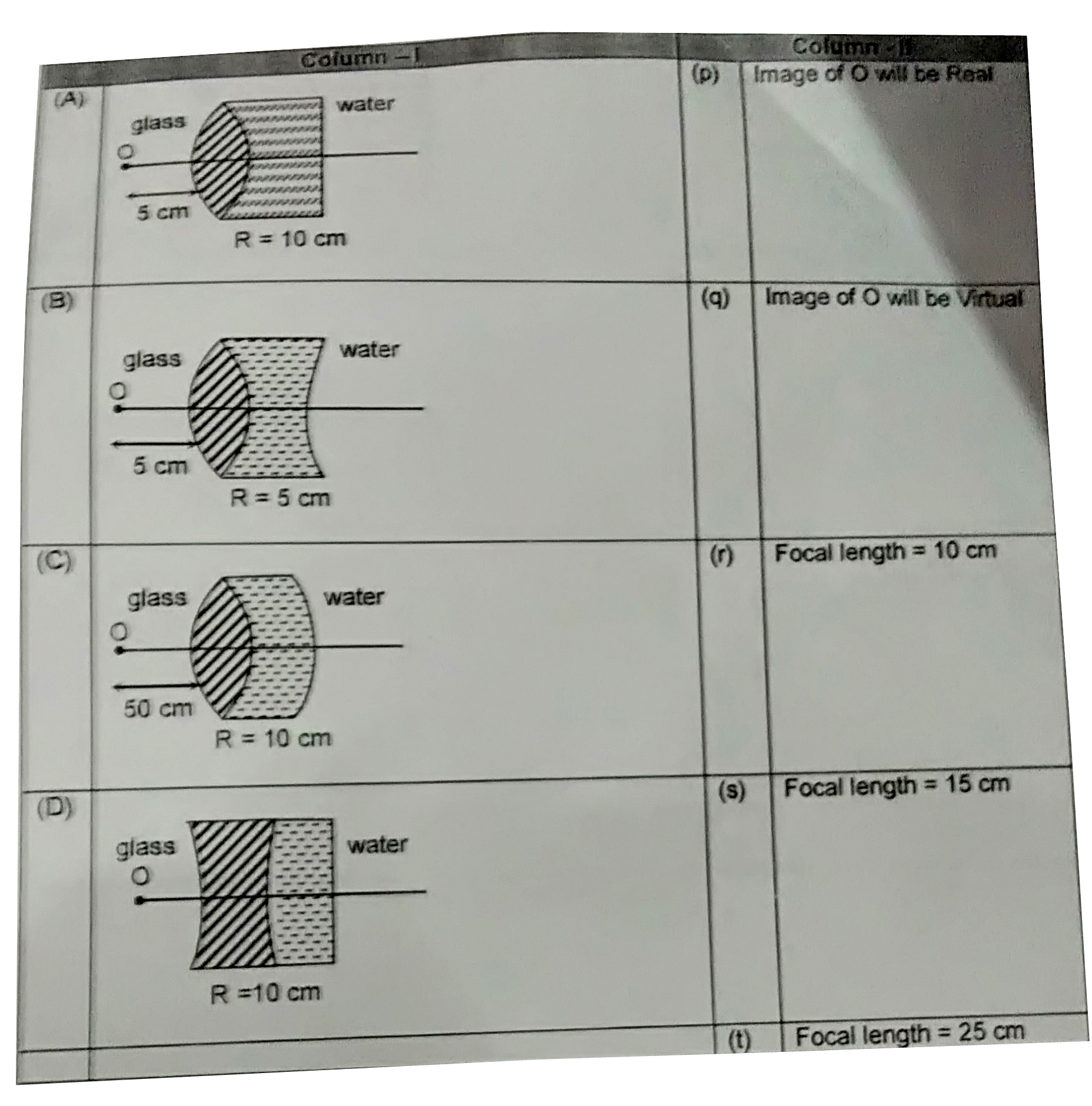
Two thin lens made of glass (mu=3/2) and...

Two thin lens made of glass `(mu=3/2)` and water `(mu=4/3)` kept in contact with each other. An object is placed at point `O` . Assume all curved surfaces have equal radius.
Match the following Columns:

Promotional Banner

Similar Questions

Explore conceptually related problems

A convex lens made of glass (mu_(g)=3//2) has focal length f in air. The image of an object placed in front of it is inverted, real and magnified. Now the whole arrangement distance between object and lens. Then

A convex lens made of glass (mu_(g)=3//2) has focal length f in air. The image of an object placed in front of it is inverted, real and magnified. Now the whole arrangement distance between object and lens. Then

A convex lens made of glass ( mu_(g) = 3/2) has focal length f in air. The image of an object placed . infront of it is inverted real and magnified. Now the whole arrangement is immersed in water ( mu_(w) = 4/3) without changing the distance between object and lens. Then

A spherical convex surface of radius of curvature 20 cm, made of glass (mu=1.5) is placed in air. Find the positon of the image formed, if a point object is placed at 30 cm in front of the convex surface on the principal axis.

A thin equiconvex glass lens (mu_(1) = 1.5) of radius of curvature 'R' and a thin plano-concave lens (mu_(2) = 1.4) are kept in contact and the plane surface is silvered. This lens system is placed in air. When a point object is placed at a distance 20 cm from the lens system on its principal axis, the image formed by the lens system coincides with the object. Then the value of radius of curvature 'R' is

A thin equiconvex glass lens (mu_(1) = 1.5) of radius of curvature 'R' and a thin plano-concave lens (mu_(2) = 1.4) are kept in contact and the plane surface is silvered. This lens system is placed in air. When a point object is placed at a distance 20 cm from the lens system on its principal axis, the image formed by the lens system coincides with the object. Then the value of radius of curvature 'R' is

There is an equiconcave glass lens with radius of each face as R and ._(a)mu_(g) = 3//2 and ._(a)mu_(W) = 4//3 . If there is water in object space and air in image space, then the focal length is

[" A thin prism of crown glass "(mu_(r)=1.515,mu_(V)=1.525)" and a "],[" thin prism of flint glass "(mu_(r)=1.612,mu_(V)=1.632)" are placed "],[" in contact with each other.Their refracting angles are "5^(@)],[" each and are similarly directed.Calculate the angular "],[" dispersion produced by the combination."],[[" (1) "0.15^(@)],[" (2) "0.2^(@)],[" (3) "025^(@)],[" (4) "0.3^(@)]]