Home
Class 12
CHEMISTRY
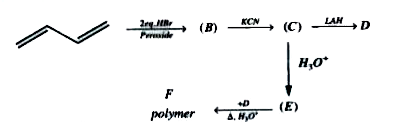
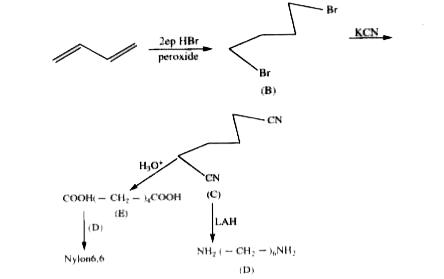
Compound (D) is...


Compound (D) is

A

`H_(2)N(CH_(2))_(4)NH_(2)`

B

`H_(2)N(CH_(2))_(6)NH_(2)`

C

`OHC(CH_(2))_(4)CHO`

D

`OHC(CH_(2))_(6)NH_(2)`

Text Solution

Verified by Experts

The correct Answer is:
B

Promotional Banner

Topper's Solved these Questions

  • POLYMERS

    AAKASH SERIES|Exercise Practice Sheet-1 (Match the following questions)|4 Videos
  • POLYMERS

    AAKASH SERIES|Exercise Practice Sheet-1 (Integer answer Types Questions)|6 Videos
  • POLYMERS

    AAKASH SERIES|Exercise Practice Sheet-1 (Single correct questions)|14 Videos
  • PERIODIC TABLE

    AAKASH SERIES|Exercise QUESTIONS FOR DESCRIPTIVE ANSWERS|37 Videos
  • PRACTICAL CHEMISTRY

    AAKASH SERIES|Exercise PRACTICE SHEET-5 (Integer answer Type questions)|6 Videos

Similar Questions

Explore conceptually related problems

Primary alkyl halide C_(4)H_(9)Br (a) reacted with alcoholic KOH to give compound (b). Compound (b) is reacted with HBr to give (c) which is an isomer of (a). When (a) is reacted with sodium metal it gives compound (d), C_(8)H_(18) which is different from the compound formed when n-butyl bromide is reacted with sodium. Give the structural formula of (a) and write the equations for all the reactions.

An organic compound A(C_4 H_7 C_(13)) yields (B) when treated with aq. KOH. (B) upon treatment with C_2 H_5 OH in presence of acid gave (C) which upon reducing with LiAIH_4 gave (D) and (E). (B) upon treatment with NH_3 followed by heating with P_4 O_(10) and subsequent hydrolysis gives back (B). Sodium salt of (B) on Kolbe's electrolysis gave 2, 3-dimethylbutane at anode. The dehydration of compound (D) gives

Boron reacts with oxygen at 700^(@)C to give (A). Compound (A) reacts with carbon and dry chlorine to give (B) an carbon monoxide. (B) on reduction with LiAlH_(4) gives (C ) along with LiCl and AlCl_(3) . (C ) on reaction with ammonia at 200^(@)C gives (D). Compound (C ) is

A compound (X) C_(6)H_(12)O_(6) is oxidised by bromine water into monobasic acid and also reduces Tollens' reagent. It reacts with HCN to give a compound (Y) which on hydrolysis gives a compound (Z).On treating compound (Z) with HI in the presence of red phosphorus n-heptanoic acid is obtained. Compound (X) on treatment with excess phenylhydrazine gave D-glucosazone. The cyclic form of compound (X) is

A, B, C are with molecular formula C_(8)H_(11)N three isomeric amines. A and B react with CHCl_(3)+KOH but not C. C reacts with NaNO_(2)+HCl to give yellow oily liquid. A and B on treatment with Br_(2) and acetic acid separately produced compounds D (C_(8)H_(9)NBr_(2)) and E(C_(8)H_(8)N Br_(3)) . The name of compound B is likely to be

A compound (X) C_(6)H_(12)O_(6) is oxidised by bromine water into monobasic acid and also reduces Tollens' reagent. It reacts with HCN to give a compound (Y) which on hydrolysis gives a compound (Z).On treating compound (Z) with HI in the presence of red phosphorus n-heptanoic acid is obtained. Compound (X) on treatment with excess phenylhydrazine gave D-glucosazone. The compound (Y) is

The compound AgF_(2) is unstable compound. However, if formed, the compound acts as a very strong oxidising agent. Why ?

Find structure of compound D :

Find structure of compound D :

