Home
Class 12
CHEMISTRY
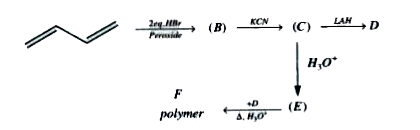
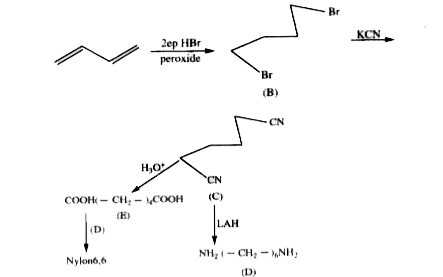
Compound (E) is...


Compound (E) is

A

`OHC(CH_(2))_(4)CHO`

B

`OHC(CH_(2))_(4)COOH`

C

`OHC(CH_(2))_(6)COOH`

D

`HOOC(-CH_(2)-)_(4)COOH`

Text Solution

Verified by Experts

The correct Answer is:
D

Promotional Banner

Topper's Solved these Questions

  • POLYMERS

    AAKASH SERIES|Exercise Practice Sheet-1 (Match the following questions)|4 Videos
  • POLYMERS

    AAKASH SERIES|Exercise Practice Sheet-1 (Integer answer Types Questions)|6 Videos
  • POLYMERS

    AAKASH SERIES|Exercise Practice Sheet-1 (Single correct questions)|14 Videos
  • PERIODIC TABLE

    AAKASH SERIES|Exercise QUESTIONS FOR DESCRIPTIVE ANSWERS|37 Videos
  • PRACTICAL CHEMISTRY

    AAKASH SERIES|Exercise PRACTICE SHEET-5 (Integer answer Type questions)|6 Videos

Similar Questions

Explore conceptually related problems

An alcohol (A) on dehydration gives (B) which on ozonolysis gives two products C & D (D) gives positive iodoform test and on heating with dilute alkali gives alpha . beta -unsaturated carbonyl compound (E) which does not gives positive iodoform test. (C) on oxidation gives a mono basic acid (F) Ag salt of (F) contains 59.6% Ag. Oxime of (D) contains 16.09% nitrogen. the structure of (E ) is given reaction is

An alcohol (A) on dehydration gives (B) which on ozonolysis gives two products C & D (D) gives positive iodoform test and on heating with dilute alkali gives alpha . beta -unsaturated carbonyl compound (E) which does not gives positive iodoform test. (C) on oxidation gives a mono basic acid (F) Ag salt of (F) contains 59.6% Ag. Oxime of (D) contains 16.09% nitrogen. the structure of (A) is

An alcohol (A) on dehydration gives (B) which on ozonolysis gives two products C & D (D) gives positive iodoform test and on heating with dilute alkali gives alpha . beta -unsaturated carbonyl compound (E) which does not gives positive iodoform test. (C) on oxidation gives a mono basic acid (F) Ag salt of (F) contains 59.6% Ag. Oxime of (D) contains 16.09% nitrogen. structure of D is

Compounds (C) and (E) are respectively

A bluish green coloured compound 'A' on heating gives two products 'B' and 'C'. A metal 'D' is deposited on passing H_(2) through heated 'B'. The compound 'A' and 'B' are insoluble in water. 'B' is black in colour, dissolves in HCI and on treatment with K_(4)[Fe(CN)_(6)] gives a chocolate brown ppm of compound 'E'. 'C' is colourless, odourless gas and turns lime water milkly. Compound 'A' is

A black are [x]on fraiment Na_(2)CO_(3) in the presence of air gives a green compound (a). When Rreen compound (a) died in water it producess dark precipitate (b) and pink solution (e) crystal of (e) when treated with propene produces dark ppr (b) Geometry around central atom in (a) and (c) respectively

A black are [x]on fraiment Na_(2)CO_(3) in the presence of air gives a green compound (a). When Rreen compound (a) died in water it producess dark precipitate (b) and pink solution (e) crystal of (e) when treated with propene produces dark ppr (b) Metal present in ore extracted by

The starting compound which gives compound (A) by aldol reaction is

The compound AgF_(2) is unstable compound. However, if formed, the compound acts as a very strong oxidising agent. Why ?

Can we write the structure of a compound if the name of the compound is given ?

