A
B
C
D
Text Solution
Verified by Experts
The correct Answer is:



Topper's Solved these Questions
CHEMICAL KINETICS
AAKASH SERIES|Exercise LEVEL-1 (EXERCISE -I COLLISION THEORY:)|18 VideosCHEMICAL KINETICS
AAKASH SERIES|Exercise LEVEL-1 (EXERCISE -I ORDER MOLECULARIT AND HALF LIFE:)|45 VideosCHEMICAL KINETCS
AAKASH SERIES|Exercise EXERCISE - 3.2|45 VideosCHEMICAL THERMODYNAMICS
AAKASH SERIES|Exercise Additional Practice Exercise|54 Videos
Similar Questions
Explore conceptually related problems
AAKASH SERIES-CHEMICAL KINETICS-Objective Exercise - 4 (Assertion (A) & Reason (R) Type Questions)
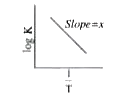
- The graph of log K versus 1/T is given below. Here x is equal to [Wh...
Text Solution
|
- (A) Spontaneous reaction may be slow or fast. (R ) Spontaneous natur...
Text Solution
|
- A: Rate of reaction increases with increasse in concentration of react...
Text Solution
|
- A: Hydrolysis of an ester is a slow reaction R: Reactions between co...
Text Solution
|
- (A) All collisions lead to chemical reaction (R ) All molecules brin...
Text Solution
|
- A: Order of reaction is evaluated from the mechanism of a reaction ...
Text Solution
|
- A: A catalyst increases the rate of a reaction. R: In presence of a ...
Text Solution
|
- (A) The rate of the reaction is the rate of change of concentration of...
Text Solution
|
- (A ) If in a zero order reaction, the concentration of the reactant is...
Text Solution
|
- (A) The addition of catalyst lowers the activation barrier, yet there ...
Text Solution
|
- (A) In a multiple reaction, the rate determining step is the fast step...
Text Solution
|
- (A) Half-life period of a reaction of first order is independent of in...
Text Solution
|
- (A) Order of recation is related to molecularity of reaction (R ) Mo...
Text Solution
|
- (A) The rate law equation can be found only by experiment. (R ) Rate...
Text Solution
|
- (A) Reactions of higher order are rare (R ) The chances of multimole...
Text Solution
|
- (A) Rate of reaction increases with increase in temperature. (R ) Nu...
Text Solution
|
- (A) The mass of the products formed in a reaction depends upon the lim...
Text Solution
|
- (A) Order with respect to any reactant or product can be zero or posit...
Text Solution
|
- (A) The rections 2NO+O(2) to 2NO(2) and 2CO+O(2) to 2CO(2), proceed at...
Text Solution
|
- (A) Hydrolysis of ethyl acetate in presence of acid is a reaction of f...
Text Solution
|
- (A) The rate of reaction is always negative. (R ) Minus sign used in...
Text Solution
|