Home
Class 10
BIOLOGY
(a) List two reasons for the appearance ...

(a) List two reasons for the appearance of variations among the progeny formed by sexual
(b) reproduction.
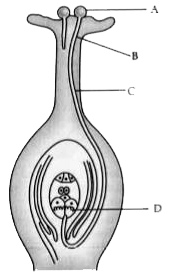
(i) Name the part marked 'A' in the diagram.
(ii) How does 'A' reaches part 'B'?
(iii) State the importance of the part 'C'.
(iv) What happens to the part marked ‘D’ after fertilization is over?

Text Solution

Verified by Experts

(a) (i) Involvement of two different individuals.
(ii) Creation of new combination of variants.
(b) (i) pollen/pollen grain.
(ii) by pollination/agents of pollination.
(iii)It (pollen tube) helps male gamete to reach egg (ovule).
(iv) Converts into embryo.
Promotional Banner

Topper's Solved these Questions

  • HOW DO ORGANISMS REPRODUCE?

    OSWAAL PUBLICATION|Exercise TOPIC - 2 (SEXUAL REPRODUCTION IN PLANTS)(LONG ANSWER TYPE QUESTIONS)|7 Videos
  • HOW DO ORGANISMS REPRODUCE?

    OSWAAL PUBLICATION|Exercise TOPIC - 3 (REPRODUCTION IN HUMAN BEINGS)(MULTIPLE CHOICE QUESTIONS)|2 Videos
  • HOW DO ORGANISMS REPRODUCE?

    OSWAAL PUBLICATION|Exercise TOPIC - 2 (SEXUAL REPRODUCTION IN PLANTS)(SHORT ANSWER TYPE QUESTIONS - I)|7 Videos
  • HEREDITY AND EVOLUTION

    OSWAAL PUBLICATION|Exercise NCERT CORNER TEXTBOOK EXERCISES|11 Videos
  • LIFE PROCESSES

    OSWAAL PUBLICATION|Exercise NCERT CORNER ( TEXTBOOK EXERCISES )|13 Videos

Similar Questions

Explore conceptually related problems

Distinguish between unisexual and bisexual flowers giving one example of each. Draw a neat diagram showing fertilisation in a flower and label: a] Pollen tube b] Male germ cell c] Female germ cell, on it. OR Draw the diagram showing the germination of pollen on stigma and label the part on which pollination takes place. Answer the following questions based on diagram given aside. i] Name the part marked 'P. in the diagram. ii] How does 'P. reach part 'B'? iii] State the importance of the part 'C'. iv] What happens to the part marked 'D' after fertilisation is over? Mention the role of gamete and zygote in sexually reproducing organisms.

Identify the following diagram and name the parts marked as A B and C.

Name the parts A, B and C shown in the following diagram and state one function of each.

In the given diagram of reflex arc : Name the parts labelled A, B, C, D and E.

In the given diagram name the parts A, B, C and D and E .

a] Draw a well labelled diagram of human female reproductive system and label the following parts. i] Produces eggs ii] Part where fusion of sperm and egg takes place iii] Part where zygote is implanted iv] Part where sperms enter. b] What happens to human egg when it is not fertilised?

(a) Name the respective part of human female reproductive system: (i) that produces eggs, (ii) where fusion of eggs and sperm takes place. (b) Describe in brief what happens to the zygote after it gets implanted.

OSWAAL PUBLICATION-HOW DO ORGANISMS REPRODUCE?-TOPIC - 2 (SEXUAL REPRODUCTION IN PLANTS)(SHORT ANSWER TYPE QUESTIONS - II)
  1. Name the parts A, B and C shown in the diagram and write their functio...

    Text Solution

    |

  2. What is meant by pollination? Name and differentiate between the two t...

    Text Solution

    |

  3. Describe in brief the function of various parts of female reproductive...

    Text Solution

    |

  4. Name three parts of carpel and give one function each.

    Text Solution

    |

  5. (i) Why is vegetative propagation practised for growing some types of ...

    Text Solution

    |

  6. (i) What is the difference between self-pollination and cross pollinat...

    Text Solution

    |

  7. Enumerate the method of fertilisation as seen in a flowering plant.

    Text Solution

    |

  8. What is a seed ? How does it help in reproduction in plants?

    Text Solution

    |

  9. Mention the important post-fertilisation changes in the flower.

    Text Solution

    |

  10. What is sexual reproduction? List its four significance.

    Text Solution

    |

  11. Draw longitudinal section of a bisexual flower and label the following...

    Text Solution

    |

  12. Name the parts A, B and C shown in the following diagram and state one...

    Text Solution

    |

  13. In a germinating seed, which parts are known as future shoot and futur...

    Text Solution

    |

  14. (a) List two reasons for the appearance of variations among the progen...

    Text Solution

    |

  15. Name the reproductive parts of an angiosperm. Where are these parts lo...

    Text Solution

    |

  16. Draw a diagram of the longitudinal section of a flower exhibiting germ...

    Text Solution

    |

  17. (i) Draw a neat labelled diagram of a germinated seed and label radicl...

    Text Solution

    |
