Home
Class 10
BIOLOGY
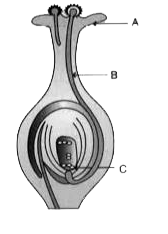
Name the parts A, B and C shown in the d...

Name the parts A, B and C shown in the diagram and write their functions.

Text Solution

Verified by Experts
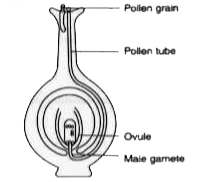
(a) In the given figure,
A-represents the pollen grain
B-represents the pollen tube
C-represents the ovule
D-represents the male gamete

(b) The transfer of pollen grains from the anther to the stigma of a flower is known as pollination.
Significance of pollination:
(i) It is a significant event because it precedes fertilization.
(ii) It brings the male and female gametes closer for the process of fertilization.
(iii) Cross-pollination introduces variations in plants because of the mixing of different genes. These variations further increase the adaptability of plants towards the environment or surroundings.
(c) Double fertilization is a characteristic feature of flowering plants. In this process, out of the two sperm nuclei, one sperm nucleus fuses with the egg nucleus to form an embryo (process is called syngamy) and another fuses with the polar nucleus to form an endosperm (process is called triple fusion). Because two kinds of fusion-syngamy and triple fusion-take place, the process is known as double fertilisation. After fertilisation,
(i) the ovule develops into a seed
(ii) the ovary develops into a fruit
Promotional Banner

Topper's Solved these Questions

  • HOW DO ORGANISMS REPRODUCE?

    OSWAAL PUBLICATION|Exercise TOPIC - 3 (REPRODUCTION IN HUMAN BEINGS)(MULTIPLE CHOICE QUESTIONS)|2 Videos
  • HOW DO ORGANISMS REPRODUCE?

    OSWAAL PUBLICATION|Exercise TOPIC - 3 (REPRODUCTION IN HUMAN BEINGS)(MATCH THE COLUMN)|1 Videos
  • HOW DO ORGANISMS REPRODUCE?

    OSWAAL PUBLICATION|Exercise TOPIC - 2 (SEXUAL REPRODUCTION IN PLANTS)(SHORT ANSWER TYPE QUESTIONS - II)|17 Videos
  • HEREDITY AND EVOLUTION

    OSWAAL PUBLICATION|Exercise NCERT CORNER TEXTBOOK EXERCISES|11 Videos
  • LIFE PROCESSES

    OSWAAL PUBLICATION|Exercise NCERT CORNER ( TEXTBOOK EXERCISES )|13 Videos

Similar Questions

Explore conceptually related problems

Name the parts A, B and C shown in the following diagram and state one function of each.

(a) Identify A, B, and D in the given diagram and write their names. (b) What is pollination? Explain its significance. (c) Explain the process of fertilization in flowers. Name the parts of the flower that develop after fertilization into (i) seed, (ii) fruit.

Which type of aestivation is shown in the diagram ?

Parts A, B, C and D of the human eye are shown in the diagram. Select the option which gives correct identification along with its functions/ characteristics

Where does digestion start in our alimentary canal ? Name the enzyme secreted in that part and write its function.

(a) Name the human male reproductive organ that produces sperms and also secretes a hormone. Write the functions of the secreted hormone. (b) Name the parts of the human female reproductive system where- (i) Fertilisation takes place (ii) Implantation of the fertilised egg occurs. (c) Explain how the embryo gets nourishment inside the mother's body.

Name the parts of the brain that perform the following functions : Sensation of hunger or feeling full.

Name the parts of the brain that perform the following functions : Regulating blood pressure.

Name the parts of the brain that perform the following functions : Maintaining the posure and balance of the body.

