Home
Class 10
BIOLOGY
(i) Name a sexually transmitted disease ...

(i) Name a sexually transmitted disease and a method to avoid it.
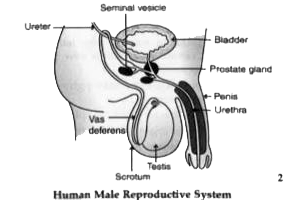
(ii) Draw a neat diagram of human male reproductive system and label the parts performing the following functions :
(a) Production of sperms, (b) Gland which provide fluid, (c) Provides low temperature for the formation of sperms. (d) Common passage for sperm and urine.

Text Solution

Verified by Experts
(i) Viral infection such as warts or HIV-AIDS.
By using condoms during sexual intercourse.
(ii) (a) Testis, (b) Prostate gland, (c) Scrotum, (d) Urethra.
Promotional Banner

Topper's Solved these Questions

  • HOW DO ORGANISMS REPRODUCE?

    OSWAAL PUBLICATION|Exercise NCERT CORNER (INTEXT QUESTIONS)|12 Videos
  • HOW DO ORGANISMS REPRODUCE?

    OSWAAL PUBLICATION|Exercise NCERT CORNER (TEXTBOOK EXERCISES)|11 Videos
  • HOW DO ORGANISMS REPRODUCE?

    OSWAAL PUBLICATION|Exercise TOPIC - 3 (REPRODUCTION IN HUMAN BEINGS)(SHORT ANSWER TYPE QUESTIONS - II)|17 Videos
  • HEREDITY AND EVOLUTION

    OSWAAL PUBLICATION|Exercise NCERT CORNER TEXTBOOK EXERCISES|11 Videos
  • LIFE PROCESSES

    OSWAAL PUBLICATION|Exercise NCERT CORNER ( TEXTBOOK EXERCISES )|13 Videos

Similar Questions

Explore conceptually related problems

a] Draw a well labelled diagram of human female reproductive system and label the following parts. i] Produces eggs ii] Part where fusion of sperm and egg takes place iii] Part where zygote is implanted iv] Part where sperms enter. b] What happens to human egg when it is not fertilised?

In the diagram of human male reproductive system given below : (i) Label the parts A and B. (ii) Name the hormone produced by organ 'X'. What is the role of this hormone in the human male? (iii) Mention the name of substances that are transported by tubes. (i) C and (ii)

(a) Name the human male reproductive organ that produces sperms and also secretes a hormone. Write the functions of the secreted hormone. (b) Name the parts of the human female reproductive system where- (i) Fertilisation takes place (ii) Implantation of the fertilised egg occurs. (c) Explain how the embryo gets nourishment inside the mother's body.

a] What is puberty ? b] Describe in brief the functions of the following parts in the human male reproductive system: {i) Testes (ii) Seminal vesicle (iii) Vas deferens {iv) Urethra OR Explain the significant function of each structure in human male reproductive system. c] Why are testes located outside the abdominal cavity? d] State how sperms move towards the female germ cell?

Distinguish between unisexual and bisexual flowers giving one example of each. Draw a neat diagram showing fertilisation in a flower and label: a] Pollen tube b] Male germ cell c] Female germ cell, on it. OR Draw the diagram showing the germination of pollen on stigma and label the part on which pollination takes place. Answer the following questions based on diagram given aside. i] Name the part marked 'P. in the diagram. ii] How does 'P. reach part 'B'? iii] State the importance of the part 'C'. iv] What happens to the part marked 'D' after fertilisation is over? Mention the role of gamete and zygote in sexually reproducing organisms.

a] Name the parts of the human female reproductive system where i] fertilisation takes place, ii] implantation of the fertilised egg occurs. b] Explain how the embryo gets nourishment inside the mother's body. c] Write the function of following parts in human female reproductive system: i] Ovary ii] Oviduct iii] Uterus d] Describe in brief the structure and function of placenta. OR Explain the structure and important role of placenta during gestation period of woman.

