Home
Class 12
CHEMISTRY
A, B, C are with molecular formula C(8)H...

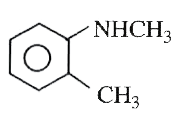
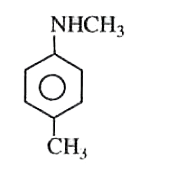
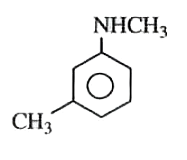
A, B, C are with molecular formula `C_(8)H_(11)N` three isomeric amines. A and B react with `CHCl_(3)+KOH` but not C. C reacts with `NaNO_(2)+HCl` to give yellow oily liquid. A and B on treatment with `Br_(2)` and acetic acid separately produced compounds D `(C_(8)H_(9)NBr_(2))` and `E(C_(8)H_(8)N Br_(3))`.
compound C may be

A

B

C

D

All the above

Text Solution

Verified by Experts

The correct Answer is:

D

`2^(@)` amine
Promotional Banner

Topper's Solved these Questions

  • AMINES AND AZO COMPOUNDS

    AAKASH SERIES|Exercise LEVEL - II (LECTURE SHEET) EXERCISE-IV (Match the following questions)|8 Videos
  • AMINES AND AZO COMPOUNDS

    AAKASH SERIES|Exercise LEVEL - II (LECTURE SHEET) EXERCISE-IV (Integer answer type Questions)|6 Videos
  • AMINES AND AZO COMPOUNDS

    AAKASH SERIES|Exercise LEVEL - II (LECTURE SHEET) EXERCISE-III (Linked Comprehension type questions) Passage - I :|3 Videos
  • ALKYL AND ARYL HALIDES

    AAKASH SERIES|Exercise OBJECTIVE EXERCISE - 4 (ASSERTION (A) & REASON (R) TYPE QUESTIONS)|19 Videos
  • AMINES AND DIAZONIUM SLATS

    AAKASH SERIES|Exercise PRACTICE EXERCISE|25 Videos

Similar Questions

Explore conceptually related problems

A, B, C are with molecular formula C_(8)H_(11)N three isomeric amines. A and B react with CHCl_(3)+KOH but not C. C reacts with NaNO_(2)+HCl to give yellow oily liquid. A and B on treatment with Br_(2) and acetic acid separately produced compounds D (C_(8)H_(9)NBr_(2)) and E(C_(8)H_(8)N Br_(3)) . compound A is

A, B, C are with molecular formula C_(8)H_(11)N three isomeric amines. A and B react with CHCl_(3)+KOH but not C. C reacts with NaNO_(2)+HCl to give yellow oily liquid. A and B on treatment with Br_(2) and acetic acid separately produced compounds D (C_(8)H_(9)NBr_(2)) and E(C_(8)H_(8)N Br_(3)) . The name of compound B is likely to be

An organic compound with molecular formula C_(3)H_(5)N on hydrolysis gives an acid. The acid on heating with N_(3)H and conc. H_(2)SO_(4) gives

In the compound, O_(2)N-C_(6)H_(4)-N=N-C_(6)H_(4)-N(CH_(3))_(2) , the chromophore is

The structural form of a compound A(C_(6)H_(11)N) is resolvable, dissolve in dil.HCl and reacts with HNO_(3) . Compound a could be

An organic acid with molecular formula C_(8)H_(8)O_(2) on decarboxylation forms Toluene. Idnetify the organic acid.

Give the IUPAC names of the compound CH_(3) C (p-Cl-C_(6) H_(4))_(2) CH (Br)CH_(3)

A compound "X" has molecular formula C_5H_(9) Cl . It does not react with bromine in C Cl_4 . On treatment with strong base it produces single compound "Y" (C_5H_8) and reacts with Br_(2)(aq) . Ozonolysis of "Y" produces a compound C_5H_(8)O_2 . The structure of X is

The isomeric compounds ‘A’ and 'B' with molecular fomula C_(7)H_(9)N gave the following reactions. When B is acetylated and then brominated, it gave one monobromo derivative. 'A' when treated with NaNO_(2) and HCI gave the compound 'C'. 'C' was heated with acetic acid in the presence of conc. H_(2)SO_(4) , a pleasant smelling liquid (D) was obtained. 'B' was treated with Na ‘B’ is

The isomeric compounds ‘A’ and 'B' with molecular fomula C_(7)H_(9)N gave the following reactions. When B is acetylated and then brominated, it gave one monobromo derivative. 'A' when treated with NaNO_(2) and HCI gave the compound 'C'. 'C' was heated with acetic acid in the presence of conc. H_(2)SO_(4) , a pleasant smelling liquid (D) was obtained. 'B' was treated with Na 'D' is
