Home
Class 12
CHEMISTRY
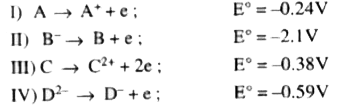
Deduce from the following E^@ values of ...

Deduce from the following `E^@` values of half cells, what combination of two half cells would result in a cell with the largest potential?

A

I and IV

B

II and III

C

III and IV

D

I and II

Text Solution

Verified by Experts

The correct Answer is:

D
Promotional Banner

Topper's Solved these Questions

  • REVISION EXERCISE

    AAKASH SERIES|Exercise SURFACE CHEMISTRY|45 Videos
  • REVISION EXERCISE

    AAKASH SERIES|Exercise VA GROUP ELEMENTS|26 Videos
  • REVISION EXERCISE

    AAKASH SERIES|Exercise CHEMICAL KINETICS|39 Videos
  • REDOX REACTONS

    AAKASH SERIES|Exercise Questions For Descriptive Answers|27 Videos
  • SOLID STATE

    AAKASH SERIES|Exercise PRACTICE SHEET - 5|30 Videos

Similar Questions

Explore conceptually related problems

The following types of cells are constantly replaced by new cells formed as a result of mitosis

What is the size of largest cell?

Which of the following have negative values for a flaccid cell and partly turgid cell ?

Destruction of the anterior horn cells of the spinal cord would result in loss of :

If the half cell reaction A to e^(-) to A^(-) has a larger negative potential , it follows that :

The oxidation potential of hydrogen half-cell will be negative if :

Which of the following is not correct ? Virchow explained that cells ae formed from pre existing cells

Name the two half-cell reactions that are taking place in the Daniell cell.

Redox reactions play a pivotal role I chemistry and bilogy . The values of standard redox potential (E^(@)) of two half - cell reaction decided which way the reaction is expected to proceed. A simple example is a Daniel cell in which zinc goes into solution and copper get deposited. Given below are a set of half 0 cell reactions ( acidic medium ) along with their E^(@) values ( with respect to normal hydrogen electrode ) Using this data : I_2 + 2e^(-) to 2I^(-) E^(@) = 0.54 , Cl_2 + 2e^(-) to 2Cl^(-) " "E=1.36V Mn^(3+) + e^(-) to Mn^(2+) E^(@) = 1.50 , Fe^(3+) + e^(-) to Fe^(2+) E = 0.77V O_2 +4H^(+) + 4e^(-) to 2H_2O" " E^(@) = 1.23 , Among the following , identify the correct statement :

Redox reactions play a pivotal role I chemistry and bilogy . The values of standard redox potential (E^(@)) of two half - cell reaction decided which way the reaction is expected to proceed. A simple example is a Daniel cell in which zinc goes into solution and copper get deposited. Given below are a set of half 0 cell reactions ( acidic medium ) along with their E^(@) values ( with respect to normal hydrogen electrode ) Using this data : I_2 + 2e^(-) to 2I^(-) E^(@) = 0.54 , Cl_2 + 2e^(-) to 2Cl^(-) " "E=1.36V Mn^(3+) + e^(-) to Mn^(2+) E^(@) = 1.50 , Fe^(3+) + e^(-) to Fe^(2+) E = 0.77V O_2 +4H^(+) + 4e^(-) to 2H_2O" " E^(@) = 1.23 , While Fe^(3+) is stable , Mn^(3+) is not stable in acid solution because :

AAKASH SERIES-REVISION EXERCISE -ELECTROCHEMISTRY
  1. On passing 3F electricity through three cells containing fused Na2CO3 ...

    Text Solution

    |

  2. For the electrolytic production of NaClO4 from NaClO3 according to t...

    Text Solution

    |

  3. The quantity of electricity in Faradays required to reduce 1.23 gm of ...

    Text Solution

    |

  4. When 3.86 amperes current are passed through an electrolyte for 50 min...

    Text Solution

    |

  5. When 965 amp current is passed through aqueous solution of salt X usin...

    Text Solution

    |

  6. What is the approximate quantity of electricity (in coulomb) required ...

    Text Solution

    |

  7. Four moles of electrons were transferred from anode to cathode in an e...

    Text Solution

    |

  8. One Faraday of electricity is passed separately through one litre of o...

    Text Solution

    |

  9. The resistance of 0.5 N solution of an electrolyte in a conductivity c...

    Text Solution

    |

  10. 0.05M NaOH solution offered a resistance of 31.69Omega in a conducti...

    Text Solution

    |

  11. The resistance of 0.05M KCl solution at 25^@C is 100 ohm in a cell wh...

    Text Solution

    |

  12. Aluminium displaces hydrogen from acids, but copper does not. A galvan...

    Text Solution

    |

  13. When E(Ag^(+) | Ag)^@ = 0.80 volt and E(Zn^(2+)|Zn)^@ = 0.76 volt, wh...

    Text Solution

    |

  14. Deduce from the following E^@ values of half cells, what combination o...

    Text Solution

    |

  15. The half cell reaction for the corrosion are , 2H^(+) + (1)/(2) O2 + ...

    Text Solution

    |

  16. A cell constructed by coupling a standard copper electrode and a stand...

    Text Solution

    |

  17. E^@ values of Zn^(2+), Zn and Cu^(2+), Cu are respectively -0.76 V a...

    Text Solution

    |

  18. E^@ of Fe|Fe^(2+) is +0.44V , E^@ of Cu|Cu^(2+) is -0.32V. Then in the...

    Text Solution

    |

  19. The standard reduction potentials of Ag, Cu, Co and Zn are 0.799, 0.33...

    Text Solution

    |

  20. The standard reduction potentials of Zn^(2+)//Zn,Cu^(2+)//Cu and Ag^(+...

    Text Solution

    |
