Home
Class 12
PHYSICS
A ray of light normally on one of the fa...

A ray of light normally on one of the faces of a right-angled isosceles glass prism is found to be totally reflected. What is the minimum value of the refractive index of the material of the prism ?

A

`sqrt(2)`

B

`sqrt((3)/(2))`

C

`4//3`

D

`3//4`

Text Solution

Verified by Experts

The correct Answer is:
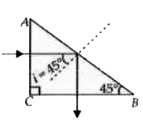
A

For total internal reflaction to take place AB
`igtC` or `sinigtsinC`
where, `i=`Angle of incidence
C=Critical angle
Here, `i=45^(@)` and `sinC=(1)/(mu)`
`:.sin45^(@)gt(1)/(mu)implies(1)/(sqrt(2))gt(1)/(mu)` or `mugtsqrt(2)`
`:.mu_("min")=sqrt(2)`
Promotional Banner

Topper's Solved these Questions

  • OPTICS

    MTG GUIDE|Exercise Check your NEET vitals|25 Videos
  • OPTICS

    MTG GUIDE|Exercise AIPMT/NEET|55 Videos
  • OPTICS

    MTG GUIDE|Exercise AIPMT/NEET|55 Videos
  • MAGNETIC EFFECTS OF CURRENT AND MAGNETISM

    MTG GUIDE|Exercise AIPMT/NEET (MCQs)|48 Videos

Similar Questions

Explore conceptually related problems

A ray of light incident normally on one of the faces of a right-angle isosceles prism is found to be totally reflected as shown in the figure. What is the minimum value of the refractive index of the material of the prism? When the prism is immersed in water, trace the path of the emergent ray for the same incident ray, indicating the values of all the angles (mu_omega=4//3) .

A ray of light is incident normally on one face of a right-angled isosceles prism and then it grazes the hypotenuse. The refractive index of the material of the prism is

A ray incident normally on one face of a right-angled isosceles glass prism in air is deviated through 90^(@) . What can you say about the refractive index of glass ?

A ray of light is incident on the hypotenuse of a right-angled prism after travelling parallel to the base inside the prism. If mu is the refractive index of the material of the prism, the maximum value of the base angle for which light is totally reflected from the hypotenuse is

A monochromatic ray of light is incident normally on one of the refracting surfaces of a prism . The emergent ray grazes the second refracting surface . What is the angle of the prism if the refractive index of the material of the prism is 1.6 ?

The angle of minimum deviation caused by a prism is equal to the angle of the prism. What are the possible values of refractive index of the material of the prism?

A ray of ligh is incident normally on one of the faces of right angled isosceles prism as shhown above. It undergoes total internal reflection from hypotenuse. Which on of the following is the minimum refractive index of the material of the prism?

An isosceles glass prism has one of its faces silvered. A light ray is incident normally on the other face which is identical in size to the silvered face. The light ray is reflected twice on the same sized faces and emerges through the base of the prism perpendicularly. Find the minimum value of refractive index of the material of the prism.

A ray of light is incident horizontally on the face AB of the.right angled prism as shown in the figure. If the ray emerges grazing the surface AC, find the value of phi . Refractive index of the material of the prism is given to be n.

MTG GUIDE-OPTICS-Topicwise Practice Questions
  1. A ray of light passes through an equilateral glass prism in such a man...

    Text Solution

    |

  2. A light ray is incident normally on the face AB of a right-angled pris...

    Text Solution

    |

  3. A ray of light normally on one of the faces of a right-angled isoscele...

    Text Solution

    |

  4. Check the correct statements on scattering of light S1: Rayleigh sca...

    Text Solution

    |

  5. When sunlight is scattered by atmospheric atoms and molecules, the amo...

    Text Solution

    |

  6. When sun light is scatterred by minute particles of atmosphere, then t...

    Text Solution

    |

  7. An under-water swimmer cannot see very clearly even in absolutely clea...

    Text Solution

    |

  8. If a person can sees clearly at a distance of 100 cm, then find the po...

    Text Solution

    |

  9. When objects at different distances are seen by the eye, which of the ...

    Text Solution

    |

  10. A student's near point is 0.5 m and far point is 3m . What are the po...

    Text Solution

    |

  11. The least distance of distinct vision of a person is 75 cm. The focal ...

    Text Solution

    |

  12. The image formed by an objective of a compound microscope is

    Text Solution

    |

  13. The magnifying power of a telescope can be increased

    Text Solution

    |

  14. v34

    Text Solution

    |

  15. The objective of a compound microscope is essentially

    Text Solution

    |

  16. The length of a telescope is 36 cm . The focal lengths of its lenses c...

    Text Solution

    |

  17. The magnifying power of an astronomical telescope is 8 and the distanc...

    Text Solution

    |

  18. In a laboratory four convex lenses L(1), L(2), L(3) and L(4) of focal ...

    Text Solution

    |

  19. A telescope has an objective lens of focal length 200cm and an eye pie...

    Text Solution

    |

  20. Least distance of distinct vision is 25 cm . Magnifying power of simpl...

    Text Solution

    |

