Home
Class 12
PHYSICS
Electron in hydrogen atom first jumps fr...

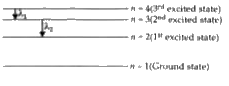
Electron in hydrogen atom first jumps from third excited state to second excited state and then form second excited state to first excited state. The ratio of wavelength `lambda_(1): lambda_(2)` emitted in two cases is

A

`(7)/(5)`

B

`(27)/(20)`

C

`(27)/(5)`

D

`(20)/(7)`

Text Solution

Verified by Experts


`(1)/(lambda)=R[(1)/(n_(f)^(2))-(1)/(n_(i)^(2))]`
In first case, `n_(f)=3, n_(i)=4`
`therefore" "(1)/(lambda_(1))=R[(1)/(3^(2))-(1)/(4^(2))]=R[(1)/(9)-(1)/(16)]=(7)/(144)R" …(i)"`
In second case, `n_(f)=2, n_(i)=3`
`therefore" "(1)/(lambda_(2))=R[(1)/(2^(2))-(1)/(3^(2))]=R[(1)/(4)-(1)/(9)]=(5)/(36)R" ...(ii)"`
Divide (ii) by (i), we get
`(lambda_(1))/(lambda_(2))=(5)/(36)xx(144)/(7)=(20)/(7)`
Promotional Banner

Topper's Solved these Questions

  • ATOMS AND NUCLEI

    MTG GUIDE|Exercise CHECK YOUR NEET VITALS|25 Videos
  • CURRENT ELECTRICITY

    MTG GUIDE|Exercise MCQs AIPMT / NEET|32 Videos

Similar Questions

Explore conceptually related problems

In a hydrogen atom,electron moves from second excited state to first excited state and then from first excited state to ground state.The ratio of wavelengths is

An electron in hydrogen atom first jumps form second excited state to first excited state and then form first excited state to ground state. Let the ratio of wavelength, momentum and energy of photons emitted in these two cases be a, b and c respectively, Then

The ratio of wavelenghts of photons emitted when hydrogen atom de-excites from third excieted state to second excited state then de-excities form second excited state to first excited state is :

When a hydrogen atom is excited from ground state to first excited state then

When a hydrogen atom is excited from ground state to first excited state, then

The ratio of energies of hydrogen atom in its first excited state to third excited state is

The ratio of the areas of the orbit for the second excited state to the first excited state for the hydrogen atom is

MTG GUIDE-ATOMS AND NUCLEI-AIPMT/NEET(MCQs)
  1. Two radioactive nuclei P and Q in a given sample decay into a stable n...

    Text Solution

    |

  2. Out of the following which one is not a possible energy for a photon t...

    Text Solution

    |

  3. Electron in hydrogen atom first jumps from third excited state to seco...

    Text Solution

    |

  4. If the nuclear radius of .^27 A1 is 3.6 Fermi, the approximate nuclear...

    Text Solution

    |

  5. A mixture consists of two radioactive materials A1 and A2 with half-li...

    Text Solution

    |

  6. An electrons of a stationary hydrogen aton passes form the fifth enegr...

    Text Solution

    |

  7. The transition form the state n = 3 to n = 1 in a hydrogen-like atom r...

    Text Solution

    |

  8. The half-life of a radioactive nucleus is 50 days. The time interval (...

    Text Solution

    |

  9. Ratio of longest wavelengths corresponding to Lyman and Balmer series ...

    Text Solution

    |

  10. A certain mass of hydrogen is changes to helium by the process of fusi...

    Text Solution

    |

  11. The half-life of a radioactive isotope X is 20 years. It decays to ano...

    Text Solution

    |

  12. Hydrogen atom in ground state is excited by a monochromatic radiation ...

    Text Solution

    |

  13. The binding energy per nucleon of .(3)^(7) Li and .(2)^(4)He nuclei ar...

    Text Solution

    |

  14. A radio isotope X with a half-life 1.4 xx 10^9 years decays of Y which...

    Text Solution

    |

  15. If radius of the .(13)^(27)Al nucleus is taken to be R(AI), then the r...

    Text Solution

    |

  16. Consider 3rd orbit of He^(+) (Helium) using nonrelativistic approach t...

    Text Solution

    |

  17. A nucleus of uranium decays at rest into nuclei of thorium and helium....

    Text Solution

    |

  18. In the spectrum of hydrogen atom, the ratio of the longest wavelength ...

    Text Solution

    |

  19. Given the value of Rydberg constant is 10^(7)m^(-1), the waves number ...

    Text Solution

    |

  20. When an alpha-particle of mass 'm' moving with velocity 'v' bombards o...

    Text Solution

    |