

Home
Class 11
PHYSICS
A bead of mass m is attached to one end ...

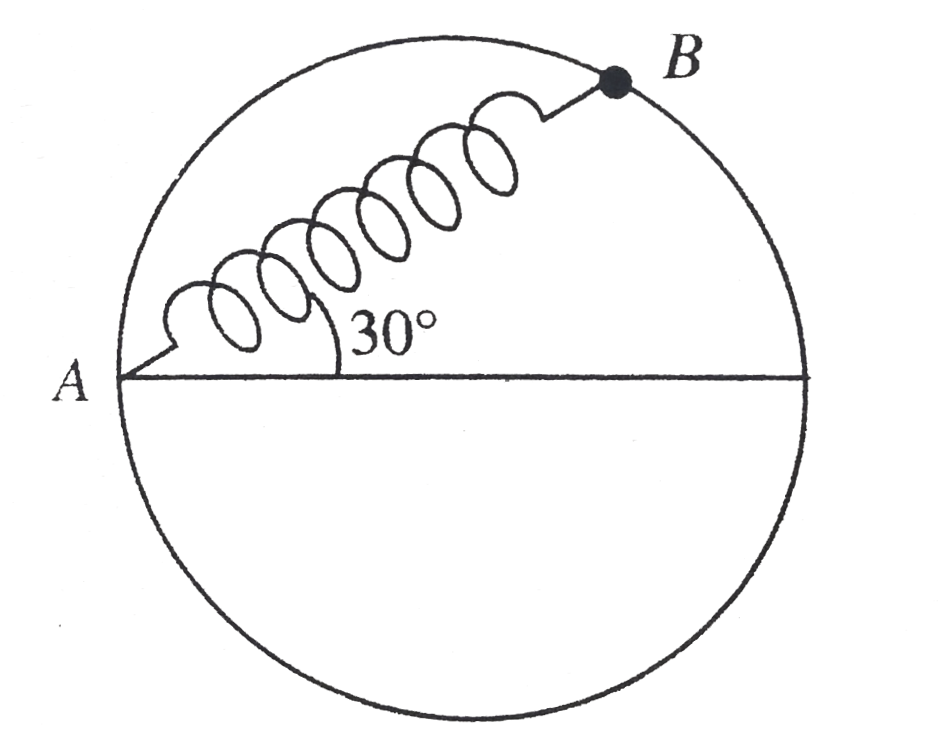
A bead of mass m is attached to one end of a spring of natural length R and spring constant `K=((sqrt(3)+1)mg)/(R )`. The other end of the spring is fixed at a point A on a smooth vertical ring of radius R as shown in fig. The normal reaction at B just after it is released to move is

Promotional Banner

Similar Questions

Explore conceptually related problems

A Bead of mass m is attached to one end of a spring of natural length 'R' and spring cosntant 'k=((sqrt3+1)mg)/R' . The other end of the spring is fixed at point 'A' on a smooth vertical ring of radius 'R' as shown

A bead of mass 'm' is attached to one end of a spring of natural length R & spring constant k = ((sqrt3 + 1))/(R) . The other end of the spring is fixed at point A on a smooth vertical ring of radius R as shown. The normal reaction at B just after it is released to move is

A block of mass 'm' is attached to a spring in natural length of spring constant 'k' . The other end A of the spring is moved with a constat velocity v away from the block . Find the maximum extension in the spring.

A bead of mass m can slide without friction on a fixed circular horizontal ring of radius 3R having a centre at the point C. The bead is attached to one of the ends of spring of spring constant k. Natural length of spring is R and the other end of the spring is R and the other end of the spring is fixed at point O as shown in the figure. If the bead is released from position A, then the kinetic energy of the bead when it reaches point B is

A bead of mass m can slide without friction on a fixed circular horizontal ring of radius 3R having a centre at the point C. The bead is attached to one of the ends of spring of spring constant k. Natural length of spring is R and the other end of the spring is R and the other end of the spring is fixed at point O as shown in the figure. If the bead is released from position A, then the kinetic energy of the bead when it reaches point B is

A ring of mass m is attached to a horizontal spring of spring constant k and natural length l_0 . The other end of the spring is fixed and the ring can slide on a horizontal rod as shown. Now the ring is shifted to position B and released Find the speed of the ring when the spring attains its natural length.

A block ofmass m is attached with a spring in its natural length, of spring constant k. The other end A of spring is moved with a constant acceleration 'a' away from the block as shown in the figure -3.74 . Find the maximum extension in the spring. Assume that initially block and spring is at rest w.r.t ground frame:

A small block of mass m, can move without friction on the outside of a fixed vertical circular track of radiusR. The block is attached to a spring of natural length R//2 and spring constant K. The other end of spring is connected to a point at height R//2 directly above the centre of track. If the block is released from rest when the spring is in horizontal state (see figure) then at that moment,

A small block of mass m, can move without friction on the outside of a fixed vertical circular track of radiusR. The block is attached to a spring of natural length R//2 and spring constant K. The other end of spring is connected to a point at height R//2 directly above the centre of track. If the complete stup is in a gravity free space, then the minimum speed (v_(0)) required at the highest point A to just reach the lowest point is