Two trains `A` and `B` are moving with speeds `20 m//s` respectively in the same direction on the same stright track, with `B` ahead of `A`. The engines are at the front ends. The engines of train `A` blows a long whistle.
Assume that the sound of the whistle is composed of components varying in frequency from `f_(1) = 800 Hz` to `f_(2) = 1120 Hz`, asz shown in figure. The spread in the frequency (highest frequency - lowest frequency) is thus `320 Hz`. The speed of sound in still air is `340 m//s`.
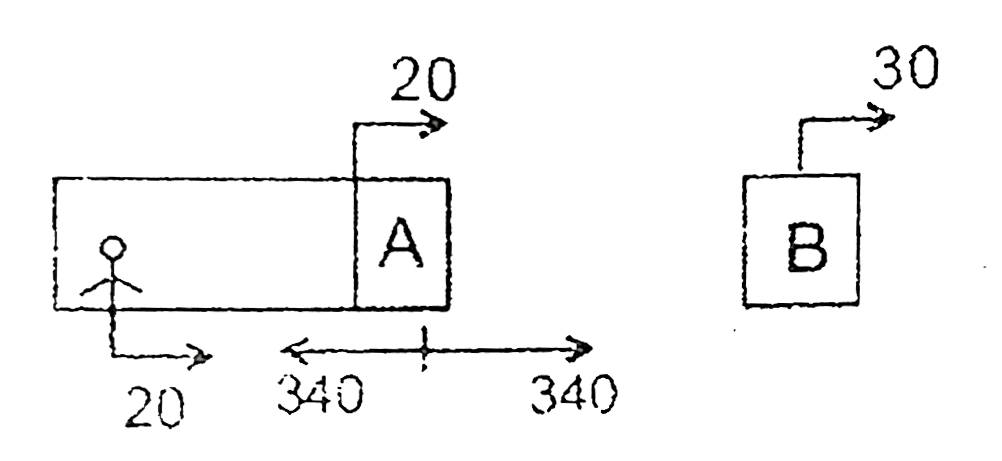
The spred of frequency as observed by the passengers in train `B` is
Two trains `A` and `B` are moving with speeds `20 m//s` respectively in the same direction on the same stright track, with `B` ahead of `A`. The engines are at the front ends. The engines of train `A` blows a long whistle.
Assume that the sound of the whistle is composed of components varying in frequency from `f_(1) = 800 Hz` to `f_(2) = 1120 Hz`, asz shown in figure. The spread in the frequency (highest frequency - lowest frequency) is thus `320 Hz`. The speed of sound in still air is `340 m//s`.
The spred of frequency as observed by the passengers in train `B` is
Assume that the sound of the whistle is composed of components varying in frequency from `f_(1) = 800 Hz` to `f_(2) = 1120 Hz`, asz shown in figure. The spread in the frequency (highest frequency - lowest frequency) is thus `320 Hz`. The speed of sound in still air is `340 m//s`.
The spred of frequency as observed by the passengers in train `B` is



Similar Questions
Explore conceptually related problems
Two trains A and B are moving with speeds 20 m//s respectively in the same direction on the same stright track, with B ahead of A . The engines are at the front ends. The engines of train A blows a long whistle. Assume that the sound of the whistle is composed of components varying in frequency from f_(1) = 800 Hz to f_(2) = 1120 Hz , as shown in figure. The speed in the frequency (highest frequency - lowest frequency) is thus 320 Hz . The speed of sound in still air is 340 m//s . The spread of frequency as observed by the passengers in train B is
Two trains A and B moving with speeds 20m//s and 30m//s respectively in the same direction on the same straight track, with B ahead of A . The engines are at the front ends. The engine of train A blows a long whistle. Assume that the sound of the whistle is composed of components varying in frequency from f_(1) = 800 Hz to f_(2) = 1120 Hz , as shown in the figure. the spread in the frequency (highest frequency - lowest frequency) is thus 320 Hz . the speed of sound in still air is 340 m//s . The spread of frequency as observed by the passenger in train B is
Two trains A and B moving with speeds 20m//s and 30m//s respectively in the same direction on the same straight track, with B ahead of A . The engines are at the front ends. The engine of train A blows a long whistle. Assume that the sound of the whistle is composed of components varying in frequency from f_(1) = 800 Hz to f_(2) = 1120 Hz , as shown in the figure. the spread in the frequency (highest frequency - lowest frequency) is thus 320 Hz . the speed of sound in still air is 340 m//s . The spread of frequency as observed by the passenger in train B is
two trains Aand B moving with speeds 20m//s and 30m//s respectively in the same direction on the same straight track, with B ahesd of A . The engines are at the front ends. The engine of train A blows a long whistle. Assume that the sound of the whistle is composed of components varying in frequency from f_(1) = 800 Hz to f_(2) = 1120 Hz , as shown in the figure. the spread in the frequency (highest frequency - lowest frequency) is thus 320 Hz . the speed of sound in still air is 340 m//s . The spread of frequency as observed by the passenger in train B is
Two trains A and B moving with speeds 20m//s and 30m//s respectively in the same direction on the same straight track, with B ahead of A . The engines are at the front ends. The engine of train A blows a long whistle. Assume that the sound of the whistle is composed of components varying in frequency from f_(1) = 800 Hz to f_(2) = 1120 Hz , as shown in the figure. The spread in the frequency (highest frequency - lowest frequency) is thus 320 Hz . The speed of sound in still air is 340 m//s . The speed of sound of the whistle is
Two trains A and B moving with speeds 20m//s and 30m//s respectively in the same direction on the same straight track, with B ahead of A . The engines are at the front ends. The engine of train A blows a long whistle. Assume that the sound of the whistle is composed of components varying in frequency from f_(1) = 800 Hz to f_(2) = 1120 Hz , as shown in the figure. The spread in the frequency (highest frequency - lowest frequency) is thus 320 Hz . The speed of sound in still air is 340 m//s .The speed of sound of the whistle is
Two trains A and B moving with speeds 20m//s and 30m//s respectively in the same direction on the same straight track, with B ahead of A . The engines are at the front ends. The engine of train A blows a long whistle. Assume that the sound of the whistle is composed of components varying in frequency from f_(1) = 800 Hz to f_(2) = 1120 Hz , as shown in the figure. The spread in the frequency (highest frequency - lowest frequency) is thus 320 Hz . The speed of sound in still air is 340 m//s . (4) The speed of sound of the whistle is
Two trains A and B moving with speeds 20m//s and 30m//s respectively in the same direction on the same straight track, with B ahead of A . The engines are at the front ends. The engine of train A blows a long whistle. Assume that the sound of the whistle is composed of components varying in frequency from f_(1) = 800 Hz to f_(2) = 1120 Hz , as shown in the figure. The spread in the frequency (highest frequency - lowest frequency) is thus 320 Hz . The speed of sound in still air is 340 m//s . (4) The speed of sound of the whistle is
two trains Aand B moving with speeds 20m//s and 30m//s respectively in the same direction on the same straight track, with B ahesd of A . The engines are at the front ends. The engine of train A blows a long whistle. Assume that the sound of the whistle is composed of components varying in frequency from f_(1) = 800 Hz to f_(2) = 1120 Hz , as shown in the figure. the spread in the frequency (highest frequency - lowest frequency) is thus 320 Hz . the speed of sound in still air is 340 m//s . (4) The speed of sound of the whistle is
Two trains A and B moving with speeds 20m//s and 30m//s respectively in the same direction on the same straight track, with B ahead of A . The engines are at the front ends. The engine of train A blows a long whistle. Assume that the sound of the whistle is composed of components varying in frequency from f_(1) = 800 Hz to f_(2) = 1120 Hz , as shown in the figure. the spread in the frequency (highest frequency - lowest frequency) is thus 320 Hz . the speed of sound in still air is 340 m//s . (5) The distribution of the sound intensity of the whistle as observed by the passengers in train A is best represented by
Recommended Questions
- Two trains A and B are moving with speeds 20 m//s respectively in the ...
Text Solution
|
- two trains Aand B moving with speeds 20m//s and 30m//s respectively in...
Text Solution
|
- two trains Aand B moving with speeds 20m//s and 30m//s respectively in...
Text Solution
|
- two trains Aand B moving with speeds 20m//s and 30m//s respectively in...
Text Solution
|
- Two trains A and B are moving with speeds 20 m//s respectively in the ...
Text Solution
|
- Passage-II दो रेलगाड़ियाँ A तथा B क्रमशः 20 m//s तथा 30 m//s की चाल स...
Text Solution
|
- दो रेलगाड़ी A तथा B एक ही सीधे पथ पर, एक ही दिशा में क्रमशः 20 मी / ...
Text Solution
|
- दो रेलगाड़ी A तथा B एक ही सीधे पथ पर, एक ही दिशा में क्रमशः 20 मी / ...
Text Solution
|
- A train is moving with a unifrom speed of 33 m/ s and an observer is a...
Text Solution
|