

Home
Class 11
PHYSICS
One end of an ideal spring of unstreched...

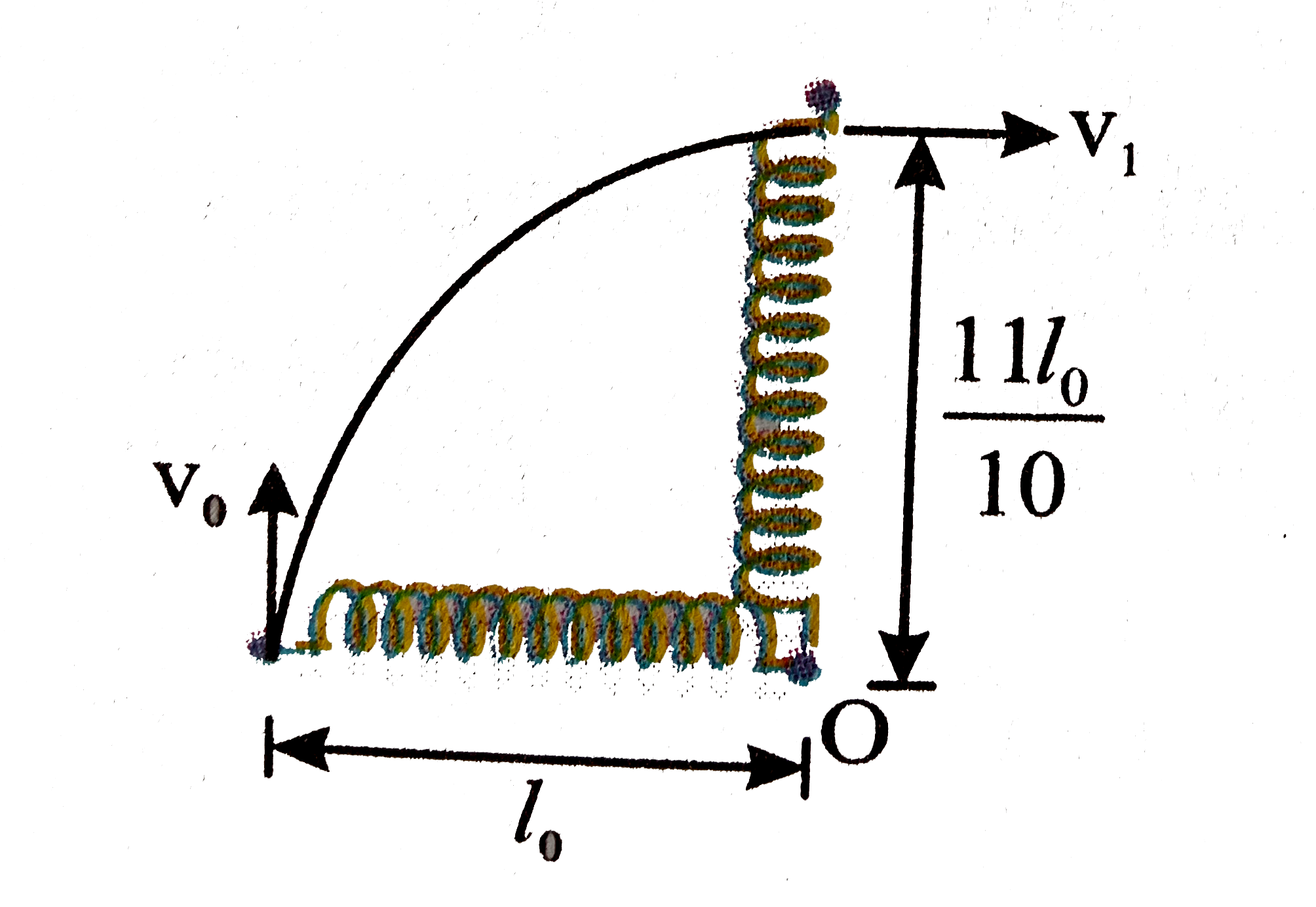
One end of an ideal spring of unstreched length `l_(O)=1m`, is fixed on a frictionless horizontal table. The other end has a small disc of mass `0.1 kg` attached to it. The disc is projected with a velocity `upsilon_(0)=11 m//s` perpendicular to the spring.

Choose the correct statements

Promotional Banner

Similar Questions

Explore conceptually related problems

One end of an ideal spring of unstreched length l_(O)=1m , is fixed on a frictionless horizontal table. The other end has a small disc of mass 0.1 kg attached to it. The disc is projected with a velocity upsilon_(0)=11 m//s perpendicular to the spring. What is the force constant of spring?

One end of an ideal spring of unstreched length l_(O)=1m , is fixed on a frictionless horizontal table. The other end has a small disc of mass 0.1 kg attached to it. The disc is projected with a velocity upsilon_(0)=11 m//s perpendicular to the spring. In the subsequent motion of disc, maximum elongation of spring is 11l_0//10 . the velocity of disc of this instant is:

One side of spring of initial, instreached length l_(0) = 1m , lying on a frictionless table, is fixed, the other one is fastened to a small puck of mass m = 0.1 kg . The puck is given velocity in a direction perpendicular to the spring at an initial speed v_(0) = 11 m//s . In the course of the motion, the maximum elogation of the spring is l = l_(0)//10 . What is the force constant of the spring (in SI units) ? .

Mass m is connected with an ideal spring of natural length l whose other end is fixed on a smooth horizontal table. Initially spring is in its natural length l . Mass m is given a velocity 'v' perpendicular to the spring and released . The velocity perpendicular to the spring when its length l+x , will be

Mass m is connected with an ideal spring of natural length l whose other end is fixed on a smooth horizontal table. Initially spring is in its natural length l . Mass m is given a velocity 'v' perpendicular to the spring and released . The velocity perpendicular to the spring when its length l+x , will be

The length of an ideal spring in increases by 0.1 cm when a body of 1 kg is suspended from it If this spring is laid on a frictionless horizontal table and bodies of 1 kg each are suspended from its ends , then what will be the increase in its length ?