

Home
Class 11
PHYSICS
A sound wave of wavelength 0.40 m enter...

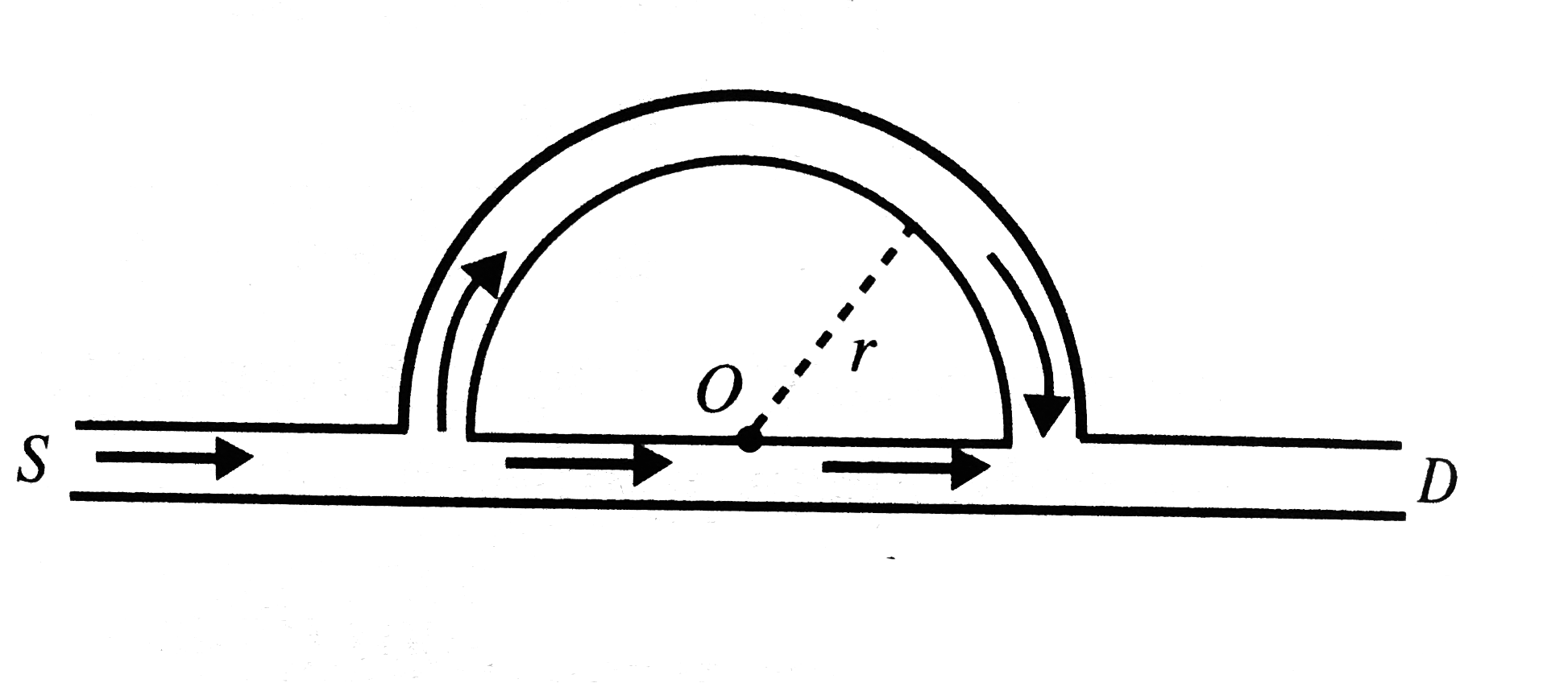
A sound wave of wavelength `0.40 m` enters the tube at `S`. The smallest radius `r` of the circular segment to hear minimum at detector `D` must be

Promotional Banner

Similar Questions

Explore conceptually related problems

A sound wave of wavelength 32 cm enters the tube at S as shown in the figure. Then the smallest radius r so that a minimum of sound is heard at detector D is

The sound waves of wavelength 5 m and 6 m formed 30 beats in 3 s. The velocity of sound is

Two sound waves of wavelength 10 m and 10.1 m produces 0.33 beats/s. Then the velocity of sound is

A sound wave of wavelength 90 cm in glass is reflected into air. If the speed of sound in glass is 5400 m//s , the wavelength of wave in air (speed of sound in air = 330 m//s ) is :

Two sources of sound, S_1 and S_2 , emitting waves of equal wavelength 20.0 cm, are placed with a separation of 20.0 cm between them. A detector can be moved on a line parallel to S_1S_2 and at a distance of 20.0 cm from P it. Initially, the detector is equidistant from the two sources. Assuming that the waves emitted by the sources are in phase, find the minimum distance through wffich the detector should be shifted to detect a minimum of sound.

Two sources of sound, S_1 and S_2 , emitting waves of equal wavelength 20.0 cm, are placed with a separation of 20.0 cm between them. A detector can be moved on a line parallel to S_1S_2 and at a distance of 20.0 cm from P it. Initially, the detector is equidistant from the two sources. Assuming that the waves emitted by the sources are in phase, find the minimum distance through wffich the detector should be shifted to detect a minimum of sound.

Figure shows two isotropic point sources of sound, S_1 and S_2 The sources emit waves in phase at wavelength 0.50 m, they are separated by D = 2.20 m. If we move a sound detector along a large circle centered at the midpoint between the sources, at how many points do waves arrive at the detector (a) exactly in phase and (b) exactly out of phase?