

Home
Class 11
PHYSICS
Two moles of a diatomic gas are carried ...

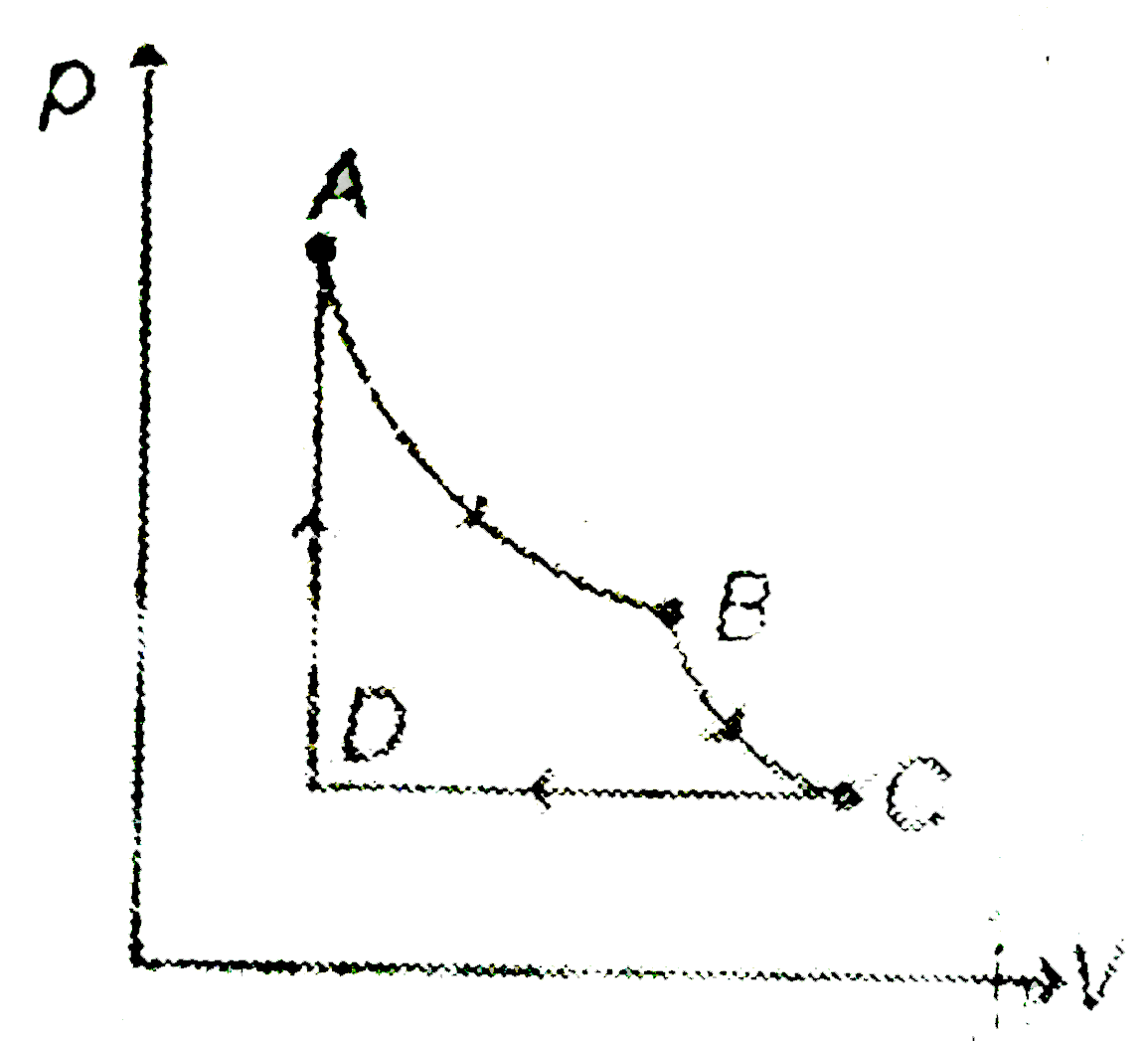
Two moles of a diatomic gas are carried trhough the cycle ABCDA as shown in figure. The segment AB represents an isothermal expansion, the segment BC an adiabatic expansion. The pressure and temperature at A are 5 atm and 600K respectively. The volume at B is twice that at A. The pressure at D is 1 atm.

What is the temperature at C?

Promotional Banner

Similar Questions

Explore conceptually related problems

Two moles of a diatomic gas are carried trhough the cycle ABCDA as shown in figure. The segment AB represents an isothermal expansion, the segment BC an adiabatic expansion. The pressure and temperature at A are 5 atm and 600K respectively. The volume at B is twice that at A. The pressure at D is 1 atm. What is the pressure at B?

Two moles of a diatomic gas are carried trhough the cycle ABCDA as shown in figure. The segment AB represents an isothermal expansion, the segment BC an adiabatic expansion. The pressure and temperature at A are 5 atm and 600K respectively. The volume at B is twice that at A. The pressure at D is 1 atm. What is the pressure at B?

Two moles of a diatomic gas are carried trhough the cycle ABCDA as shown in figure. The segment AB represents an isothermal expansion, the segment BC an adiabatic expansion. The pressure and temperature at A are 5 atm and 600K respectively. The volume at B is twice that at A. The pressure at D is 1 atm. Find the T versus V graph of the above cyclic process.

Two moles of a diatomic gas are carried trhough the cycle ABCDA as shown in figure. The segment AB represents an isothermal expansion, the segment BC an adiabatic expansion. The pressure and temperature at A are 5 atm and 600K respectively. The volume at B is twice that at A. The pressure at D is 1 atm. Find the T versus V graph of the above cyclic process.

One mole of diatomic ideal gas undergoes a cyclic process ABC as shown in figure. The process BC is adiabatic. The temperature at A,B and C are 400K, 800K and 600K respectively. Choose the correct statement:

One mole of a diatomic ideal gas undergoes a cyclic process ABC as shown in figure. The process BC is adiabatic. The temperature at A,B and C are 400K, 800K and 600K respectively. Choose the correct statement:

One mole of a diatomic ideal gas undergoes a cyclic process ABC as shown in figure. The process BC is adiabatic. The temperature at A,B and C are 400K, 800K and 600K respectively. Choose the correct statement:

One mole of a diatomic ideal gas undergoes a cyclic process ABC as shown in figure. The process BC is adiabatic. The temperature at A,B and C are 400K, 800K and 600K respectively. Choose the correct statement:

One mole of a diatomic ideal gas undergoes a cyclic process ABC as shown in figure. The process BC is adiabatic. The temperature at A,B and C are 400K, 800K and 600K respectively. Choose the correct statement:

One mole of a diatomic ideal gas undergoes a cyclic process ABC as shown in figure. The process BC is adiabatic. The temperature at A,B and C are 400K, 800K and 600K respectively. Choose the correct statement: