

Home
Class 11
PHYSICS
The graph below represents the velocity ...

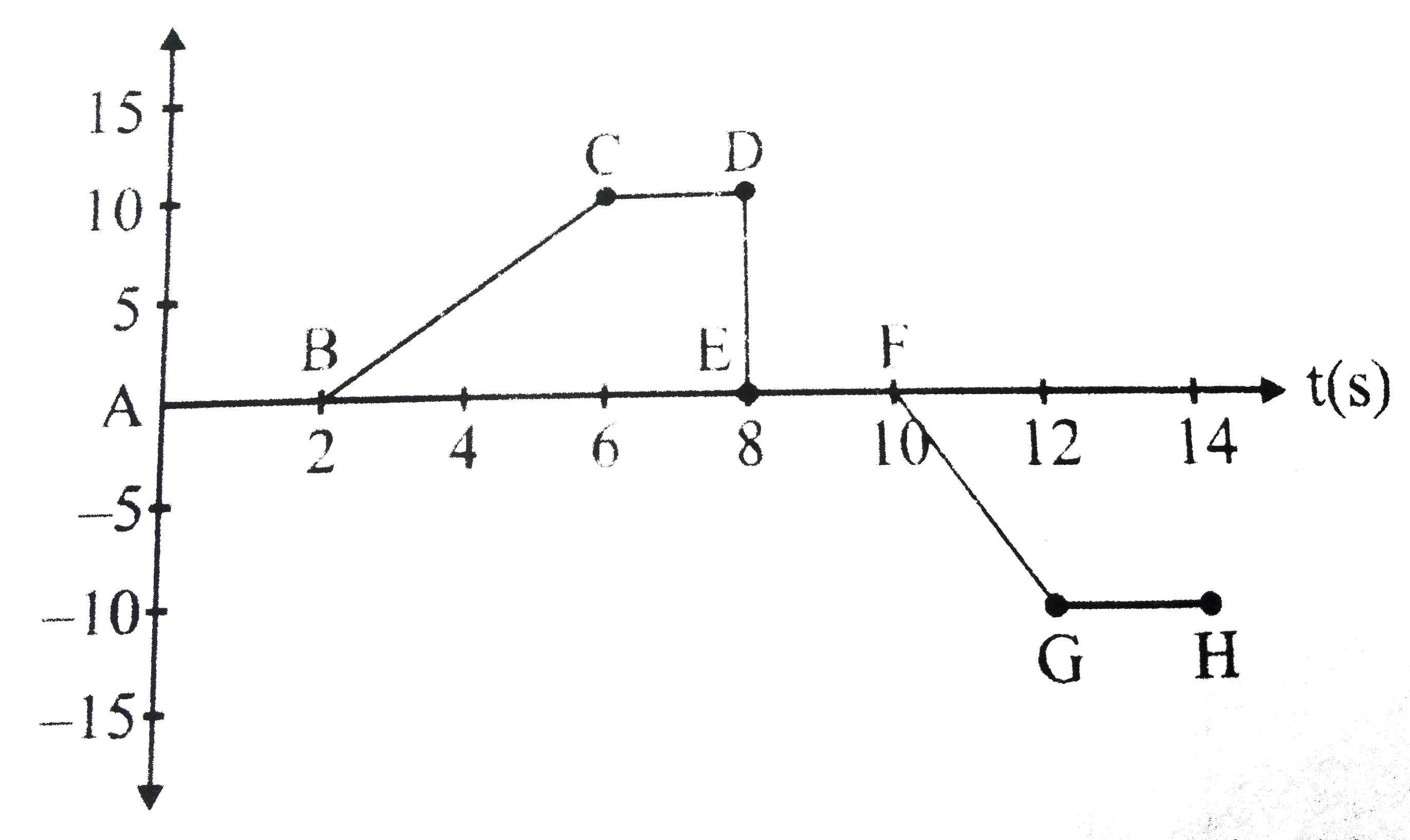
The graph below represents the velocity `vs.` time graph for a car.

(A) During which intervals is the car at rest?
(B) During which intervals is the car moving a constant nonzero velocity ? State the velocity at each of these intervals
(C) There are two intervals during which the car is accelerating. Find the acceleration in each of these intervals.
(D) Sketch the acceleration `vs`. time garph that corresponds to the motion of the car form `0s` to `14s`.

Promotional Banner

Similar Questions

Explore conceptually related problems

The area under velocity-time graph for a particle in a given interval of time represents

The following figure represents the velocity-time graph of a moving car on a road: Which segment of the graph represents the retardation?

The figure below shows the velocity-time graph of a body moving in a straight line. Find the time interval in which the body is moving with zero acceleration

Study the following velocity-time graph. Determine the displacement and distance in the time interval t=0 to t=12 s . Sketch the acceleration-time graph.

The velocity-time graph of an objects is as shown. The displacement during the interval 0 to t_(4) is

The velocity-time graph of an objects is as shown. The displacement during the interval 0 to t_(4) is

The velocity-time graph of an objects is as shown. The displacement during the interval 0 to t_(4) is

The v-t graph for a particle moving along x-axis is shown in the figure, find (a) Average velocity in the interval 0 to 8 s. (b) Average speed in the interval 0 to 8 s. (c) Average acceleration in the interval 0 to 4 s. (d) Instantaneous acceleration at t = 2.5 s.

The v-t graph for a particle moving along x-axis is shown in the figure, find (a) Average velocity in the interval 0 to 8 s. (b) Average speed in the interval 0 to 8 s. (c) Average acceleration in the interval 0 to 4 s. (d) Instantaneous acceleration at t = 2.5 s.