

Home
Class 11
PHYSICS
A container of large uniform cross secto...

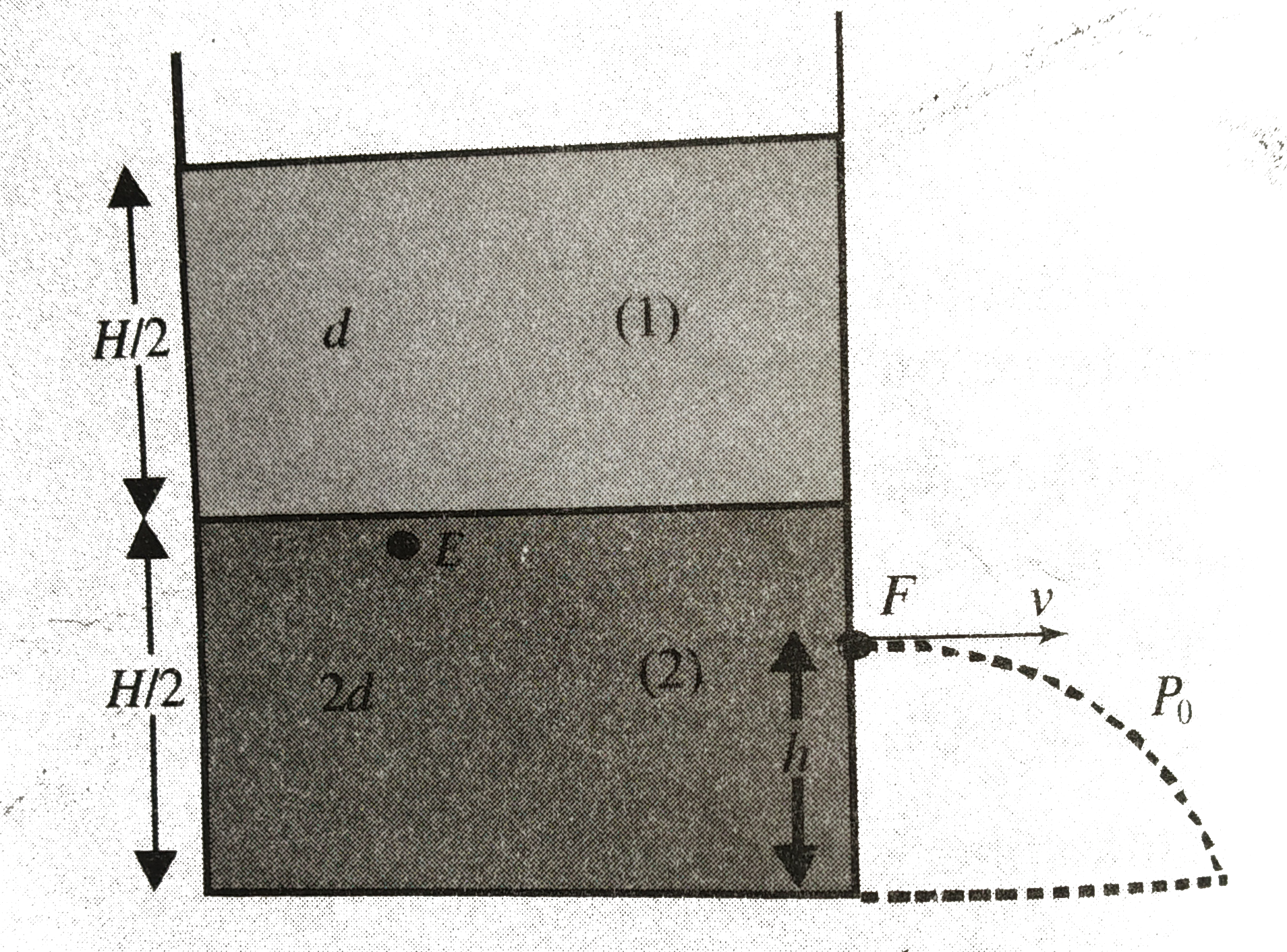
A container of large uniform cross sectonal area `A`, resting on horizontal surface, holds two immiscible non viscous and incompresible liquids of density `d` and `2d`, each of height `H/2` as shown in the figure. Thelower density liquid is open to the atmospher having presure `P_(0)`. A tiny hole of area `(s(sgt gtA)` is punched on the vertical side of the container at a height `h(hgtH/2)`. Determine

a.the initial speed of efflux of the liquid at the hole
b. the horizontal disance `x` travelled by the liquid initially
c. the height `h_m` at which at the hole should be punched so that the liquid travels the maximum distance `x_(m)` initially. also calculate `x_(m)` (neglect air resistance inte calculations).

Promotional Banner

Similar Questions

Explore conceptually related problems

A container of large uniform cross sectional area A , resting on horizontal surface, holds two immiscible non viscous and incompressible liquids of density d and 2d , each of height H/2 as shown in the figure. The lower density liquid is open to the atmosphere having pressure P_(0) . A tiny hole of area (s(sltltA) is punched on the vertical side of the container at a height h(hltH/2) . Determine the initial speed of efflux of the liquid at the hole

A container of large uniform cross sectional area A , resting on horizontal surface, holds two immiscible non viscous and incompressible liquids of density d and 2d , each of height H/2 as shown in the figure. The lower density liquid is open to the atmosphere having pressure P_(0) . A tiny hole of area (s(sltltA) is punched on the vertical side of the container at a height h(hltH/2) . Determine The horizontal distance traveled by the liquid, initially, is :

A container of large uniform cross sectional area A resting on a horizontal surface holds two immiscible non-viscous and incompressible liquids of density d and 3d each of height H/2. The lower density liquid is open to the atmosphere having pressure P_o . A tiny hole of area a (a lt lt A) is punched on the vertical side of the lower container at a height h (0 lt h lt H/2) for which range is maximum.

A container of large uniform cross sectonal area A , resting on horizontal surface, holds two immiscible non viscous and incompresible liquids of density d and 2d , each of height H/2 as shown in the figure. The lower density liquid is open to the atmosphere having pressure P_(0) . A tiny hole of area s(s a.the initial speed of efflux of the liquid at the hole b. the horizontal disance x travelled by the liquid initially c. the height h_m at which at the hole should be punched so that the liquid travels the maximum distance x_(m) initially. also calculate x_(m) (neglect air resistance inte calculations).

A container of cross-section area A resting on a horizontal surface, holds two immiscible and incompressible liquid of densities rho and 2 rho as shown in figure. The lower density liquid is open to the atmosphere having pressure P_(0) . The pressure at the bottom of the container is

A container of cross-section area A resting on a horizontal surface, holds two immiscible and incompressible liquid of densities rho and 2 rho as shown in figure. The lower density liquid is open to the atmosphere having pressure P_(0) . The pressure at the bottom of the container is

A container of large uniform cross-sectional area A resting on a horizontal surface, holes two immiscible, non-viscous and incompressible liquids of densities d and 2d each of height H//2 as shown in the figure. The lower density liquid is open to the atmosphere having pressure P_(0) . A homogeneous solid cylinder of length L(LltH//2) and cross-sectional area A//5 is immersed such that it floats with its axis vertical at the liquid-liquid interface with length L//4 in the denser liquid, The density D of the material of the floating cylinder is

A container of large uniform cross-sectional area A resting on a horizontal surface, holds two immiscible, non-viscous and incompressible liquids of densities d and 2d, each of height H/2 as shown in the figure. The lower density liquid is open to the atmosphere having pressure P_0 . (a) A homogeneous solid cylinder of length L(LltH//2) , cross-sectional area A//5 is immersed such that it floats with its axis vertical at the liquid-liquid interface with length L//4 in the denser liquid. Determine: (i) the density D of the solid and (ii) the total pressure at the bottom of the container. (b) The cylinder is removed and the original arrangement is restored. A tiny hole of area s(slt ltA) is punched on the vertical side of the container at a height h(hltH//2) . Determine: (i) the initial speed of efflux of the liquid at the hole, (ii) the horizontal distance x travelled by the liquid initially, and (iii) the height h_m at which the hole should be punched so that the liquid travels the maximum distance x_m initially. Also calculate x_m .