Home
Class 10
PHYSICS
Which of the following figures correctly...

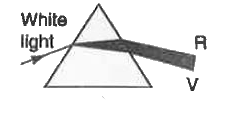
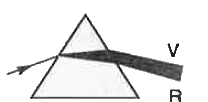
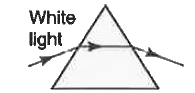
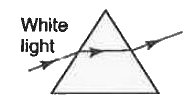
Which of the following figures correctly represents the passage of white light through a prism?

A

B

C

D

Text Solution

AI Generated Solution

The correct Answer is:

To determine which figure correctly represents the passage of white light through a prism, we need to understand the phenomenon of dispersion of light. Here’s a step-by-step solution: ### Step 1: Understand the Concept of Dispersion When white light passes through a prism, it undergoes a phenomenon known as dispersion. This occurs because different colors (wavelengths) of light refract at different angles when they enter and exit the prism. **Hint:** Remember that dispersion separates white light into its constituent colors. ### Step 2: Identify the Colors of White Light White light is made up of seven colors: violet, indigo, blue, green, yellow, orange, and red. These colors can be remembered using the acronym VIBGYOR. **Hint:** Recall the order of colors in the visible spectrum. ### Step 3: Analyze the Refraction of Colors When white light enters a prism, the shorter wavelengths (like violet) bend more than the longer wavelengths (like red). Thus, violet light will deviate the most, and red light will deviate the least. **Hint:** Consider the relationship between wavelength and refractive index. ### Step 4: Determine the Correct Path of Light In a correctly represented diagram, white light should enter the prism, split into its component colors, and emerge from the prism with violet at the bottom (most deviated) and red at the top (least deviated). **Hint:** Visualize how light bends when it passes through different mediums. ### Step 5: Evaluate the Options Now, we need to evaluate the given figures based on the principles discussed: - **Option 1:** Shows white light entering the prism and splitting into colors with violet at the bottom and red at the top. This is correct. - **Option 2:** Incorrectly places red at the bottom and violet at the top, which contradicts the dispersion principle. - **Option 3:** Shows no dispersion, which is incorrect. - **Option 4:** Incorrectly depicts the path of light and shows no spectrum. **Hint:** Compare each option against the principles of dispersion and the expected order of colors. ### Conclusion The first option correctly represents the passage of white light through a prism, showing the correct order of colors after dispersion. ---
Promotional Banner

Topper's Solved these Questions

  • REFRACTION OF LIGHT

    MCGROW HILL PUBLICATION|Exercise HIGHER ORDER THINKING QUESTIONS|37 Videos
  • REFLECTION OF LIGHT

    MCGROW HILL PUBLICATION|Exercise HIGHER ORDER THINKING QUESTIONS|10 Videos
  • SOURCES OF ENERGY

    MCGROW HILL PUBLICATION|Exercise ELEMENTARY QUESTIONS|82 Videos

Similar Questions

Explore conceptually related problems

Which of the following diagrams correctly rep resents the passage of a ray of light through a concave lens?

Which of the following diagrams correctly represents the ray of light passing through the optical centre?

Which of the following figures is correct when a monochromatic light passes through a prism?

Which of the following figures correctly represents the development according to Piaget's developmental theory?

For the refraction of light through a prism

Which of the following diagrams shows correctly the dispersion of white light by a prism ?

For refractin of light through a prism

MCGROW HILL PUBLICATION-REFRACTION OF LIGHT-HIGHER ORDER THINKING QUESTIONS
  1. Which of the following figures correctly represents the passage of whi...

    Text Solution

    |

  2. On grinding a lens, its focal length

    Text Solution

    |

  3. On entering a denser medium, the wavelength of light

    Text Solution

    |

  4. Velocity (v) of light in a medium (refractive index mu) vary as

    Text Solution

    |

  5. Refractive index is minimum for

    Text Solution

    |

  6. Refractive index is maximum for

    Text Solution

    |

  7. The value of refractive index of diamond is

    Text Solution

    |

  8. If d is the real path length, then the optical path length (in medium ...

    Text Solution

    |

  9. If mu(1),mu(2) are refractive indices of a body and its surrounding me...

    Text Solution

    |

  10. Refractive index (mu) of a medium depends upon

    Text Solution

    |

  11. With increase in temperature of the medium, its refractive index

    Text Solution

    |

  12. If d actual thickness of a plate of refractive index mu, then decrease...

    Text Solution

    |

  13. In terms of wavelength of light (lamda), intensity (I) of scattered li...

    Text Solution

    |

  14. The blue colour of sky can be explained on the basis of

    Text Solution

    |

  15. Which of the following physical quantities change during refraction of...

    Text Solution

    |

  16. Which of the following figures shows a correct representations of devi...

    Text Solution

    |

  17. A completely transparent material will be invisible in vacuum when its...

    Text Solution

    |

  18. A tank of height 50 m is filled with oil fully. If the bottom of the t...

    Text Solution

    |

  19. The time taken by light to cross a glass slab of thickness 4 mm and re...

    Text Solution

    |

  20. Two lenses of power 2.5 D and 1.5 D are joined together. The power of ...

    Text Solution

    |

  21. The focal length of a glass lens in air is f. When immersed in water (...

    Text Solution

    |
