Home
Class 10
PHYSICS
How will the reading in the ammeter A of...

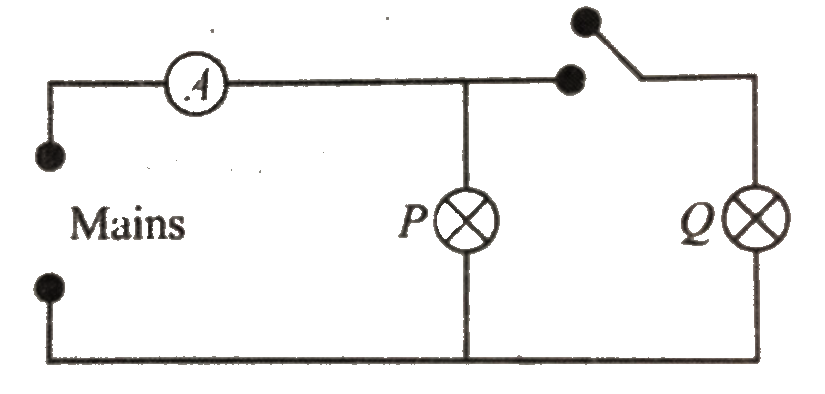
How will the reading in the ammeter `A` of Fig. 6.39 be affected if another identical bulb `Q` is connected in parallel to `P` as shows. The voltage in the mains is maintained at a constant value.

A

the reading will be reduced to one-half.

B

the reading will not be affected.

C

the reading will be double the previous value.

D

the reading wil be increased four-fold.

Text Solution

Verified by Experts

The correct Answer is:

C
Promotional Banner

Topper's Solved these Questions

  • ELECTRIC CURRENT

    MCGROW HILL PUBLICATION|Exercise HIGHER ORDER THINKING QUESTIONS|29 Videos
  • GRAVITATION

    MCGROW HILL PUBLICATION|Exercise HIGHER ORDER THINKING QUESTIONS|25 Videos

Similar Questions

Explore conceptually related problems

The ammeter shows in Fig. 6.73. Consists of 480 Omega coil connected in parallel to 20 Omega shunt. The reading of the ammeter comes out to be 1//'**'A . What is '**'?

Read the following text and answer the following questions on the basis of the same: Shunt resistance: The ammeter shunt is the device which provides the low resistance path to the flow of current. It is connected in parallel with the ammeter. In some ammeter the shunt is in-built inside the instrument while in others it is externally connected to the circuit. Manganin and Constantan are used for making the shunt of DC and AC ammeter respectively. Ammeters are designed for measurement of low current. For measuring high current, the shunt is connected in parallel to the ammeter. The significant portion of the current passes to the shunt because of the low resistance path and little amount of current passes through the ammeter. The shunt is connected in parallel to the ammeter because of which the voltage drops across the meter and shunt remain the same. Thus, the movement of the pointer is not affected by the shunt. Let us consider that the current to be measured is I. The circuit has ammeter and shunt connected parallel to each other. The ammeter is designed for measurement of small current say, I_(m) . The magnitude of the current I passes through the meter is very high, and it will burn the meter. So, for measuring the current I the shunt is required in the circuit. As the shunt connects in parallel with the ammeter, thus the same voltage drops occur between them: I_(Sh)R_(SH)=I_(m)R_(m) :.R_(SH)=I_(m)R_(m)//I_(SH) Shunt current I_(SH)=I-I_(m) So, R_(SH)=I_(m)R_(m)//(I-I_(m)) :.I//I_(m)=1+(R_(m)//R_(SH)) The ratio of the total current to the current required for the movement of the ammeter coil is called the multiplying power of the shunt. :. The multiplying power =m=I//L_(m) R_(SH)=R_(m)//(m-1) The following are the requirements of the shunt. • The resistance of the shunt should remain constant with time. • The temperature of the material-should remain same even though substantial current flows through the circuit. Materials used for making shunt of DC and AC ammeter are respectively

Read the following text and answer the following questions on the basis of the same: Shunt resistance: The ammeter shunt is the device which provides the low resistance path to the flow of current. It is connected in parallel with the ammeter. In some ammeter the shunt is in-built inside the instrument while in others it is externally connected to the circuit. Ammeters are designed for measurement of low current. For measuring high current, the shunt is connected in parallel to the ammeter. The significant portion of the current passes to the shunt because of the low resistance path and little amount of current passes through the ammeter. The shunt is connected in parallel to the ammeter because of which the voltage drops across the meter and shunt remain the same. Thus, the movement of the pointer is not affected by the shunt. Let us consider that the current to be measured is I. The circuit has ammeter and shunt connected parallel to each other. The ammeter is designed for measurement of small current say, I_(m) . The magnitude of the current I passes through the meter is very high, and it will burn the meter. So, for measuring the current I the shunt is required in the circuit. As the shunt connects in parallel with the ammeter, thus the same voltage drops occur between them: I_(Sh)R_(SH)=I_(m)R_(m) :.R_(SH)=I_(m)R_(m)//I_(SH) Shunt current I_(SH)=I-I_(m) So, R_(SH)=I_(m)R_(m)//(I-I_(m)) :.I//I_(m)=1+(R_(m)//R_(SH)) The ratio of the total current to the current required for the movement of the ammeter coil is called the multiplying power of the shunt. :. The multiplying power =m=I//L_(m) R_(SH)=R_(m)//(m-1) The following are the requirements of the shunt. • The resistance of the shunt should remain constant with time. • The temperature of the material-should remain same even though substantial current flows through the circuit. Manganin and Constantan are used for inaking the shunt of DC and AC ammeter respectively. What is multiplying power of the shunt?

A parallel plate air-filled capacitor is charged by connecting it across a voltage source for a long time. It is then disconnected from the source and connected across a voltmeter. How the voltage reading in the voltmeter will be affected if a dielectric is inserted between the plates of the capacitor? State your assumptions if any in the explanation.

Three resistance P, Q, R each of 2 Omega and an unknown resistance S from the four amrs of a Wheatstone's bridge circuit. When a resistance of 6 Omega is connected in parallel to S the bridge gets balanced. What is the value of S ?

MCGROW HILL PUBLICATION-ELECTRIC CURRENT -HIGHER ORDER THINKING QUESTIONS
  1. How will the reading in the ammeter A of Fig. 6.39 be affected if anot...

    Text Solution

    |

  2. With decreae in density of the material, the resistance of the conduct...

    Text Solution

    |

  3. With decrease in temperature, resistivity of a conductor

    Text Solution

    |

  4. If length of a metallic wire becomes n times, its resistance becomes

    Text Solution

    |

  5. If radius of a metallic wire becomes n times, its resistance becomes

    Text Solution

    |

  6. If area of cross-section of a metalic wire becomes n times, its resist...

    Text Solution

    |

  7. What happens to its resistivity when some impurity is added in a condu...

    Text Solution

    |

  8. If a wire of resistacne R is fold n times so that its length becomes (...

    Text Solution

    |

  9. A conductor behaves as a superconductor

    Text Solution

    |

  10. A rectangular conducting cube (resistivity rho ) has dimensions l xx b...

    Text Solution

    |

  11. If equivalent resistances of R (1) and R (2) in series and parallel be...

    Text Solution

    |

  12. If an equilateral triangle is made of a uniform wire is resistance R, ...

    Text Solution

    |

  13. A resistor of 25 cm length and 4 ohm is stretched to a uniform wire of...

    Text Solution

    |

  14. A wire of resistance 1 Omega is stretched so as to change its diameter...

    Text Solution

    |

  15. The V-I graph for a good conductor makes angle 42 ^(@) with V-axis. He...

    Text Solution

    |

  16. If a variable resistance is connected to a cell of constant e.m.f., th...

    Text Solution

    |

  17. When the switch S is closed in the given circuit, the current passed t...

    Text Solution

    |

  18. You are given three equal resistors. How many resistances can be obtai...

    Text Solution

    |

  19. A 8 Omega resistance wire is bent through 180^(@) at its mid point an...

    Text Solution

    |

  20. The equivalent resistance of network of three 4 Omega resistors can no...

    Text Solution

    |

  21. Six equal resistances, each 1 Omega, are joined to form a network as s...

    Text Solution

    |
