

Home
Class 12
PHYSICS
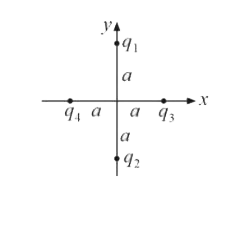
Four charges q(1)=q(2)=-q(3)=-q(4)=q a...

Four charges `q_(1)=q_(2)=-q_(3)=-q_(4)=q` are arranged in the y-plane forming an elastic quadrupole. Bringing these charges from infinity, what is the needed work to compose such an arrangement?

Promotional Banner

Similar Questions

Explore conceptually related problems

" A charge "q_(0)" is brought from infinity to the centre of a dipole.The work done is "

Four charges q_(1) = 1 muC,q_(2)=2 muC,q_(3)=-3 muC and q_(4)=4 muC are kept on the vertices of a square of side 1 m . Find the electric potential energy of this system of charges.

Four charges q_(1) = 1 muC,q_(2)=2 muC,q_(3)=-3 muC and q_(4)=4 muC are kept on the vertices of a square of side 1 m . Find the electric potential energy of this system of charges.

Four equal charges Q are placed at the four corners of a square of each side is 'a'. Work done in removing a charge -Q from its centre to infinity is

Four equal charges Q are placed at the four corners of a square of each side is 'a'. Work done in removing a charge -Q from its centre to infinity is

Four positive charges (2sqrt2-1)Q are arranged at the four corners of a square. Another charge q is placed at the centre of the square. Resulting force acting on each corner charge is zero if q is

Four positive charges (2sqrt2-1)Q are arranged at the four corners of a square. Another charge q is placed at the center of the square. Resulting force acting on each corner charge is zero if q is

Four identical charges q are kept on each vertices of a square of side a. Calculate the extra amount of work done in bringing a Q charge from infinity to the centre of the square.

Assertion: Four point charges q_(1),q_(2),q_(3) and q_(4) are as shown in Fig,The flux over the shown Gaussians surface depends only on charges q_(1) and q_(2) Reason:Electric field at all points on Gaussians surface depends on any charges q_(1) and q_(2)