

Home
Class 12
PHYSICS
A 50 cm long wire of mass 20 g supports ...

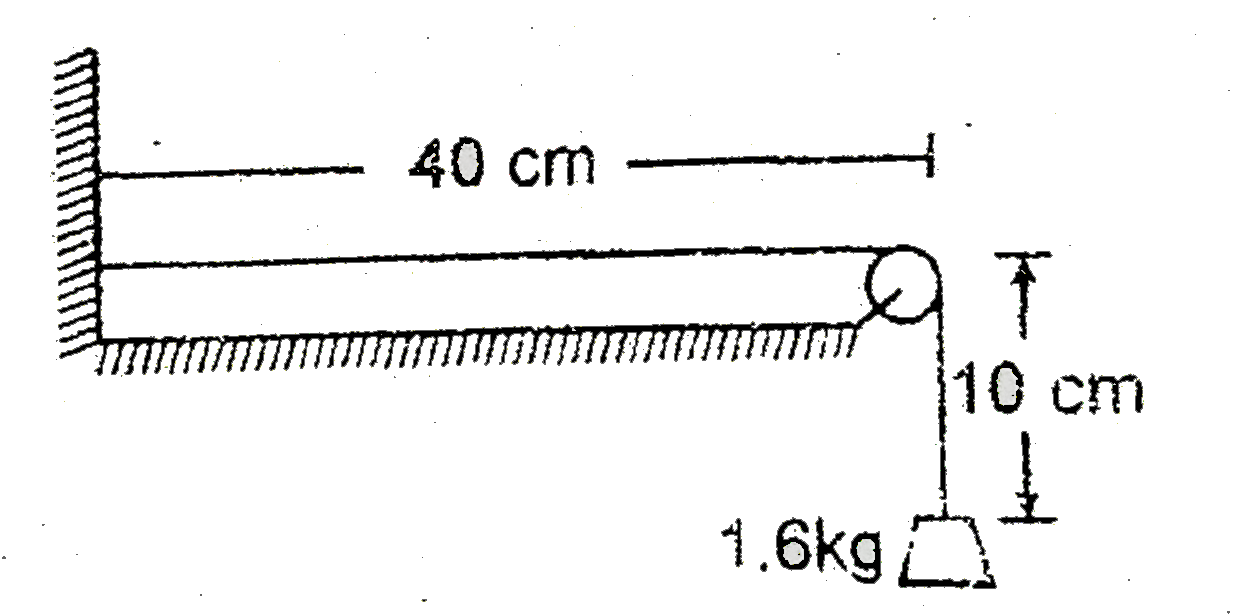
A `50 cm` long wire of mass `20 g` supports a mass of `1.6 kg` as shown in figure. Find the first overtone frequency of the portion of the string between the wall and the pulley. Take `g = 10 m//s^(2)`

Promotional Banner

Similar Questions

Explore conceptually related problems

A 100 cm long wire of mass 40 g supports a mass of 1.6 kg as shown in figure . Find the fundamental frequency of the portion of the string between the wall and the pulley. Take g=10m//s^(2) .

A 50 cm long wire of mass 20 g suports a mass of 1.6 kg as shown in figure. Find the fundamental frequency of the portioin of the strig between the wall and the pulley. Take g=10 ms^-2 .

A 50 cm long wire of mass 20 g suports a mass of 1.6 kg as shown in figure. Find the fundamental frequency of the portioin of the strig between the wall and the pulley. Take g=10 ms^-2 .

A 50 cm long wire of mass 20 g suports a mass of 1.6 kg as shown in figure. Find the fundamental frequency of the portioin of the strig between the wall and the pulley. Take g=10 ms^-2 .

Find the acceleration of the 6 kg block in the figure. All the surfaces and pulleys are smooth. Also the strings are inextensible and light. [Take g = 10 m//s^(2) ] .

Find the acceleration of the 6 kg block in the figure. All the surfaces and pulleys are smooth. Also the strings are inextensible and light. [Take g = 10 m//s^(2) ] .

Two unequal masses of 1 kg and 2 kg are attached at the two ends of a light inextensible string passing over a smooth pulley as shown in figure. If the system is released from rest, find the work done by string on both the blocks in 1 s. (Take g = 10 ms^(-2) )

Two unequal masses of 1 kg and 2 kg are attached at the two ends of a light inextensible string passing over a smooth pulley as shown in figure. If the system is released from rest, find the work done by string on both the blocks in 1 s. (Take g = 10 ms^(-2) )