

Home
Class 12
PHYSICS
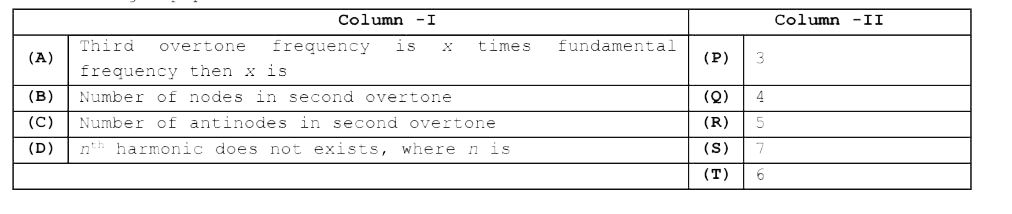
In closed organ pipe at one end-...

In closed organ pipe at one end-

Promotional Banner

Similar Questions

Explore conceptually related problems

Assertion: An open organ pipe of certain length has the same fundamental frequency as closed organ pipe of half the length. Reason : In case of an open organ organ pipe, at both the ends antinodes are formed while in case of closed organ pipe, at one end antinode and at the other end node is formed.

Assertion: An open organ pipe of certain length has the same fundamental frequency as closed organ pipe of half the length. Reason : In case of an open organ organ pipe, at both the ends antinodes are formed while in case of closed organ pipe, at one end antinode and at the other end node is formed.

A): An open organ pipe of certain length have the same fundamental frequency as closed organ pipe of half the length. (R): In the case of open organ pipe, at both the ends antinodes are formed, while in the closed organ pipe at one end antinode and at the other end node is formed.

A): An open organ pipe of certain length have the same fundamental frequency as closed organ pipe of half the length. (R): In the case of open organ pipe, at both the ends antinodes are formed, while in the closed organ pipe at one end antinode and at the other end node is formed.

Compare the length of a closed organ pipe and an open organ pipe, if the second overtone of the open pipe is unison with the second overtone of the closed organ pipe.

If the fundamental frequency of a closed of pipe is equal to the first overtone of an open organ pipe then the ratio of lengths of closed organ pipe to open organ pipe is

Compare the length of a closed organ pipe and an open organ pipe, if the second overtone of the open pipe is unison with the second overtone of the closed organ pipe.

If the fundamental frequency of a closed of pipe is equal to the first overtone of an open organ pipe then the ratio of lengths of closed organ pipe to open organ pipe is

A closed organ pipe (closed at one end) is excited to support the third overtone. It is found that air in the pipe has