

Home
Class 12
PHYSICS
A block of mass m = 1 kg slides with vel...

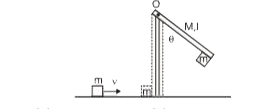
A block of mass m = 1 kg slides with velocity `upsilon = 6 m//s` on a frictionless horizontal surface and collides with a uniform vertical rod and sticks to it as shown. The rod is pivoted about O and swings as a result of the collision making angle `theta` before momentarily coming to rest. If the rod has mass M = 2 kg, and length `l = 1m`, the value of `theta` is approximately: (take `g = 10 m//s^2`)

Promotional Banner

Similar Questions

Explore conceptually related problems

A particle of mass m and speed u collides elastically with the end of a uniform rod of mass M and length L as shown. If the particle comes to rest after collision, find m/M

In the shown figure a mass m slides down the frictionless surface from height h and collides with the uniform vertical rod of length L and mass M after collision the mass m sticks to the rod. The rod is face to rotate in a vertical plane about fixed axis through O . Find the maximum angular deflection of the rod from its initial position.

In the shown figure a mass m slides down the frictionless surface from height h and collides with the uniform vertical rod of length L and mass M after collision the mass m sticks to the rod. The rod is face to rotate in a vertical plane about fixed axis through O . Find the maximum angular deflection of the rod from its initial position.

A rod of mass M and length L is kept on a frictionless horizontal floor. A particle of mass m moving perpendicular to the rod with a speed v strikes at the end of the rod and sticks there. Calculate angular velocity acquired by the combined system.

A uniform rod lies at rest on a frictionless horizontal surface. A particle, having a mass equal to that of the rod, moves on the surface perpendicular to the rod collides with it, and finally sticks to it. The minimum loss of KE in the collision , under the given conditions, is

A uniform rod lies at rest on a frictionless horizontal surface. A particle, having a mass equal to that of the rod, moves on the surface perpendicular to the rod collides with it, and finally sticks to it. The minimum loss of KE in the collision , under the given conditions, is

A rod AB of mass M and length L is lying on a horizontal frictionless surface. A particle of mass m traveling along the surface hits the end A of the rod with a velocity v_(0) in a direction perpendicular to AB . The collision is completely elastic. After the collision the particle comes to rest. Find the ration m//M .