

Home
Class 11
PHYSICS
A ball of mass m is attached to one end ...

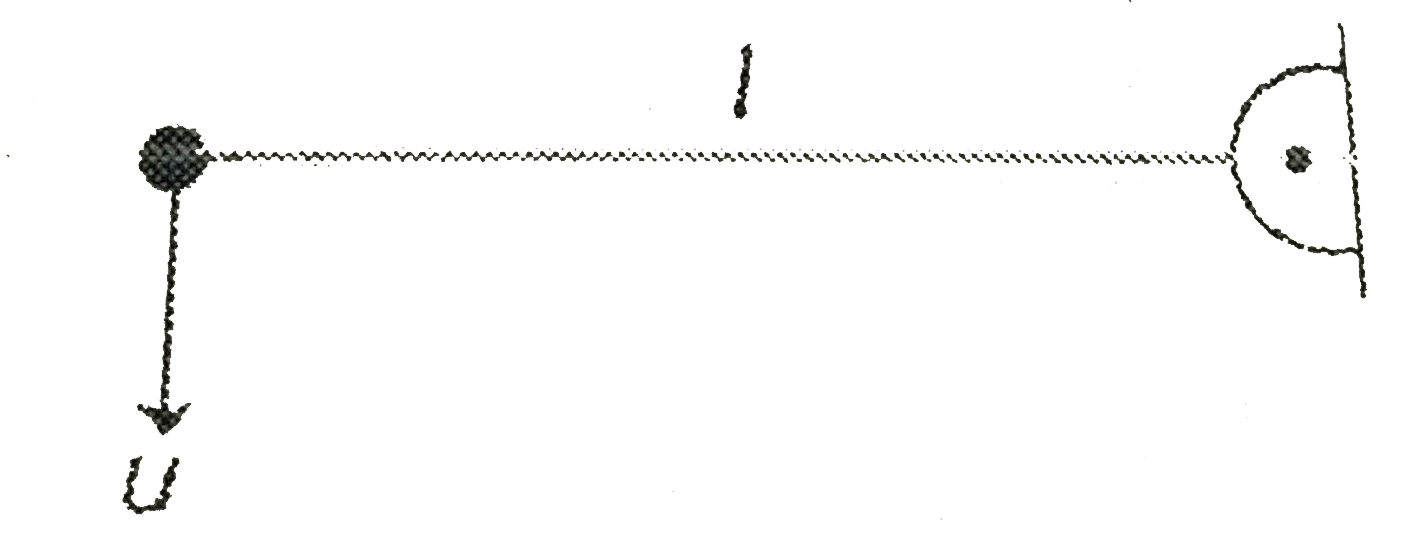
A ball of mass `m` is attached to one end of a light rod of length `l`, the other end of which is hinged. What minimum velocity `v` should be imparted to the ball downwards, so that it can complete the circle ?

Promotional Banner

Similar Questions

Explore conceptually related problems

A particle of mass of mass m is attached to a light rod of lenght l other end of the rod is hinged to a wall . Minimumm velocity (Vo) that should be given to a particle in lowest positiion so that it completes a vertical circle

A small hevy block is attached to the lower4 end of a light rod of lenth l which fan be rotated about its clamped upper end. What minimum horizontal velocity should the block be given so that it moves in a complete vertical circle ?

A small hevy block is attached to the lower4 end of a light rod of lenth l which fan be rotated about its clamped upper end. What minimum horizontal velocity should the block be given so that it moves in a complete vertical circle ?

A mass 2 m is fixed at one end of a light rod of length I . What horizontal velocity should be imparled to the lower end so that it may just take up the horizontal position ? If the mass is now rearanged with m at the lower end and the other m at the middle, what velocity is required ?

A particle of mass m is fixed to one end of a light rigid rod of length l and rotated in a vertical ciorcular path about its other end. The minimum speed of the particle at its highest point must be

A particle of mass m is fixed to one end of a light rigid rod of length l and rotated in a vertical ciorcular path about its other end. The minimum speed of the particle at its highest point must be

A mass m is tied to a string of length l and is rotated in a vertical circle with centre at the other end of the string. (a) Find the minimum velocity of the mass at the top of the circle so that it is able to complete the circle. (b) Find the minimum velocity at the bottom of the circle corresponding to the above condition.

A light rod of length l is pivoted at the upper end. Two masses (each m), are attached to the rod, one at the middle and the other at the free end. What horizontal velocity must be imparted to the lower end mass, so that the rod may just take up the horizontal position ?

A light rod of length l is pivoted at the upper end. Two masses (each m), are attached to the rod, one at the middle and the other at the free end. What horizontal velocity must be imparted to the lower end mass, so that the rod may just take up the horizontal position ?