

Home
Class 12
PHYSICS
A particle of mass m strikes a disc of r...

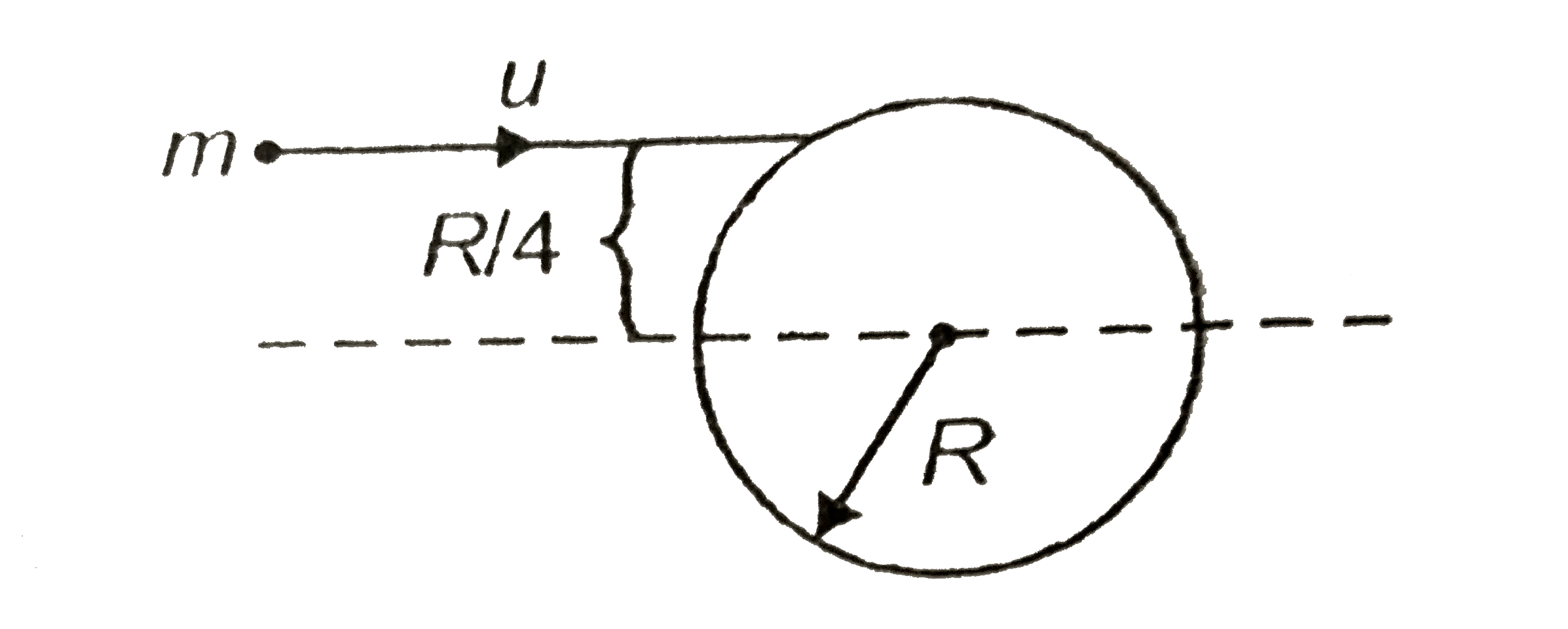
A particle of mass `m` strikes a disc of radius `R` and mass `m` with a speed `u` as shown in the figure. What is the speed of the particle just after the collision if the collision is perfectly inelastic ?

Promotional Banner

Similar Questions

Explore conceptually related problems

A particle of mass m strikes elastically with a disc of radius R , with a velocity vec"v" as shown in the figure. If the mass of the disc is equal to that of the particle and the surface of the contact is smooth, find the velocity of the disc just after the collision.

A particle of mass m strikes another particle of same at rest. Find the angle between velocities of particles after the collision , if the collision is elastic.

A particle of mass m moving with horizontal speed 6 m//s as shown in the figure. If m lt lt M then for one - dimensional elastic collision , the speed of lighter particle after collision will be

Two particle of masses m and 2m are coliding elastically as given in figure. If V_(1) and V_(2) speed of particle just after collision then

Two particle of masses m and 2m are coliding elastically as given in figure. If V_(1) and V_(2) speed of particle just after collision then

A particle (a mud pallet, say) of mass m strikes a smooth stationary wedge of mass M with as velocity v_(0) at an angle theta with horizontal. If the collision is perfectly inelastic, find the a. velocity of the wedge just after the collision. b. Chane in KE of the system (M+m) in collision.

A particle (a mud pallet, say) of mass m strikes a smooth stationary wedge of mass M with as velocity v_(0) at an angle theta with horizontal. If the collision is perfectly inelastic, find the a. velocity of the wedge just after the collision. b. Change in KE of the system (M+m) in collision.