

Home
Class 12
MATHS
Concavity and convexity : if f''(x) ...

Concavity and convexity :
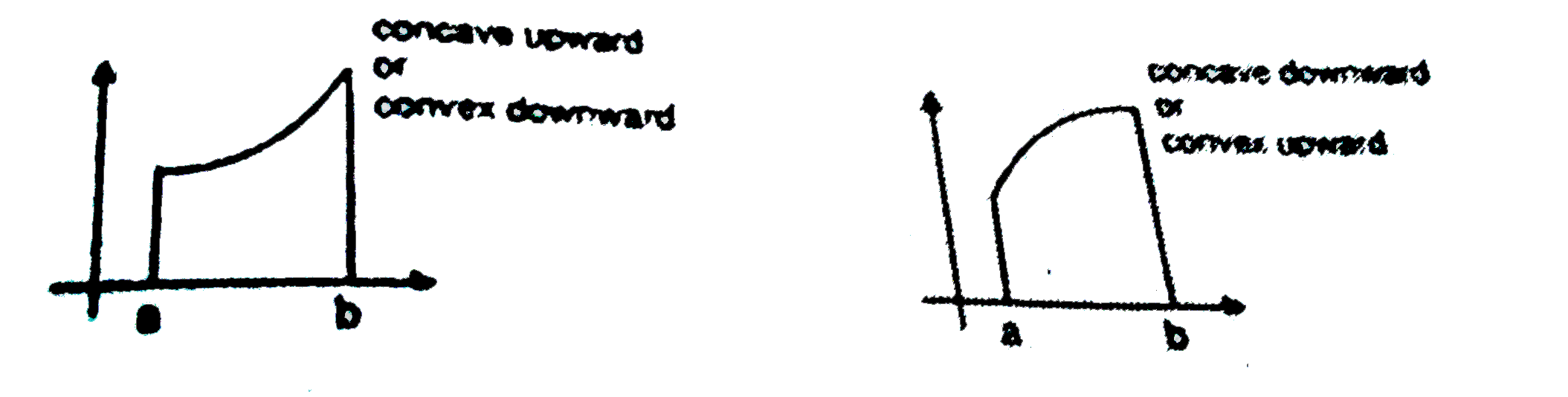
if `f''(x) gt 0 AA x in (a,b)` then the curve y=f(x) is concave up ( or convex down) in (a,b) and `if f''(x) lt 0 AA x in (a,b)` then the curve y=f(x) is concave down (or convex up ) in (a,b)

Inflection point :
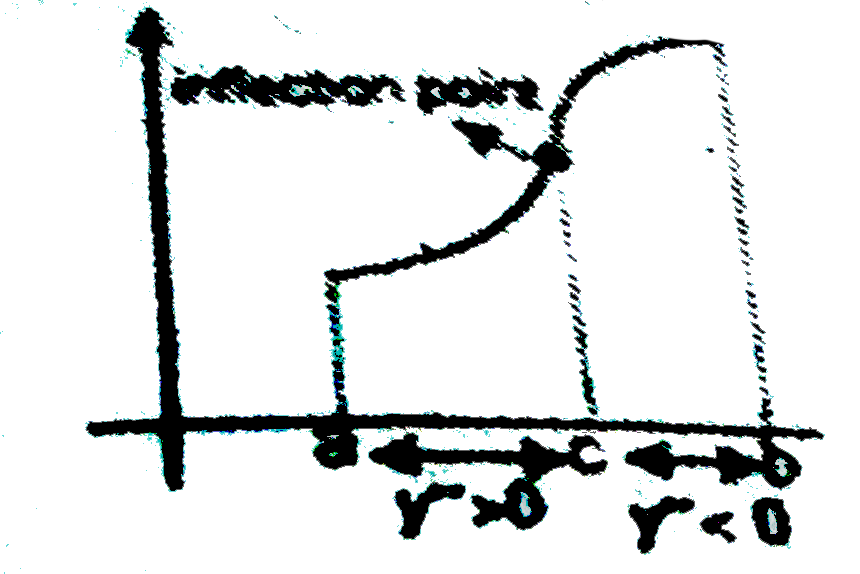
The point where concavity of the curve changes is known as point of inflection (at inflection point `f''(x)` is equal to 0 or undefined)


Number of point of inflection for `f(x) =(x-1)^(3) (x-2)^(2)` is :

Promotional Banner

Similar Questions

Explore conceptually related problems

Concavity and convexity : if f''(x) gt 0 AA x in (a,b) then the curve y=f(x) is concave up ( or convex down) in (a,b) and if f''(x) lt 0 AA x in (a,b) then the curve y=f(x) is concave down (or convex up ) in (a,b) Inflection point : The point where concavity of the curve changes is known as point of inflection (at inflection point f''(x) is equal to 0 or undefined) Exhaustive set of values of 'a' for which the function f(x) =x^(4) +ax^(3)+(3x^(2))/(2)+1 will be concave upward along the entire real line is :

Concavity and convexity : if f''(x) gt 0 AA x in (a,b) then the curve y=f(x) is concave up ( or convex down) in (a,b) and if f''(x) lt 0 AA x in (a,b) then the curve y=f(x) is concave down (or convex up ) in (a,b) Inflection point : The point where concavity of the curve changes is known as point of inflection (at inflection point f''(x) is equal to 0 or undefined) Exhaustive set of values of 'a' for which the function f(x) =x^(4) +ax^(3)+(3x^(2))/(2)+1 will be concave upward along the entire real line is : (A) [-1,1] (B) [-2,2] (C) [0,2] (D) [0,4]

Determine the intervals of concavity of the curve f(x)=(x-1)^(3)(x-5),x in R and , points of inflection if any

If A and B are the points of intersection of y=f(x) and y=f^(-1)(x) , then

If A and B are the points of intersection of y=f(x) and y=f^(-1)(x) , then

Determine the intervals of concavity of the curve f(x) = (x -2)^(3) (x-4), x in R and the points of inflection if any.

If f^(11)(x)lt0(gt0) on an interval (a,b) then the curve y=f(x) on this interval is convex (concave) i.e it is below (above) any of its tangent lines If f^(11)(x_(0))=0 or does not exist and the second derivative changes sign when passing through the point x_(0) then the point (x_(0),f(x)) is the = point of inflection of the curve y=f(x) If y=x^(4)+x^(3)-18x^(2)+24x-12 then

If f''(x) lt 0 AA x in (a,b) and (c, f(c)) is a point lying on the curve y =f(x) , where a < c < b and for that value of c , f(c) has a maximum then f'(c) equals

If f^(11)(x)lt0(gt0) on an interval (a,b) then the curve y=f(x) on this interval is convex (concave) i.e it is below (above) any of its tangent lines If f^(11)(x_(0))=0 or does not exist and the second derivative changes sign when passing through the point x_(0) then the point (x_(0),f(x)) is the = point of inflection of the curve y=f(x) If y=xsin(logx) then