

Home
Class 11
PHYSICS
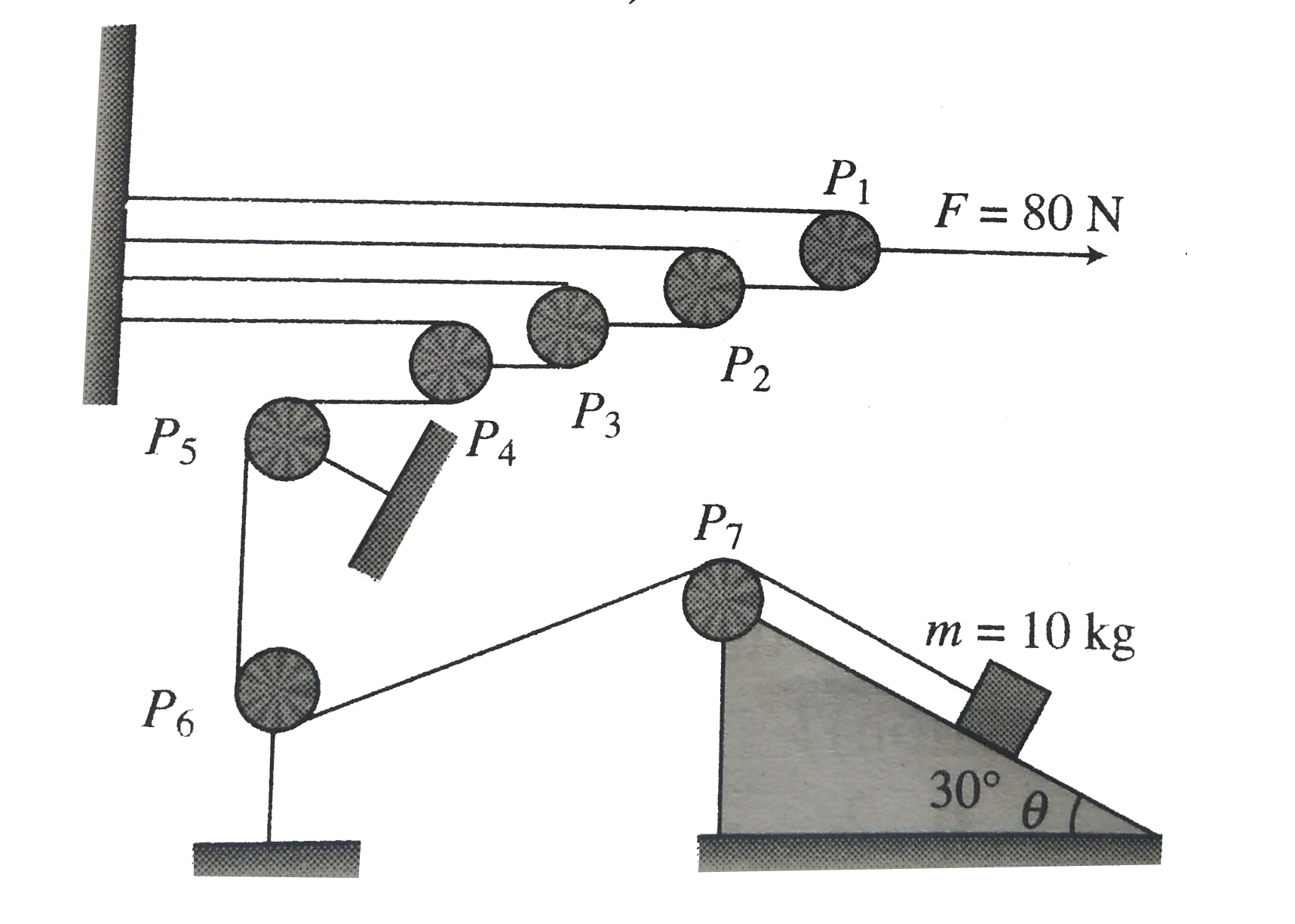
In fig, all the pulleys and strings are ...

In fig, all the pulleys and strings are massless and all the surfaces are frictionless. A small block of mass m is placed on fixed wedge (take `f=10ms^(-2)`).

The tension in the string attached to m is

Promotional Banner

Similar Questions

Explore conceptually related problems

In fig, all the pulleys and strings are massless and all the surfaces are frictionless. A small block of mass m is placed on fixed wedge (take f=10ms^(-2) ). The acceleration of m is

In fig, all the pulleys and strings are massless and all the surfaces are frictionless. A small block of mass m is placed on fixed wedge (take f=10ms^(-2) ). The acceleration of pulley p_(4) is

In fig, all the pulleys and strings are massless and all the surfaces are frictionless. A small block of mass m is placed on fixed wedge (take f=10ms^(-2) ). The acceleration of pulley p_(4) is

In the shown arrangement , both pulleys and the string are massless and all the surface are frictionless. Find the acceleration of the wedge.

In the shown arrangement , both pulleys and the string are massless and all the surface are frictionless. Find the acceleration of the wedge.

In fig. both pulleys and the string are massless and all the surfaces are frictionless. Given m_(1)=1kg, m_(2)= 2kg, m_(3)=3kg . Find the tension in the string

In fig. both pulleys and the string are massless and all the surfaces are frictionless. Given m_(1)=1kg, m_(2)= 2kg, m_(3)=3kg . Find the tension in the string

In fig. both pulleys and the string are massless and all the surfaces are frictionless. Given m_(1)=1kg, m_(2)= 2kg, m_(3)=3kg . The acceleration of m_(3) is

In fig. both pulleys and the string are massless and all the surfaces are frictionless. Given m_(1)=1kg, m_(2)= 2kg, m_(3)=3kg . The acceleration of m_(1) is

In fig. both pulleys and the string are massless and all the surfaces are frictionless. Given m_(1)=1kg, m_(2)= 2kg, m_(3)=3kg . The acceleration of m_(3) is