

Home
Class 12
PHYSICS
A source and detector both start moving ...

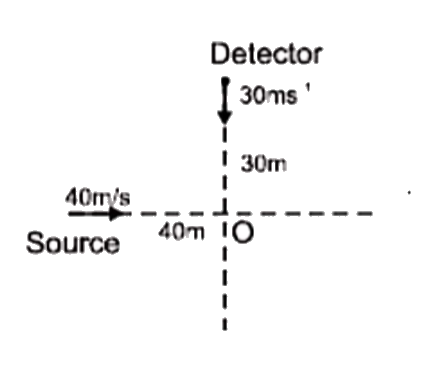
A source and detector both start moving simultaneously fro the position shown in the figure, one along x-axis and the other along y-axis with speeds 40 `ms^(-1)` and 30 `ms^(-1)` respectively. If n is the frequency of the source then the graph between the apparent frequency n' observed by detector and time t would be [assume that source and detector do not collide]

Promotional Banner

Similar Questions

Explore conceptually related problems

Source and observer both start moving simultaneously from origin one along X-axis an the other along y-axis with speed of source = 2 (speed of observer). The graph between the apparent frequency observed by observer (t) and time (t) would be: (Here, f0 = natural frequency of source)

source and observer both start moving simultaneously from origion one along y - axis with speed of source = 2 (speed of observer ). The graph between the apparent frequency observed by observer (f) and time (t) would be

Source and observer start moving simulatneously along x and y-axis respectively. The speed of source is twice the speed of observer V_0 . If the ratio of observer frequency to the frequency of the source is 0.75 , find the velocity of sound.

Source and observer start moving simulatneously along x and y-axis respectively. The speed of source is twice the speed of observer V_0 . If the ratio of observer frequency to the frequency of the source is 0.75 , find the velocity of sound.

Source and observer start moving simulatneously along x and y-axis respectively. The speed of source is twice the speed of observer V_0 . If the ratio of observer frequency to the frequency of the source is 0.75 , find the velocity of sound.

An observer moves towards a stationary source of sound with a speed 1//5^(th) of the speed of sound. The wavelength and frequency of the source emitted are X and f respectively. The apparent frequency and wavelength recorded by the observer are respectively