

Home
Class 12
PHYSICS
A biconvex lens of focal length f(1)=10c...

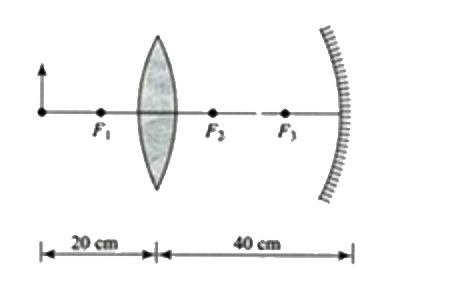
A biconvex lens of focal length `f_(1)=10cm` is placed 40 cm in front of a concave mirror of focal length `f_(2)=7.50 cm,` as shown in the figure. An object, 2 cm high, is placed 20 cm to the left of the lens.

The image formed by the lens, as rays travel to the right, is

Promotional Banner

Similar Questions

Explore conceptually related problems

An equiconvex lens, f_(1)=10cm , is placed 40 cm in front of a concave mirror, f_(2)=7.50cm as shown in Figure ., An object 2 cm high is placed 20cm to the left of the lens . Find the position of the final image is formed when leftward travelling rays once again pass through the lens. Find overall magnification.

An equiconvex lens, f_(1)=10cm , is placed 40 cm in front of a concave mirror, f_(2)=7.50cm as shown in Figure ., An object 2 cm high is placed 20cm to the left of the lens . Find the position of the final image is formed when leftward travelling rays once again pass through the lens. Find overall magnification.

An object is placed 25 cm in front of a concave lens of focal length 25 cm. The position of images is

A convex lens of focal length 10 cm is placed in contact with a concave lens of focal length 20 cm. What is the nature and focal length of the combination ?

An object is placed at a distance of 40 cm in front of a concave mirror of focal length 20 cm. The image produced is

A convex lens of focal length 10 cm is placed in contact with a concave lens of focal length 20 cm. The focal length of this combination of lenses will be:

A convex lens of focal length 20 cm is placed in contact with a concave lens of focal length 10 cm. What is the focal length and power of the combination ?

A convex lens of focal length 10 cm is placed coaxially 5 cm away from a concave lens of focal length 10 cm. If an object is placed 30 cm in front of the convex lens, find the position of the final image formed by the combined system.