

Home
Class 12
PHYSICS
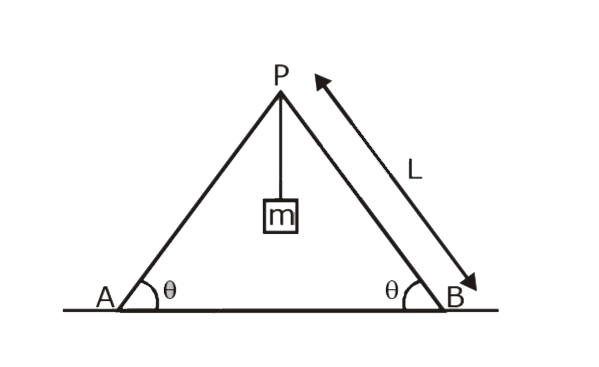
Two identical ladders are arranged as sh...

Two identical ladders are arranged as shown in the figure. Mass of each ladder is M and length L. The systemis in equilibrium. Find direction and magnitude of frictional force acting at A or B.

Promotional Banner

Similar Questions

Explore conceptually related problems

Two identical ladders are arranged as shown in the figure. Mass of the block is m and the mass of each ladder is M. The length of each of the ladder is L. The system is in equilibrium. What is the magnitude of frictional force acting at A or B?

Two identical ladders are arranged as shown in the figure. Mass of the block is m and the mass of each ladder is M. The length of each of the ladder is L. The system is in equilibrium. What is the magnitude of frictional force acting at A or B?

Two identical ladders, each of mass M and length L are resting on the rough horizontal surface as shown in the figure. A block of mass m hangs from P. if the system is in equilibrium, find the magnitude and the direction of frictional force at A and B.

Two identical ladders, each of mass M and length L are resting on the rough horizontal surface as shown in the figure. A block of mass m hangs from P. If the system is in equilibrium, find the magnitude and the direction of frictional force at A and B.

Two identical ladders, each of mass M and length L are resting on the rough horizontal surface as shown in the figure. A block of mass m hangs from P. if the system is in equilibrium, find the magnitude and the direction of frictional force at A and B.

A hollow cylindrical pipe of mass M and radius R has a thin rod of mass m welded inside it, along its length. A light thread is tightly wound on the surface of the pipe. A mass m_(0) is attached to the end of the thread as shown in figure. The system stays in equilibrium when the cylinder is placed such that alpha = 30^(@) The pulley shown in figure is a disc of mass (M)/(2) (a) Find the direction and magnitude of friction force acting on the cylinder. (b) Express mass of the rod ‘m’ in terms of m_(0)

Two uniform thin rods each of length L and mass m are joined as shown in the figure. Find the distance of centre of mass the system from point O

Two uniform thin rods each of length L and mass m are joined as shown in the figure. Find the distance of centre of mass the system from point O