

Home
Class 9
MATHS
In, D and E are two points on BC such th...

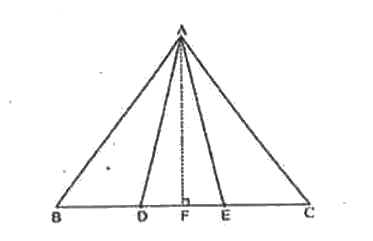
In, D and E are two points on BC such that BD = De = EC. Show that ar (ABD) = ar (ADE) = ar (AEC).
Can you now answer the question that you have left in the 'introduction' of this chapter, whether the field of Budhia has been actually divided into three parts of equal area?

Promotional Banner

Similar Questions

Explore conceptually related problems

In the following Figure, D and E are two points on BC such that BD = DE = EC . Show that ar (ABD) = ar (ADE) = ar(AEC) can you now answer the equation that you left in the "Introduction " of the capther, whether the filed of Budhia has been actually divided into three parts of equal area ?

In Fig. 9.30, D and E are two points on BC such that B D=D E=E C . Show that a r(A B D)=a r(A D E)=a r(A E C) . Can you now answer the question that you have left in the Introduction of this chapter, whether the field of Budha has been actually divided into three parts of equal area ?

In Fig. 9.30, D and E are two points on BC such that B D" "=" "D E" "=" "E C . Show that a r" "(A B D)" "=" "a r" "(A D E)" "=" "a r" "(A E C) . Can you now answer the question that you have left in the Introduction of this chapter, whether the field of Budha has been actually divided into three parts of equal area ?

In Fig.30D and E are to points on BC such that BD=DE=EC. Show that ar(ABD)=ar(ADE)=ar(AEC)

In a Delta ABC , D and E are two points on BC such that BD : DE : EC = 4 : 5 : 6 If the area of Delta ADE = 30 cm^(2) . find area of Delta ABC

In the figure, D and E are the points on sides AB and AC of /_\ABC such that DE|\|BC. and divides △ABC into two parts, equal in area, Find AB BD ​ .

In triangleABC , P is the mid-point of BC and Q is the mid-point of AP. Find the ratio of the area of triangleABQ and the area of angleABC . The following are the steps involved in solving the above problem. A) We know that a a median of a triangle divides a triangle into two triangles of equal area. B) rArr Ar(triangleABP) =1/2[Ar(triangleABC)] C) Ar(triangleABQ)=1/2[Ar(triangleABP)]=1/4[Ar(triangleABC)] D) rArr(triangleABQ):Ar(triangleABC)=1:4

In DeltaABC , D and E are points on AB and AC respectively such that DE is parallel to BC. If AD= 2 cm, BD = 3 cm, then (ar(DeltaADE))/(ar(DeltaABC)) is

ABC is a right triangle right angled at A. BCED,ACFG and ABMN are squares on the sides BC,CA and AB respectively. Line segments AX bot DE meets BC at Y and DE at X. Join AD,AE also BF and CM Show that ar(BCED)=ar(ABMN)+ar(ACFG) Can you write the result in words? This is a famous theorem of Pythagoras. You shall learn a simple proof in this theorem in class X.