Home
Class 12
CHEMISTRY
A mixture of carboxylic acids (X) and (Y...

A mixture of carboxylic acids (X) and (Y) cannot be separated by normal methods however when this mixture is treated with optically active quinine give optically active salts (P) and (Q). These two salis can be separated by fractional crystallization, separated and acidified with HCl to form amines and carboxylic acids.
The compound (X) and (Y) may be

A

`CH_(3)COOH, CH_(3)CH_(2)COOH`

B

C

(+) and (-) - Tartaric acid

D

`CH_(3)CH_(2)CH_(2)COOH, CH_(3)CH_(2)CH_(2)CH_(2)COOH`

Text Solution

Verified by Experts

The correct Answer is:

C

dl - Tartaric Acid
Promotional Banner

Topper's Solved these Questions

  • PRACTICAL CHEMISTRY

    AAKASH SERIES|Exercise PRACTICE SHEET-2 (Match the following questions)|2 Videos
  • PRACTICAL CHEMISTRY

    AAKASH SERIES|Exercise PRACTICE SHEET-2 (Integer answer Type questions)|7 Videos
  • PRACTICAL CHEMISTRY

    AAKASH SERIES|Exercise PRACTICE SHEET-2 (Single answer questions)|15 Videos
  • POLYMERS

    AAKASH SERIES|Exercise OBJECTIVE EXERCISE - 4|59 Videos
  • PRINCIPLES OF METALLURGY

    AAKASH SERIES|Exercise SUBJECTIVE EXERCISE-2 (LONG ANSWER QUESTIONS )|7 Videos

Similar Questions

Explore conceptually related problems

A mixture of carboxylic acids (X) and (Y) cannot be separated by normal methods however when this mixture is treated with optically active quinine give optically active salts (P) and (Q). These two salis can be separated by fractional crystallization, separated and acidified with HCl to form amines and carboxylic acids. (P) and (Q) are separated by fractional crystallization due to

A mixture of carboxylic acids (X) and (Y) cannot be separated by normal methods however when this mixture is treated with optically active quinine give optically active salts (P) and (Q). These two salis can be separated by fractional crystallization, separated and acidified with HCl to form amines and carboxylic acids. What is the diastereoisorner of (+) -tartaric acid ?

The compound X on oxidation gives a mixture of acetic acid and formic acid, while Y on oxidation forms only propionic acid. X and Y are

Two aldopentoses X and Y give the same osazone derivative. X is oxidized to an optically active aldaric acid by dilute nitric acid. Ruff degradation of Y gave a tetroe which was similarly oxidized to an optically active aldaric acid. Assign the structures of X and Y from the following list?

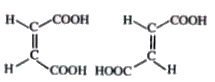
Structural isomers have different covalent linkage of atoms. Stereoisomers are compounds that have same sequence of covalent bonds but differ in the relative dispositions of their atoms in space. Geometri cal and optical isomers are the two important types of configurational isomers. The compound with double bonds or ring structure have restricted rotation, so exist in two geometrical forms. The double bonds in larger rings (ring size 10 carbon large) can also cause geometrical isomerism. The optical isomers rotate the plane of plane-polarised light. A sp^(3) -hybridised carbon atom bearing four different types of substituents is called an asymmetric centre or chiral centre. A chiral object or molecule cannot be superimposed on its mirror image. Stereoisomers that are mirror images of each other are called enantiomers. The stereosomers that the pot mirror images of each other are called diastereomers. Diasteremers have different physical properties. A racemic mixture is optically inactive and contains equal amounts of both the enantiomers. Resolution refers to method of separating a racemic mixture. Into two pure enantiomers. A meso compound is an optically inactive stereoisomer, which is achiral due to the presence of an internal plane of symmetry or centre of symmetry within the molecule. The following two compounds are

Structural isomers have different covalent linkage of atoms. Stereoisomers are compounds that have same sequence of covalent bonds but differ in the relative dispositions of their atoms in space. Geometri cal and optical isomers are the two important types of configurational isomers. The compound with double bonds or ring structure have restricted rotation, so exist in two geometrical forms. The double bonds in larger rings (ring size 10 carbon large) can also cause geometrical isomerism. The optical isomers rotate the plane of plane-polarised light. A sp^(3) -hybridised carbon atom bearing four different types of substituents is called an asymmetric centre or chiral centre. A chiral object or molecule cannot be superimposed on its mirror image. Stereoisomers that are mirror images of each other are called enantiomers. The stereosomers that the pot mirror images of each other are called diastereomers. Diasteremers have different physical properties. A racemic mixture is optically inactive and contains equal amounts of both the enantiomers. Resolution refers to method of separating a racemic mixture. Into two pure enantiomers. A meso compound is an optically inactive stereoisomer, which is achiral due to the presence of an internal plane of symmetry or centre of symmetry within the molecule. The number of chiral centres present in the following compounds is

A black power (X) when treated with common salt and chamber acid gives off a greenish yellow gas (Y). Y on passing through boiling potash yields compounds are of which when heated with X evolves oxygen. What are X and Y?

Monosaccharides have -CHO (or C=O) and -OH groups, so they undergo usual oxidation and reduction. Further, monosaccharides from osazone when treated with excess of phenylhdrazine (3 equivalents). In osazone formation only the first two carbon atoms are involved. Thus monosaccharidxes having identical configuration on reset of C atoms except first two will form same osazone, as is the case with glucose and fructose. A, B and C are three hexoses and form same osazone D. Compounds A to D behave as below (A) D overset(HCl)rarr underset(CH_(3)COOH)overset(Zn)rarr D - Fructose (B) A overset(Ni.H_(2))rarr overset(HNO_(3))rarr underset(H_(3)O^(+))overset(Na-Hg)rarr B + C (C ) B overset(HNO_(3))rarr Optically active glycaric acid (D) C overset(HNO_(3))rarr Optically inactive glycaric acid Compound D is an osazone which can be obtained from
