Home
Class 12
CHEMISTRY
PCl(5) in solid state exists as PCl(4)^(...

`PCl_(5)` in solid state exists as `PCl_(4)^(+) and PCl_(6)^(-)` and also in some solvents it undergoes dissociation as `2PCl_(5) hArr PCl_(4)^(+) +PCl_(6)^(-)`
Which statement is wrong ?

A

In `PCl_5` all the P - Cl bonds are of same enery

B

`PCl_5` has no lone pair of electrons

C

`PCl_(5)` is a white solid wich melts at `167^0C`

D

`PCl_(5)` gives white fumes with moist air

Text Solution

Verified by Experts

The correct Answer is:
A

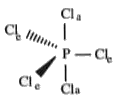
`PCl_5 -Sp^3d` - trigonal bipyramidal geometry

`P-Cl_(a) = P-Cl_(e)`
- yellowish white powder
- Gives white forms in moist air because of liberation of HCl.
`PCl_(5)+4H_(2)O rarr H_(3)PO_(4)+5HCl rarr ` white fumes
Promotional Banner

Similar Questions

Explore conceptually related problems

PCl_(5) in solid state exists as PCl_(4)^(+) and PCl_(6)^(-) and also in some solvents it undergoes dissociation as 2PCl_(5) hArr PCl_(4)^(+) +PCl_(6)^(-) The geometry and hybridisation of PCl_(6)^(-) is

PCl_(5) in solid state exists as PCl_(4)^(+) and PCl_(6)^(-) and also in some solvents it undergoes dissociation as 2PCl_(5) hArr PCl_(4)^(+) +PCl_(6)^(-) The geometry and hydridisation of PCl_(4)^(+) is

In PCl_(5) Bond angle in plane is

For the reaction PCl_(5(g)) harr PCl_(3(g)) + Cl_(2(g)) . Which of the graph "is"//"are" correct?

PCl_(5)+Cl^(-) to PCl_(6)^(-) . The wrong statement regarding the above equation is

The solid PCl_5 exists as ........

For the reaction PCl_(5(g)) hArr PCl_(3(g)) + Cl_(2(g)) the forward reaction at constant temperature is favoured by

Consider the following reaction, PCl_(5) (g) hArr PCl_(3) (g) + Cl_(2)(g) the forward reaction at constant temperature is favoured by

Explain hybridisation of phosphorous in the formation of PCl_(5)

Under certain conditions, the equilibrium constant for the decomposition of PCl_(5)(g) into PCl_(3)(g) and Cl_(2)(g) is 0.0211 "mol"L^(-1) . What are the equilibrium concentrations of PCl_(5),PCl_(3)d and Cl_(2) if the initial concentration of PCl_(5) was 1.00 M ?

