Home
Class 12
CHEMISTRY
One Faraday charge was passed through th...

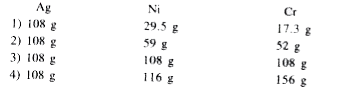
One Faraday charge was passed through the electrolytic cell placed in series containing solutions of `Ag^(+), Ni^(2+) and Cr^(3+)`. Then Ag, Ni and Cr deposited will be (Atomic masses , Ag= 108, Ni = 59 and Cr = 52)

Text Solution

Verified by Experts

The correct Answer is:

A
Promotional Banner

Topper's Solved these Questions

  • ELECTROCHEMISTRY

    AAKASH SERIES|Exercise LEVEL-II (LECTURE SHEET ( EXERCISE -I ( SINGLE & ONE OR MORE THAN ONE CORRECT ANSWER )))|32 Videos
  • ELECTROCHEMISTRY

    AAKASH SERIES|Exercise LEVEL-II (LECTURE SHEET ( EXERCISE -II (LINKED COMPREHENSION TYPE QUESTIONS )) )|12 Videos
  • ELECTROCHEMISTRY

    AAKASH SERIES|Exercise LEVEL-I ( EXERCISE-I)|146 Videos
  • DILUTE SOLUTIONS

    AAKASH SERIES|Exercise EXERCISE - 1.2|55 Videos
  • ELEMENTS OF D - BLOCK

    AAKASH SERIES|Exercise EXERCISE - 5.2|33 Videos

Similar Questions

Explore conceptually related problems

Magnetic moment 2.84B.M. is given by (Atomic number, Ni = 28, Ti = 22, Cr = 24, Co = 27)

One Faraday of electricity is passed separately through one litre of one molar aqueous solutions of (i) AgNO_3 (ii) SnCl_4 and (iii) CuSO_4 . The number of moles of Ag, Sn and Cu deposited at cathode are respectively

A current of 0.965 amp. Is passed through an aqueous solution of AgNO_(3) for 10 minutes during electroysis, Calculate the mass of Ag deposited at the cathode (Atomic weight of Ag=108 ).

Same amount of electricity is passed through aqueous solutions of AgNO_3 and CuSO_4 . The number of Ag and Cu atoms deposited are x and y respectively. The correct relationship between x and y is

Three electrolytic cells A,B,C containing solutions of ZnSO_(4) , AgNO_(3) and CuSO_(4) , respectively are connected in series. A steady current of 1.5 amperes was passed through them until 1.45 g of silver deposited at the cathode of cell B. How long did the current flow? What mass of copper and zinc were deposited?

Three Faraday's of electricity are passed through molten Al_2O_3 , aq. solution of CuSO_4 and molten NaCl taken in three different electrolytic cells. The amounts of Al, Cu and Na deposited at the electrodes will be

One gram of [Cr(H_(2)O)_(6)]Cl_(3) was passed through cationic exchanger and the HCl produced is diluted to 1 L. Find the molarity of acid.

Electrolysis is the process in which electrical energy is converted to chemical energy. In electrolyte cell, oxidation takes place at anode and reduction at cathode. Electrode process depends on the electrode taken for electrolysis. Amount of substance liberated at an electrode is directly proportionation to the amount of charge passed through it. The mass of substance liberated at electrode is calculate using the following realation : m=(itE)/(96500) Here, E represent the equivalent mass and 96500 C is called the faraday constant. Faraday (96500 C) is the charge of 1 mole electron i.e., 6.023 xx 10^(23) electrons, it is used to liberate on gram equivalent of the substance. The passage of current liberates H_2 at cathode and Cl_2 at anode. The solution is

Electrolysis is the process in which electrical energy is converted to chemical energy. In electrolyte cell, oxidation takes place at anode and reduction at cathode. Electrode process depends on the electrode taken for electrolysis. Amount of substance liberated at an electrode is directly proportionation to the amount of charge passed through it. The mass of substance liberated at electrode is calculate using the following realation : m=(itE)/(96500) Here, E represent the equivalent mass and 96500 C is called the faraday constant. Faraday (96500 C) is the charge of 1 mole electron i.e., 6.023 xx 10^(23) electrons, it is used to liberate on gram equivalent of the substance. The platinum electrodes were immersed in a solution of cupric sulphate (CuSO_4) and electric current is passed through the solution. After sometimes, it was observed that the colour of copper sulphate disappeared with evolution of a gas at the electrode. The colourless solution contains.

Electrolysis is the process in which electrical energy is converted to chemical energy. In electrolyte cell, oxidation takes place at anode and reduction at cathode. Electrode process depends on the electrode taken for electrolysis. Amount of substance liberated at an electrode is directly proportionation to the amount of charge passed through it. The mass of substance liberated at electrode is calculate using the following realation : m=(itE)/(96500) Here, E represent the equivalent mass and 96500 C is called the faraday constant. Faraday (96500 C) is the charge of 1 mole electron i.e., 6.023 xx 10^(23) electrons, it is used to liberate on gram equivalent of the substance. Calculate the volume of gas liberated at the anode at STP during the electrolysis of a CuSO_4 solution by a current of 1 A passed for 16 minutes and 5 seconds.

AAKASH SERIES-ELECTROCHEMISTRY -LEVEL-I ( EXERCISE-II)
  1. One coulomb of charge passes through solutions of AgNO3 and CuSO4. The...

    Text Solution

    |

  2. When electricity is passed through molten AlCl3, 13.5 g. of Al is depo...

    Text Solution

    |

  3. One Faraday charge was passed through the electrolytic cell placed in ...

    Text Solution

    |

  4. The weight in grams of O2 formed at Pt anode during the electrolys of ...

    Text Solution

    |

  5. When one ampere current is passed through a Cu wire for 10 sec., the n...

    Text Solution

    |

  6. How many coulombs of electricity are required for the reduction of 1 m...

    Text Solution

    |

  7. Electric charge on 1gm ion of N^(3-) is

    Text Solution

    |

  8. The charge required for the oxidation of one mole of Mn3O4 " to " MnO...

    Text Solution

    |

  9. Time required to deposit one millimole of aluminium metal by the passa...

    Text Solution

    |

  10. Two electrolytic cells, one containing acidified ferrous sulphate and ...

    Text Solution

    |

  11. On passing a current through a KCl solution, 19.5g of potassium is dep...

    Text Solution

    |

  12. When an electric current is passed through acidulated water, 112 ml of...

    Text Solution

    |

  13. The amount of chlorine evolved when 2 amperes of current is passed for...

    Text Solution

    |

  14. The conductivity of 0.001 M acetic acid is 5 xx 10^(-5) S cm^(-1) and ...

    Text Solution

    |

  15. The distance between two electrodes of a cell is 2.5 cm and area of ea...

    Text Solution

    |

  16. The limiting molar conductivities (Lambda^(0)) for NaCl, KBr and KCl a...

    Text Solution

    |

  17. Which of the following solutions of NaCl has the higher specific condu...

    Text Solution

    |

  18. Molar conductivity of a solution is 1.26 xx 10^(2)Omega^(-1) cm^(2) "m...

    Text Solution

    |

  19. The values of equivalent conductivity at infinite dilutions for NH4Cl,...

    Text Solution

    |

  20. Specific conductance of 0.1 M Nitric acid is 6.3 xx 10^(-2) "ohm"^(-1)...

    Text Solution

    |
