Home
Class 12
CHEMISTRY
For metal electrodes show the variation ...

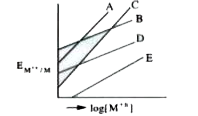
For metal electrodes show the variation in their reduction potential as shown.

Which statement is true ?

A

B can reduct `A^(+n) (1 M)`

B

E can replace `H^(+)` from acids

C

A-D' cell has maximum `E^(@)` among the given

D

C' can reduced the ions of A,B and D

Text Solution

Verified by Experts

The correct Answer is:

B, D

`E^(+) // E , C^(+) // C , D^(+)// D , A^(+) //A , B^(+)// B`
Promotional Banner

Topper's Solved these Questions

  • ELECTROCHEMISTRY

    AAKASH SERIES|Exercise PRACTICE SHEET -5 (MATCH THE FOLLOWING QUESTIONS )|2 Videos
  • ELECTROCHEMISTRY

    AAKASH SERIES|Exercise PRACTICE SHEET -5 (INTEGER ANSWER TYPE QUESTIONS )|6 Videos
  • ELECTROCHEMISTRY

    AAKASH SERIES|Exercise PRACTICE SHEET -5 (LINKED COMPREHENSION TYPE QUESTIONS (PASSAGE-I))|3 Videos
  • DILUTE SOLUTIONS

    AAKASH SERIES|Exercise EXERCISE - 1.2|55 Videos
  • ELEMENTS OF D - BLOCK

    AAKASH SERIES|Exercise EXERCISE - 5.2|33 Videos

Similar Questions

Explore conceptually related problems

For metal electrodes show the variation in their reduction potential as shown. Which is the most reactive metal ?

For metal electrodes show the variation in their reduction potential as shown. Which metal requires maximum voltage for deposition of one mole through electrolysis process ?

Which is true statement ?

Which of the statements is not true?

If phi denotes reduction potential, then which is true ?

Which of the following statement is true ?

Which of the following statement is true ?

Which of the following statements is true ?

Which of the following statements is true ?

Which of the following statements is true ?
