Home
Class 11
CHEMISTRY
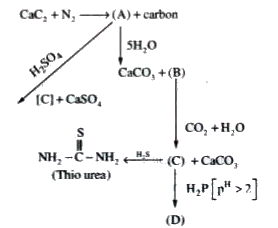
The compound 'C' is used to make urea an...


The compound 'C' is used to make urea and Thio urea.

A

`NH_(2)CN`

B

`NH_(4)CN`

C

`(NH_(4))_(3)PO_(4)`

D

`NH_(4)OH`

Text Solution

Verified by Experts

The correct Answer is:

A

`CaNCN+H_(2)SO_(4)tounderset(C )(NH_(2)CN+CaSO_(4)`
Promotional Banner

Topper's Solved these Questions

  • ALKALINE EARTH METALS

    AAKASH SERIES|Exercise Practice sheet (Level-I(Main))|10 Videos
  • ALKALINE EARTH METALS

    AAKASH SERIES|Exercise Practice sheet (Level-II(Advanced))|26 Videos
  • ALKALINE EARTH METALS

    AAKASH SERIES|Exercise Lecture sheet (Level-I (Main))|10 Videos
  • ALKALI METALS

    AAKASH SERIES|Exercise Questions for descriptive answers|17 Videos
  • AROMATIC HYDROCARBONS

    AAKASH SERIES|Exercise OBJECTIVE EXERCIES - 3 (RECENT AIPMT/NEET QUESTIONS)|10 Videos

Similar Questions

Explore conceptually related problems

At 20^(@)C , the osmotic pressure of urea solution is 400 mm. The solution is diluted and the temperature is raised to 35^(@)C , when the osmotic pressure is found to 105.3 mm. Determine the extent of dilution………

A deuterium compound (A) which is used as a moderator in nuclear reactor reacts with Ca to form compound B. A reacts with SO_2 to give compound C. Upon electrolysis compound A gives deuterium molecule. Identify A, B and C.

How do you make crystallization of urea?

Guanidine (I) and its conjugate acid (II) are given below along with urea(III) and its conjugate base (IV) Basic properties of I & II compounds are mainly influenced by resonance and the acidity of the bases depends upon lone pair of electrons. Urea is mono basic because

Guanidine (I) and its conjugate acid (II) are given below along with urea(III) and its conjugate base (IV) Basic properties of I & II compounds are mainly influenced by resonance and the acidity of the bases depends upon lone pair of electrons. Urea is mono basic because

At 10^@C , the osmotic pressure of urea solution was formed to be 500 mm. The solution is diluted 'x' times and the temperature raised to 25^@C when the osmotic prssure was noticed to be 105.3mm, then 'x' is

Guanidine (I) and its conjugate acid (II) are given below along with urea(III) and its conjugate base (IV) Basic properties of I & II compounds are mainly influenced by resonance and the acidity of the bases depends upon lone pair of electrons. The strongest base of the following is

Guanidine (I) and its conjugate acid (II) are given below along with urea(III) and its conjugate base (IV) Basic properties of I & II compounds are mainly influenced by resonance and the acidity of the bases depends upon lone pair of electrons. Which of the following is more resonance stabilized

Guanidine (I) and its conjugate acid (II) are given below along with urea(III) and its conjugate base (IV) Basic properties of I & II compounds are mainly influenced by resonance and the acidity of the bases depends upon lone pair of electrons. The strongest base of the following is

Guanidine (I) and its conjugate acid (II) are given below along with urea(III) and its conjugate base (IV) Basic properties of I & II compounds are mainly influenced by resonance and the acidity of the bases depends upon lone pair of electrons. Which of the following is more resonance stabilized

AAKASH SERIES-ALKALINE EARTH METALS-Lecture sheet (Level-II (Advanced))
  1. Which salt hydrolyses to a minimum extent

    Text Solution

    |

  2. A doctor by mistake administres a dilute Ba(NO(3)) solution to a patie...

    Text Solution

    |

  3. Consider the following statements (A) Gypsum contains a low percenta...

    Text Solution

    |

  4. Which of the following are correct

    Text Solution

    |

  5. Which following are in correct

    Text Solution

    |

  6. Which of the following are correct

    Text Solution

    |

  7. Which of the following statements are false regarding BeCl(2)

    Text Solution

    |

  8. During setting of plaster of paris which of the following process take...

    Text Solution

    |

  9. 'A' is widely used as slow acting nitrogeneous fertilizer.

    Text Solution

    |

  10. 'B' is a weak basic aqueous NH(3) solution

    Text Solution

    |

  11. The compound 'C' is used to make urea and Thio urea.

    Text Solution

    |

  12. The compound 'D' is used as nitrogeneous fertilizer.

    Text Solution

    |

  13. The compound 'A' on heating gives a colourless gas and a residue. The ...

    Text Solution

    |

  14. The compound 'A' on heating gives a colourless gas and a residue. The ...

    Text Solution

    |

  15. The compound 'A' on heating gives a colourless gas and a residue. The ...

    Text Solution

    |

  16. Match the following columns

    Text Solution

    |

  17. Match the following columns

    Text Solution

    |

  18. The value of 'n' in the molecular formula Be(n) Al(2)Si(6)O(18) is

    Text Solution

    |

  19. When gypsum is heated at 393K, the compound formed is CaSO(4).XH(2)O v...

    Text Solution

    |

  20. How many of the following will turn moist red litmus blue and finally ...

    Text Solution

    |
