Home
Class 11
CHEMISTRY
The first (IP1) and the second (IP2) ion...

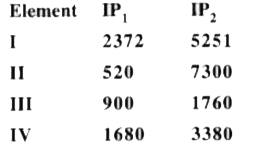
The first `(IP_1)` and the second `(IP_2)` ionisation potential (kJ mol 1) of a few elements designed by roman numerals are shown below

Identify the element which are likely to be a noble gas and a reactive metal respectively

A

I and II

B

II and III

C

I and IV

D

II and IV

Text Solution

Verified by Experts

The correct Answer is:

A
Promotional Banner

Topper's Solved these Questions

  • PERIODIC TABLE

    AAKASH SERIES|Exercise OBJECTIVE EXERCISE -3|30 Videos
  • PERIODIC TABLE

    AAKASH SERIES|Exercise EXERCISE ON PASSAGE|12 Videos
  • PERIODIC TABLE

    AAKASH SERIES|Exercise OBJECTIVE EXERCISE -2A (DIAGONAL RELATIONSHIP)|8 Videos
  • PERIODIC PROPERTIES

    AAKASH SERIES|Exercise LEVEL-II (TYPE -II) (PRACTICE SHEET -3 (SUBJECTIVE/ ANALYTICAL TYPE QUESTIONS ))|8 Videos
  • PURIFICATION OF ORGANIC COMPOUNDS AND IUPAC NOMENCLATURE

    AAKASH SERIES|Exercise ADDITIONAL PRCATICE EXERCISE (LEVEL - II (LECTURE SHEET (ADVANCED) INTEGER TYPE QUESTIONS)|2 Videos

Similar Questions

Explore conceptually related problems

The first (DletaH) and second ionisation enthalipies (DeltaH_(2)) in kJmol^(-1) and the electron gain enthalpy (DeltaHg) in kJmol^(-1) of a few elements are given below: Which element is likely a) the least reactive element c) the most reactive non-metal b) the most reactive metal d) the least reactive non-metal f) the metal which can form a predominantly stable covalent halide of the formula MX.

The first (Delta_iH_1) and the second (Delta_iH_2) ionisation enthalpies in "kJmol"^(-1) and the electron gain enthalpy (Delta_(eg)H) in "kJmol"^(-1) of a few elements are given below: {:("Elements",Delta_iH_1,Delta_iH_2,Delta_(eg)H),("(P)",520,7300,-60),("(Q)",419,3051,-48),("(R)",1681,3374,-328),("(S)",1008,1846,-295),("(T)",2372,5251,+48),("(U)",738,1451,-40):} Which one of the above elements is least reactive?

The minimum amount of energy required to remove the most loosely bound electron from an isolated atom in the gaseous state in known as ionisation energy or ionisation enthalpy (IE_1) of the element. The energy required to remove the second electron from the monovalent cation is called second ionisation enthalpy (IE_2) . Similarly, we have third, fourth ..... inonisation enthalpies. The values of ionisation energy depends on a number of factors such as (i) size of the atom (ii) screening effect (iii) nuclear charge (iv) half filled and fully filled orbitals (v) shape of orbital. In a group, the ionisation energy decreases from top to bottom. In a period, the value of ionisation energy increases from left to right. The first ionisation energy of Mg, Al, P and S follows the order:

The first ionisation potentials of four consecutive elements present in the second period of the periodic table are 8.3, 11.3, 14.5 and 13.6 eV respectively. Which one of the following is the first ionisation potential (in eV) of nitrogen ?

Two elements X and Y belong to Groups 1 and 2 respectively in the same period of the periodic Table .Compare these elements with respect to : their ionisation energy and metallic character .

Numerous forms of the periodic table have been devised from time to time. A modern version which is most convenient and widely used is the long or extended from of periodic table. The aufbau principle and the electronic configuration of atoms provide a theoretical foundation for the periodic classification. The horizontal rows are called periods. There are altogether seven periods. The first period consists of 2 elements. The subsequent periods consists of 8, 8,18, 18 and 32 elements respectively. The seventh period is incomplete and like the sixth period would have maximum of 32 elements. Elements having similar outer electronic configurations in their atoms are grouped in vertical columns. These are referred to as groups or families. According to the recommendations of IUPAC, the groups are numbered 1 to 18 replacing the older notation of groups 0, IA, IIA, ....VIIA, VIII, IB.....VIIB. Each successive period in the periodic table is associated with the filling up next higher principal energy level following aufbau sequence. The number of elements in each period is twice the number of atomic orbitals available in the energy level that is being filled. All the elements are classified into four blocks, i.e., s-block, p-block, d-block, and f-block depending on the type of atomic orbitals that are being filled with electrons. What is the position of the element in the periodic table satisfying the electronic configuration (n-1)d^1 ns^2 for n=4 ?

Numerous forms of the periodic table have been devised from time to time. A modern version which is most convenient and widely used is the long or extended from of periodic table. The aufbau principle and the electronic configuration of atoms provide a theoretical foundation for the periodic classification. The horizontal rows are called periods. There are altogether seven periods. The first period consists of 2 elements. The subsequent periods consists of 8, 8,18, 18 and 32 elements respectively. The seventh period is incomplete and like the sixth period would have maximum of 32 elements. Elements having similar outer electronic configurations in their atoms are grouped in vertical columns. These are referred to as groups or families. According to the recommendations of IUPAC, the groups are numbered 1 to 18 replacing the older notation of groups 0, IA, IIA, ....VIIA, VIII, IB.....VIIB. Each successive period in the periodic table is associated with the filling up next higher principal energy level following aufbau sequence. The number of elements in each period is twice the number of atomic orbitals available in the energy level that is being filled. All the elements are classified into four blocks, i.e., s-block, p-block, d-block, and f-block depending on the type of atomic orbitals that are being filled with electrons. Elements A, B, C, D and E have the following electronic configuration: (A) 1s^2, 2s^2 2p^1 (B) 1s^2, 2s^2 2p^6 , 3s^2 3p^1 (C ) 1s^2, 2s^2 2p^6 , 3s^2 3p^3 (D) 1s^2 , 2s^2 2p^6 , 3s^2 3p^5 (E) 1s^2 , 2s^2 2p^6 , 3s^2 3p^6 Which among these will belong to same group in the periodic table ?

Numerous forms of the periodic table have been devised from time to time. A modern version which is most convenient and widely used is the long or extended from of periodic table. The aufbau principle and the electronic configuration of atoms provide a theoretical foundation for the periodic classification. The horizontal rows are called periods. There are altogether seven periods. The first period consists of 2 elements. The subsequent periods consists of 8, 8,18, 18 and 32 elements respectively. The seventh period is incomplete and like the sixth period would have maximum of 32 elements. Elements having similar outer electronic configurations in their atoms are grouped in vertical columns. These are referred to as groups or families. According to the recommendations of IUPAC, the groups are numbered 1 to 18 replacing the older notation of groups 0, IA, IIA, ....VIIA, VIII, IB.....VIIB. Each successive period in the periodic table is associated with the filling up next higher principal energy level following aufbau sequence. The number of elements in each period is twice the number of atomic orbitals available in the energy level that is being filled. All the elements are classified into four blocks, i.e., s-block, p-block, d-block, and f-block depending on the type of atomic orbitals that are being filled with electrons. An element belongs to group 17 with atomic number is 17. What is the atomic number of the element belonging to same group and present in fifth period?

Redox reactions play a pivotal role I chemistry and bilogy . The values of standard redox potential (E^(@)) of two half - cell reaction decided which way the reaction is expected to proceed. A simple example is a Daniel cell in which zinc goes into solution and copper get deposited. Given below are a set of half 0 cell reactions ( acidic medium ) along with their E^(@) values ( with respect to normal hydrogen electrode ) Using this data : I_2 + 2e^(-) to 2I^(-) E^(@) = 0.54 , Cl_2 + 2e^(-) to 2Cl^(-) " "E=1.36V Mn^(3+) + e^(-) to Mn^(2+) E^(@) = 1.50 , Fe^(3+) + e^(-) to Fe^(2+) E = 0.77V O_2 +4H^(+) + 4e^(-) to 2H_2O" " E^(@) = 1.23 , Among the following , identify the correct statement :

AAKASH SERIES-PERIODIC TABLE-OBJECTIVE EXERCISE -2B
  1. Consider the following changes a) M((g))^(+2) rarr M((g))^(+3) + e^...

    Text Solution

    |

  2. The correct order of IP2 , values among F, Na, Mg and Al is

    Text Solution

    |

  3. The first (IP1) and the second (IP2) ionisation potential (kJ mol 1) o...

    Text Solution

    |

  4. The ionisation energies of Lithium and Sodium are 520kJ Mol^(-1) and 4...

    Text Solution

    |

  5. Successive ionisation potentials of an element M are 8.3, 25.1, 37.9, ...

    Text Solution

    |

  6. The first ionisation potentials of four consecutive elements present i...

    Text Solution

    |

  7. H-H, X-X and H-X bond energies are 104 Kcal/mole 60Kcal/mole and 101Kc...

    Text Solution

    |

  8. The ionisation energy and electron affinity of an element are 13.0ev a...

    Text Solution

    |

  9. If the ionisation energy and electron affinity of an element are 275 a...

    Text Solution

    |

  10. The elements which show both positive and negative oxidation states. i...

    Text Solution

    |

  11. Match the following two lists given below in view of higest oxidation ...

    Text Solution

    |

  12. Strongest reducing agent and strongest oxidising agent are respectivel...

    Text Solution

    |

  13. Which of the following statement is correct

    Text Solution

    |

  14. The radius of La^(3+) (Z=57) is 1.06A^(@). Which one of the following ...

    Text Solution

    |

  15. (A): According to Mendeleeff atomic weight of 'Be' is 9.1 but experime...

    Text Solution

    |

  16. Chloride of an element A gave a neutral solution in water. In the peri...

    Text Solution

    |

  17. Which one of the following relations is correct with respect to first ...

    Text Solution

    |

  18. The incorrect statement among the following is

    Text Solution

    |

  19. The decreasing order of second ionisation potential of K, Ca, Ba is

    Text Solution

    |

  20. For four elements the IP2 curve is shown. In the graph the elements re...

    Text Solution

    |
