Home
Class 11
CHEMISTRY
The diatomic molecule OH exists in the g...

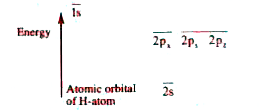
The diatomic molecule OH exists in the gas phase. The energy levels of O and H atoms are shown in the figure. Assume that the molecular axis of OH molecules is z-axis

Predict which of the following is correct about OH molecule

A

The bond order is one

B

It is paramagnetic

C

The `sigma` -bonding molecular orbitals is formed by LCAO of 2s atomic orbital of oxygen and ls atomic orbital of H-atom

D

There is high probability of formation of sigma bonding molecular orbital by LACO of ls atomic orbital of H-atom and 2`p_(z)` atomic orbital of oxygen atom

Text Solution

Verified by Experts

The correct Answer is:

A, B, D
Promotional Banner

Similar Questions

Explore conceptually related problems

The atomic number of an elemtn Z is 9. Which of the following statements about the molecule of Z is correct ?

Which of the following molecular orbital has the lowest energy for O_(2) molecule?

The concept of electronegativity (EN) is mainly to discuss the nature of chemical bonding, EN of an atom is the measure of its capacity to attract the shared electron pair towards itself. Linus Pauling compiled the values of EN that are most widely used, and that are displayed for a few elements in Table - 1. These values are based on bond energy differences between atoms bonded to themselves (e.g. A-A) and to other atoms (e.g. A-B), and an arbitary value of 4 to fluorine (most electronegative element) Mulliken regarded electronegativity as the average value of ionization energy and electron affinity of an atom EN= 1/2 (IE+EA). Both IE and EA are expressed in electron volts. In the Table-2, values of IE and EA for several elements are listed Table-3 shows the values of dipole moments and bond energies for simple molecules. Based upon the electronegativity difference of bonded atoms, which of the following about the chemical bond?

The dissolution of ammonia gas in water does not obey Henry. s law. On dissolving , a major portion of ammonia molecules unite with H_2O to form NH_4 OH molecules . A portion of the latter again dissociates into NH_4^(+) and OH ^(-) ions. In solution therefore , we have NH_3 molecules, NH_4OH molecules and NH_4^(+) ions and the following equilibrium exist : NH_(3(g) ) (pressure P and concentration c) hArr NH_(3(i)) +H_2O hArr NH_4 OH hArr NH_4^(+) +OH^(-) Let c_1 mol//L of NH_3 pass in liquid state which on dissolution in water forms c_2 mol/ L of NH_4 OH. The solution contains c_3 mol/L of NH_4^(+) ions. The dissociation constant of NH_4 OH can be given as :

The potential energy (U) between two atoms in a diatomic molecule as a function of the distance x between atoms has been shown in the adjoining figure. The atoms are

The necessary condition for a molecule to exhibit optical isomerism is dissymmetry or chiral. Thus all organic compounds which contain one as symetric carbon atom are chiral and exist in two stereoisomers. Although the two forms have the same structure, they have different arrangements of groups about the as symmetric carbon. In fact, they represent as symetric molecules. They do not have a plane of symmetry. They are related to each other as an object to its mirror image and are non superimposable. The two structures actually stand for dextro or (+) and leavo or (-) isomers. Since they are related each other as mirror images, they are commonly called enantiomers. Which of the following statements is correct regarding compounds I to III
