A pipe is shown in figure.
At point B of left end of pipe Fluid speed `=v_(1)`
Cross sectional area `=A_(1)`.
Pressure exerted on fluid `P_(1)=(F_(1))/(A_(1))`.
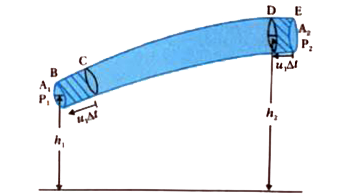
At point D , of right end of pipe ,
Fluid speed `=v_(2)`
Cross esctional area `=A_(2)`
Pressure exerted on the fluid `P_(2)=(F_(2))/(A_(2))`.
Force `F_(1)=P_(1)A_(1)` exerted on fluid at point B, covers distance `v_(1)Deltat` and reaches at point C. the work done on fluid
`W_(1)=` (Force)(displacement)
`W_(1)=P_(1)A_(1)v_(1)Deltat`
`thereforeW_(1)=P_(1)(DeltaV_(1))` ....(1)
where `DeltaV=A_(1)v_(1)Deltat=` volume of fluid)
Fluid at point d, covers distance `v_(2)Deltat` and reaches at point E, the work done by the fluid.
`W_(2)=-P_(2)A_(2)v_(2)Deltat`
`thereforeW_(2)=-P_(2)DeltaV` ....(2)
where `DeltaV=A_(2)v_(2)Deltat`= volume of fluid)
According to equation of continuity both fluids have same volume.
Total work done on the fluid
`W=W_(1)+W_(2)`
`W=P_(1)DeltaV-P_(2)DeltaV`
`W=(P_(1)-P_(2))DeltaV` ....(3)
Part of this work goes into changing the kinetic energy of the fluid and part goes into changing the gravitational potential energy.
`W=DeltaK+DeltaU` .... (4)
The mass flowing fluid of density `rho` at time `Deltat`.
`Deltam="Volume"xx"Density"`
`Deltam=rho(DeltaV)` ...(5)
This liquid when moves from B to D its velocity becomes `v_(1)` to `v_(2)` . Hence change in its kinetic energy
`DeltaK=(1)/(2)m(v_(2)^(2)-v_(1)^(2))`
`DeltaK=(1)/(2)rhoDeltaV(v_(2)^(2)-v_(1)^(2))` .....(6)
When fluid of mass `Deltam` move from B to D , it posses height from `h_(1)` to `h_(2)(h_(2)gth_(1))` . Hence its potential energy is botained as below
`DeltaU=mg(h_(2))-mg(h_(1))`
`DeltaU=mg(h_(2)-h_(1))`
`DeltaU=(rhoDeltaV)g(h_(2)-h_(1))` ....(7)
The values of W , `DeltaK,DeltaU` in equation (4) from equation (3),(6),(7)
`(P_(1)-P_(2))DeltaV=(1)/(2)rhoDeltaV(v_(2)^(2)-v_(1)^(2))+(rhoDeltaV)g(h_(2)-h_(1))`
Dividing each by `DeltaV`
`P_(1)-P_(2)=(1)/(2)rho(v_(2)^(2)-v_(1)^(2))+rhogh_(2)-h_(1))`
`thereforeP_(1)-P_(2)=(1)/(2)rhov_(2)^(2)-(1)/(2)rhov_(1)^(2)+rhogh_(2)-rhogh_(1)`
`thereforeP_(1)+(1)/(2)rho_(1)^(2)+rhogh_(1)=P_(2)+(1)/(2)rhov_(2)^(2)+rhogh_(2)` ....(8)
Equation (8) is called Bernoulli.s equation In general
`P+(1)/(2)rhov^(2)+rhogh=` constant ....(9)
In words the Bernoulli.s equation may be stated as follows :
As moving along a streamline the sum of the pressure (P) , the kinetic energy per unit volume
`((1)/(2)rhov^(2))` and the potential energy per unit volume `(rhogh)` remains a constant.


