When a container open to atmmosphere , obtain the velocity of liquid coming out of the narrow hole from the wall of container by using Bernoulli's equation and obtain Torricelli's law
When a container open to atmmosphere , obtain the velocity of liquid coming out of the narrow hole from the wall of container by using Bernoulli's equation and obtain Torricelli's law
Text Solution
Verified by Experts
Torricelli.s discovered that speed of efflux from an open tank is given by a formula identical to that of a freely falling body .
Consider a tank containing a liquid of density `rho` with a small hole in its side at a height `y_(1)` from the bottom . the air above the liquid , whose surface is at height `y_(2)` is at pressure P.
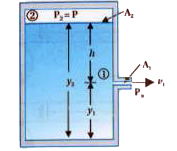
The velocities `v_(1)andv_(2)` are at point 1 and 2 respectively.
Using equation of continuity for points 1 and 2,
`A_(1)v_(1)=A_(2)v_(2)`
`v_(2)=(A_(1)v_(1))/(A_(2))` ..... (1)
`A_(2)` is the cross sectional area of the tank and
`A_(1)` is the cross sectional area of the hole
`A_(2)gtgtA_(1)` hence
`v_(2)ltltv_(1)thereforev_(2)=0`.
Using Bernoulli.s equation at 1 and 2
`P_(1)+(1)/(2)rhov_(1)^(2)+rhogy_(1)=P_(2)+(1)/(2)rhov_(2)^(2)+rhogy_(2)`
Here `P_(1)=` atmospheric pressure `P_(a)`
`P_(2)=P`
`v_(2)=0`
`P_(a)+(1)/(2)rhov_(1)^(2)+rhogy_(1)=P+rhogy_(2)`
`therefore(1)/(2)rhov_(1)^(2)=(P-P_(a))+rhog(y_(2)-y_(1))`
Taking h as the difference in height `=y_(2)-y_(1)(1)/(2)rhov_(1)^(2)=(P-P_(a))+rhogh`
`v_(1)=sqrt(2gh+(2(P-P_(a)))/(rho))` .... (2)
Special Cases : `(1)PgtgtP_(a),2gh` is neglecting with the value of `(P-P_(a))`.
`thereforev_(1)=sqrt((2(P-P_(a)))/(rho))` ....(3)
Hence , the speed of efflux determined only by the pressure of container . Such a situation occurs in rocket propulsion where efflux means coming out liquid.
(2) If the tank is open to atmosphere , then
`P=P_(a)` and equation (2) becomes as below.
`v_(1)=sqrt(2gh)` .... (4)
This is the speed of a freely falling body . This equation is known as Torricelli.s law.
Consider a tank containing a liquid of density `rho` with a small hole in its side at a height `y_(1)` from the bottom . the air above the liquid , whose surface is at height `y_(2)` is at pressure P.
The velocities `v_(1)andv_(2)` are at point 1 and 2 respectively.
Using equation of continuity for points 1 and 2,
`A_(1)v_(1)=A_(2)v_(2)`
`v_(2)=(A_(1)v_(1))/(A_(2))` ..... (1)
`A_(2)` is the cross sectional area of the tank and
`A_(1)` is the cross sectional area of the hole
`A_(2)gtgtA_(1)` hence
`v_(2)ltltv_(1)thereforev_(2)=0`.
Using Bernoulli.s equation at 1 and 2
`P_(1)+(1)/(2)rhov_(1)^(2)+rhogy_(1)=P_(2)+(1)/(2)rhov_(2)^(2)+rhogy_(2)`
Here `P_(1)=` atmospheric pressure `P_(a)`
`P_(2)=P`
`v_(2)=0`
`P_(a)+(1)/(2)rhov_(1)^(2)+rhogy_(1)=P+rhogy_(2)`
`therefore(1)/(2)rhov_(1)^(2)=(P-P_(a))+rhog(y_(2)-y_(1))`
Taking h as the difference in height `=y_(2)-y_(1)(1)/(2)rhov_(1)^(2)=(P-P_(a))+rhogh`
`v_(1)=sqrt(2gh+(2(P-P_(a)))/(rho))` .... (2)
Special Cases : `(1)PgtgtP_(a),2gh` is neglecting with the value of `(P-P_(a))`.
`thereforev_(1)=sqrt((2(P-P_(a)))/(rho))` ....(3)
Hence , the speed of efflux determined only by the pressure of container . Such a situation occurs in rocket propulsion where efflux means coming out liquid.
(2) If the tank is open to atmosphere , then
`P=P_(a)` and equation (2) becomes as below.
`v_(1)=sqrt(2gh)` .... (4)
This is the speed of a freely falling body . This equation is known as Torricelli.s law.



Topper's Solved these Questions
MECHANICAL PROPERTIES OF FLUIDS
KUMAR PRAKASHAN|Exercise SECTION-A Try Yourself (VSQs)|132 VideosMECHANICAL PROPERTIES OF FLUIDS
KUMAR PRAKASHAN|Exercise SECTION - B Numericals|29 VideosMACHANICAL PROPERTIES OF SOLIDS
KUMAR PRAKASHAN|Exercise QUESTION PAPER|11 VideosMOTION IN A STRAIGHT LINE
KUMAR PRAKASHAN|Exercise QUESTION PAPER|11 Videos
Similar Questions
Explore conceptually related problems
A spray gun is shown in the figure where a piston pushes air out of a nozzle. A thin tube of uniform cross section is connected to the nozzle. The other end of the tube is in a small liquid container. As the piston pushes air through the nozzle, the liquid from the container rises into the nozzle and is sprayed out. For the spray gun shown, the radii of the piston and the nozzle are 20mm and 1mm respectively. The upper end of the container is open to the atmosphere. If the density of air is rho_a , and that of the liquid rho_l , then for a given piston speed the rate (volume per unit time) at which the liquid is sprayed will be proportional to
A spray gun is shown in the figure where a piston pushes air out of a nozzle. A thin tube of uniform cross section is connected to the nozzle. The other end of the tube is in a small liquid container. As the piston pushes air through the nozzle, the liquid from the container rises into the nozzle and is sprayed out. For the spray gun shown, the radii of the piston and the nozzle are 20mm and 1mm respectively. The upper end of the container is open to the atmosphere. If the piston is pushed at a speed of 5mms^-1 , the air comes out of the nozzle with a speed of
There are two identical small holes on the opposite sides of a tank containing a liquid. The tank is open at the top. The difference in height between the two holes is h . As the liquid comes out of the two holes. The tank will experience a net horizontal force proportional to. .
A container of large uniform cross-sectional area A resting on a horizontal surface, holes two immiscible, non-viscon and incompressible liquids of densities d and 2d each of height H//2 as shown in the figure. The lower density liquid is open to the atmosphere having pressure P_(0) . A homogeneous solid cylinder of length L(LltH//2) and cross-sectional area A//5 is immeresed such that it floats with its axis vertical at the liquid-liquid interface with length L//4 in the denser liquid, The cylinder is then removed and the original arrangement is restroed. a tiny hole of area s(sltltA) is punched on the vertical side of the container at a height h(hltH//2) . As a result of this, liquid starts flowing out of the hole with a range x on the horizontal surface. The total pressure with cylinder, at the bottom of the container is
Shown in the figure is a container whose top and bottom diameters are D and d respectively At the bottom of the container these is a cappillary tube of outer radius b and inner radius a. the volume flow rate in the capillary is Q. if the capillary is removed the liquid comes out with a velocity of v_(0) . The density of the liquid is given as calculate the coefficient of viscosity eta (given pia^(2)=10^(-6)m^(2) and (a^(2))/(l)=2xx10^(-6)m ]
Each phase of a material can exits only in certain regions of pressure and temperature . P-T phase diagrams, in which pressure is plotted versus temperature, show the regions corresponding to various phases and phase transformations . P-V diagrams, on the other hand , can be used to study pressure volume relationship at a constant temperature. If the liquid and gaseous phases of a pure substances are heated together in a closed container, both the temperature and the vapor pressure will increase until a point is reached at which the two phases can no longer be distinguished from one another. The temperature and pressure at which this occurs are called the critical temperature and pressure. Exceeding either of these parameters, by itself ,will cause the "gas"//"liguid" phase transition to disappear. if the other variable is then changed as well, while the first variable is maintained above its critical point , a gradual transition will occur between the gaseous and liquid phases, with no clear boundary.(The liquid and solid phases, on the other hand , maintain a distinct boundary at all pressure above the triple point). Shown in figure is a combined P-T phase diagram for material A and B . If heat is added to solids A and B , each in a container that is open to the atmosphere :-
A cylindrical container of radius 'R' and height 'h' is completely filled with a liquid. Two horizontal L -shaped pipes of small cross-sectional area 'a' are connected to the cylinder as shown in the figure. Now the two pipes are opened and fluid starts coming out of the pipes horizontally in opposite directions. Then the torque due to ejected liquid on the system is
A large open top container of negligible mass and uniform cross sectional area A a has a small hole of cross sectional area A//100 in its side wall near the bottom. The container is kept on a smooth horizontal floor and contains a liquid of density rho and mass M_(0) . Assuming that the liquid starts flowing out horizontally through the hole at t=0 , calculate a the acceleration of the container and b its velocity when 75% of the liquid has drained out.
An aeroplane is flyind horizontally at a height of 2 km and with a velocity of 720 km/h. A bag containing ration is to be dropped to the Jawans on the ground then find out (i) How far from the Jawans should the bag be released so that it falls directly over them (ii) Time taken by bag to reach the ground (iii) Velocity of bag when it reach the ground. (iv) At which angle the bag will reaches the ground. (v) What path of bag will be appeared to pilot (vi) What path of bag will be appeared to Jawans. (vii) Position of aeroplane when bag reaches to the Jawans. (g=10m//s^(2))
KUMAR PRAKASHAN-MECHANICAL PROPERTIES OF FLUIDS -QUESTION PAPER (SECTION -C)
- When a container open to atmmosphere , obtain the velocity of liquid c...
Text Solution
|
- Glycerine flows steadily through a horizontal tube of length 1.5m and ...
Text Solution
|
- A U- tube contains water and methlated spirit separated by mercury . ...
Text Solution
|
- What is the excess pressure inside a bubble of soap solution of radius...
Text Solution
|