Home
Class 11
PHYSICS
Explain velocity gradient and coefficien...

Explain velocity gradient and coefficient of viscous and gives their units.

Text Solution

Verified by Experts
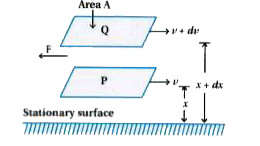
Let laminar floe on a horizontal surface as shown in figure


Suppose two layer P and Q at distance x and x+dx from stationary surface.
The velocity difference dv between two layers separated by distance dx.
`(dv)/(dx)` is know as velocity gradient.
Velocity gradient : The difference in velocity between adjacent layers of the fluid is known as a velocity gradient.
Viscous force between two layers depend on following factors .
(1) Depends on the area (A) of two contact surface .
`FpropA` ..... (1)
(2) Velocity gradient between two layers `(dv)/(dx)`
`Fprop(dv)/(dx)` ......(2)
`thereforeFpropA(dv)/(dx)`....(3)
`thereforeF=-etaA(dv)/(dx)` .....(4)
Here `eta` is known as coefficient of viscosity .Its magnitude depend on the kind of fluid and on temperature.
Negative sing indicates viscosity force , is opposite to the velocity of layers of fluid.
As the temperature increase in liquid `eta` will be decrease while in gas it increases.
In equation (4), A=1 unit, `(dv)/(dx)=-1` then `F=eta`.
Definition of coefficient of viscosity :
The viscous force acting per unit surface area of contact and per unit velocity gradient between two adjacent layers in a laminar flow is known as the coefficient of viscosity .
Unit of coefficient of viscosity :
(1) CGS unit of viscosity is dyne `scm^(-2)`
or `gcm^(-1)s^(-1)`. It is called poise. `P_(a)*S`
MKS unit of viscosity is `Nsm^(-2)` or `kgm^(-1)s^(-1)`. It is called decapoise or poisenile.
1 poisenille `(pl)=Nsm^(-2)`
`=(10^(5)"dyne")sxx(10^(2)cm)^(-2)`
`=10" dyne"*s*cm^(-2)`
=10 poise.
(3) Dimensional formula `:[M^(1)L^(-1)T^(-1)]`
Promotional Banner

Topper's Solved these Questions

  • MECHANICAL PROPERTIES OF FLUIDS

    KUMAR PRAKASHAN|Exercise SECTION-A Try Yourself (VSQs)|132 Videos
  • MECHANICAL PROPERTIES OF FLUIDS

    KUMAR PRAKASHAN|Exercise SECTION - B Numericals|29 Videos
  • MACHANICAL PROPERTIES OF SOLIDS

    KUMAR PRAKASHAN|Exercise QUESTION PAPER|11 Videos
  • MOTION IN A STRAIGHT LINE

    KUMAR PRAKASHAN|Exercise QUESTION PAPER|11 Videos

Similar Questions

Explore conceptually related problems

Write SI and CGS unit of coefficient of viscosity .

Write unit of coefficient of static friction.

Give the dimensional formula of coefficient of viscosity .

What is strain ? Give its units.

Define electric potential and explain it. Write its SI unit and give its other units.

Give definition of magnetic field and give its unit.

A cubical block of side a and density rho slides over a fixed inclined plane with constant velocity v . There is a thin film of viscous fluid of thickness t between the plane and the block. Then the coefficient of viscosity of the thin film will be: (Acceleration due to gravity is g)

What is volume expansion ? Give definition and unit of coefficient of volume expansion.

A small steel ball of mass m and radius r is falling under gravity through a viscous liquid of coefficient of viscosity eta . If g is the value of acceleration due to gravity. Then the terminal velocity of the ball is proportional to (ignore buoyancy)

