State stokes'law .By using it deduce the expression for :
(i) Initial acceleration of smooth sphere and
(ii) Equation of terminal velocity of sphere falling freely through the viscous medium.
(iii) Explain : Upward motion of bubbles produced in fluid.
State stokes'law .By using it deduce the expression for :
(i) Initial acceleration of smooth sphere and
(ii) Equation of terminal velocity of sphere falling freely through the viscous medium.
(iii) Explain : Upward motion of bubbles produced in fluid.
(i) Initial acceleration of smooth sphere and
(ii) Equation of terminal velocity of sphere falling freely through the viscous medium.
(iii) Explain : Upward motion of bubbles produced in fluid.
Text Solution
Verified by Experts
Scientist Stokes. said that , viscous force `F_(V)` on small spherical solid body of radius r and moving with velocity v through a viscous medium of large dimensions having coefficient of viscosity `eta` is `6pietarv`.
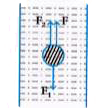
As shown in figure a small spherical body of radius r, density `rho` falling in viscous medium of density `sigma`.
Following forces acted on it .
(i) Weight `F_(1)=mg=("volume"xx"density")g`
`=((4)/(3)pir^(3)rho))g`...(1) (In downward)
Where m = mass of spehre
(ii) Buoyant force `F_(2)=m_(o)g`
`=((4)/(3)pir^(3)sigma)g=`(2) (in upward)
where `m_(0)` = mass of liquid having volume of sphere
(iii) According to stokes.law
`F_(v)=6pietarv` ...(3)
Resultant force acting on the sphere,
`F_(R)=F_(1)-F_(2)-F_((v))`
`F_(R)=((4)/(3)pir^(3)rho)g-((4)/(3)pir^(3)sigma))g-6pietarv`
`F_(R)=(4)/(3)pir^(3)g(rho-sigma)-6pietarv` ...(4)
(i) Equation of initial acceleration
If mass of sphere is m and initial acceleration `a_(0)` then
`F_(R)=ma_(0)=(4)/(3)pi^(3)rhoa_(0)`
From equation (4),
`((4)/(3)pir^(3)rho)a_(0)=(4)/(3)pir^(3)g(rho-sigma)-6pietarv`
Taking initial velocity of freely falling sphere v=0
`((4)/(3)pir^(3)rho)a_(0)=(4)/(3)pir^(3)g(rho-sigma)`
`thereforerho(a_(0))=g(rho-sigma)`
`thereforea_(0)=((rho-sigma)g)/(rho)` ...(5)
(ii) Terminal velocity :
As the time passes velocity of sphere will increase hence in equation (3), the force `6pietarv` wil increase and resultant force `F_(R)` decreases.
For any one velocity of spehere `F_(R)` becomes zero and hence according to Newton first law , spehre moves with constant velocity . This constant velocity is known as final or terminal velocity `v_(t)` of sphere.
In equation (4) `v=v_(t)andF_(R)=0`,
`therefore(6pietar)v_(t)=(4)/(3)pir^(3)g(rho-sigma)`
`thereforev_(t)=(2)/(9)(r^(2)g(rho-sigma))/(eta)` ...(6)
Hence terminal velocity of small sphere in viscous medium `v_(t)`
(i) Proportional to the square radius of sphere `v_(t)propr^(2)`
(ii) Proportional to the difference of densities of sphere and fluid.
`v_(t)prop(rho-sigma)`
(iii) Inversely proportional to the coefficients of viscosity of fluid `v_(t)prop(1)/(eta)`.
(iv) Upward motion of bubbles produced in fluid :
The denisty `(rho)` of air bubble produced in the fluid is less then the density of fluid `(sigma)` .Hence `(rholtsigma)`, so terminal velocity is negative and hence bubble would travel in upward direction.
As shown in figure a small spherical body of radius r, density `rho` falling in viscous medium of density `sigma`.
Following forces acted on it .
(i) Weight `F_(1)=mg=("volume"xx"density")g`
`=((4)/(3)pir^(3)rho))g`...(1) (In downward)
Where m = mass of spehre
(ii) Buoyant force `F_(2)=m_(o)g`
`=((4)/(3)pir^(3)sigma)g=`(2) (in upward)
where `m_(0)` = mass of liquid having volume of sphere
(iii) According to stokes.law
`F_(v)=6pietarv` ...(3)
Resultant force acting on the sphere,
`F_(R)=F_(1)-F_(2)-F_((v))`
`F_(R)=((4)/(3)pir^(3)rho)g-((4)/(3)pir^(3)sigma))g-6pietarv`
`F_(R)=(4)/(3)pir^(3)g(rho-sigma)-6pietarv` ...(4)
(i) Equation of initial acceleration
If mass of sphere is m and initial acceleration `a_(0)` then
`F_(R)=ma_(0)=(4)/(3)pi^(3)rhoa_(0)`
From equation (4),
`((4)/(3)pir^(3)rho)a_(0)=(4)/(3)pir^(3)g(rho-sigma)-6pietarv`
Taking initial velocity of freely falling sphere v=0
`((4)/(3)pir^(3)rho)a_(0)=(4)/(3)pir^(3)g(rho-sigma)`
`thereforerho(a_(0))=g(rho-sigma)`
`thereforea_(0)=((rho-sigma)g)/(rho)` ...(5)
(ii) Terminal velocity :
As the time passes velocity of sphere will increase hence in equation (3), the force `6pietarv` wil increase and resultant force `F_(R)` decreases.
For any one velocity of spehere `F_(R)` becomes zero and hence according to Newton first law , spehre moves with constant velocity . This constant velocity is known as final or terminal velocity `v_(t)` of sphere.
In equation (4) `v=v_(t)andF_(R)=0`,
`therefore(6pietar)v_(t)=(4)/(3)pir^(3)g(rho-sigma)`
`thereforev_(t)=(2)/(9)(r^(2)g(rho-sigma))/(eta)` ...(6)
Hence terminal velocity of small sphere in viscous medium `v_(t)`
(i) Proportional to the square radius of sphere `v_(t)propr^(2)`
(ii) Proportional to the difference of densities of sphere and fluid.
`v_(t)prop(rho-sigma)`
(iii) Inversely proportional to the coefficients of viscosity of fluid `v_(t)prop(1)/(eta)`.
(iv) Upward motion of bubbles produced in fluid :
The denisty `(rho)` of air bubble produced in the fluid is less then the density of fluid `(sigma)` .Hence `(rholtsigma)`, so terminal velocity is negative and hence bubble would travel in upward direction.



Topper's Solved these Questions
MECHANICAL PROPERTIES OF FLUIDS
KUMAR PRAKASHAN|Exercise SECTION-A Try Yourself (VSQs)|132 VideosMECHANICAL PROPERTIES OF FLUIDS
KUMAR PRAKASHAN|Exercise SECTION - B Numericals|29 VideosMACHANICAL PROPERTIES OF SOLIDS
KUMAR PRAKASHAN|Exercise QUESTION PAPER|11 VideosMOTION IN A STRAIGHT LINE
KUMAR PRAKASHAN|Exercise QUESTION PAPER|11 Videos
Similar Questions
Explore conceptually related problems
Write the formula of initial acceleration of sphere falling in a viscous medium and derive the formula of its terminal velocity from it .
A player throwsa a ball upwards with an initial speed of 29.4 ms^(-1) . (i) What is the direction of acceleration during the upwared motion of the ball? (ii) What are the velocity and acceleration of the ball at the highest point of its motion? (iii) Choose the x=0 and t=0 to be the location and time of the ball at its highest point, vertically downward direction to be the positive direction of X-axis, and give the signs of positive, velocity and acceleration of the ball during its upward, and downward motion. (iv) To what height does the ball rise and after how long does the ball return to the player's hand?( Take g =9.8 ms^(-2) , and neglect air resistance).
When an object moves through a fluid, as when a ball falls through air or a glass sphere falls through water te fluid exerts a viscous foce F on the object this force tends to slow the object for a small sphere of radius r moving is given by stoke's law, F_(w)=6pietarv . in this formula eta in the coefficient of viscosity of the fluid which is the proportionality constant that determines how much tangential force is required to move a fluid layer at a constant speed v, when the layer has an area A and is located a perpendicular distance z from and immobile surface. the magnitude of the force is given by F=etaAv//z . For a viscous fluid to move from location 2 to location 1 along 2 must exceed that at location 1, poiseuilles's law given the volumes flow rate Q that results from such a pressure difference P_(2)-P_(1) . The flow rate of expressed by the formula Q=(piR^(4)(P_(2)-P_(1)))/(8etaL) poiseuille's law remains valid as long as the fluid flow is laminar. For a sfficiently high speed however the flow becomes turbulent flow is laminar as long as the reynolds number is less than approximately 2000. This number is given by the formula R_(e)=(2overline(v)rhoR)/(eta) In which overline(v) is the average speed rho is the density eta is the coefficient of viscosity of the fluid and R is the radius of the pipe. Take the density of water to be rho=1000kg//m^(3) Q. What is the viscous force on a glass sphere of radius r=1mm falling through water (eta=1xx10^(-3)Pa-s) when the sphere has speed of 3m/s?
When an object moves through a fluid, as when a ball falls through air or a glass sphere falls through water te fluid exerts a viscous foce F on the object this force tends to slow the object for a small sphere of radius r moving is given by stoke's law, F_(w)=6pietarv . in this formula eta in the coefficient of viscosity of the fluid which is the proportionality constant that determines how much tangential force is required to move a fluid layer at a constant speed v, when the layer has an area A and is located a perpendicular distance z from and immobile surface. the magnitude of the force is given by F=etaAv//z . For a viscous fluid to move from location 2 to location 1 along 2 must exceed that at location 1, poiseuilles's law given the volumes flow rate Q that results from such a pressure difference P_(2)-P_(1) . The flow rate of expressed by the formula Q=(piR^(4)(P_(2)-P_(1)))/(8etaL) poiseuille's law remains valid as long as the fluid flow is laminar. For a sfficiently high speed however the flow becomes turbulent flow is laminar as long as the reynolds number is less than approximately 2000. This number is given by the formula R_(e)=(2overline(v)rhoR)/(eta) In which overline(v) is the average speed rho is the density eta is the coefficient of viscosity of the fluid and R is the radius of the pipe. Take the density of water to be rho=1000kg//m^(3) Q. If the sphere in previous question has mass of 1xx10^(-5)kg what is its terminal velocity when falling through water? (eta=1xx10^(-3)Pa-s)
When an object moves through a fluid, as when a ball falls through air or a glass sphere falls through water te fluid exerts a viscous foce F on the object this force tends to slow the object for a small sphere of radius r moving is given by stoke's law, F_(w)=6pietarv . in this formula eta in the coefficient of viscosity of the fluid which is the proportionality constant that determines how much tangential force is required to move a fluid layer at a constant speed v, when the layer has an area A and is located a perpendicular distance z from and immobile surface. the magnitude of the force is given by F=etaAv//z . For a viscous fluid to move from location 2 to location 1 along 2 must exceed that at location 1, poiseuilles's law given the volumes flow rate Q that results from such a pressure difference P_(2)-P_(1) . The flow rate of expressed by the formula Q=(piR^(4)(P_(2)-P_(1)))/(8etaL) poiseuille's law remains valid as long as the fluid flow is laminar. For a sfficiently high speed however the flow becomes turbulent flow is laminar as long as the reynolds number is less than approximately 2000. This number is given by the formula R_(e)=(2overline(v)rhoR)/(eta) In which overline(v) is the average speed rho is the density eta is the coefficient of viscosity of the fluid and R is the radius of the pipe. Take the density of water to be rho=1000kg//m^(3) Q. Calculate the highest average speed that blood (rho~~1000kg//m^(3) ) could have and still remain in laminar flow when it flows through the arorta (R=8xx10^(-3)m ) Take the coeffiicient of viscosity of blood to be 4xx10^(-3)Pa-s
When an object moves through a fluid, as when a ball falls through air or a glass sphere falls through water te fluid exerts a viscous foce F on the object this force tends to slow the object for a small sphere of radius r moving is given by stoke's law, F_(w)=6pietarv . in this formula eta in the coefficient of viscosity of the fluid which is the proportionality constant that determines how much tangential force is required to move a fluid layer at a constant speed v, when the layer has an area A and is located a perpendicular distance z from and immobile surface. the magnitude of the force is given by F=etaAv//z . For a viscous fluid to move from location 2 to location 1 along 2 must exceed that at location 1, poiseuilles's law given the volumes flow rate Q that results from such a pressure difference P_(2)-P_(1) . The flow rate of expressed by the formula Q=(piR^(4)(P_(2)-P_(1)))/(8etaL) poiseuille's law remains valid as long as the fluid flow is laminar. For a sfficiently high speed however the flow becomes turbulent flow is laminar as long as the reynolds number is less than approximately 2000. This number is given by the formula R_(e)=(2overline(v)rhoR)/(eta) In which overline(v) is the average speed rho is the density eta is the coefficient of viscosity of the fluid and R is the radius of the pipe. Take the density of water to be rho=1000kg//m^(3) Q. Blood vessel is 0.10 m in length and has a radius of 1.5xx10^(-2) m blood flows at rate of 10^(-7)m^(3)//s through this vessel. The pressure difference that must be maintained in this flow between the two ends of the vessel is 20 Pa what is the viscosity sufficient of blood?
When an object moves through a fluid, as when a ball falls through air or a glass sphere falls through water te fluid exerts a viscous foce F on the object this force tends to slow the object for a small sphere of radius r moving is given by stoke's law, F_(w)=6pietarv . in this formula eta in the coefficient of viscosity of the fluid which is the proportionality constant that determines how much tangential force is required to move a fluid layer at a constant speed v, when the layer has an area A and is located a perpendicular distance z from and immobile surface. the magnitude of the force is given by F=etaAv//z . For a viscous fluid to move from location 2 to location 1 along 2 must exceed that at location 1, poiseuilles's law given the volumes flow rate Q that results from such a pressure difference P_(2)-P_(1) . The flow rate of expressed by the formula Q=(piR^(4)(P_(2)-P_(1)))/(8etaL) poiseuille's law remains valid as long as the fluid flow is laminar. For a sfficiently high speed however the flow becomes turbulent flow is laminar as long as the reynolds number is less than approximately 2000. This number is given by the formula R_(e)=(2overline(v)rhoR)/(eta) In which overline(v) is the average speed rho is the density eta is the coefficient of viscosity of the fluid and R is the radius of the pipe. Take the density of water to be rho=1000kg//m^(3) Q. Which of the following may be concluded from the information in the passage?
KUMAR PRAKASHAN-MECHANICAL PROPERTIES OF FLUIDS -QUESTION PAPER (SECTION -C)
- State stokes'law .By using it deduce the expression for : (i) Initi...
Text Solution
|
- Glycerine flows steadily through a horizontal tube of length 1.5m and ...
Text Solution
|
- A U- tube contains water and methlated spirit separated by mercury . ...
Text Solution
|
- What is the excess pressure inside a bubble of soap solution of radius...
Text Solution
|