Home
Class 11
PHYSICS
Two mercury droplets of radii 0.1 cm . A...

Two mercury droplets of radii 0.1 cm . And 0.2 cm . Collapse into one single drop .What amount of energy is released ? The surface tension of mercury `T=435.5xx10^(-3)Nm^(-1)`

Text Solution

Verified by Experts
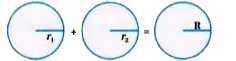

`r_(1)=0.1cm=10^(-3)m`
`r_(2)=0.2cm=2xx10^(-3)m`
Surface tension `S=435.5xx10^(-3)N//m`
Suppose radius of larger drop is R.
Volume of large drop =Volume of two small drops
`therefore(4)/(3)piR^(3)=(4)/(3)pir_(1)^(3)+(4)/(3)pir_(2)^(3)`
`thereforeR^(3)=r_(1)^(3)+r_(2)^(3)`
`R^(3)=(0.1)^(3)+(0.2)^(3)`
`=(0.001)+(0.008)`
`=0.009`
`thereforeR=0.21cm=2.1xx10^(-3)cm`
Change in area,
`DeltaA=` (surface area of large drop)-(surface area of two small drops)
`DeltaA=4piR^(2)-(4pir_(1)^(2)+4pir_(2)^(2))`
`=4pi[R^(2)=(r_(1)^(2)+r_(2)^(2))]`
`therefore` The energy increased `DeltaU=W=SDeltaA`
`thereforeDeltaU=S(4pi)[R^(2)-(r_(1)^(2)-r_(2)^(2))]`
`DeltaU=435.5xx4xx3.14[(2.1xx10^(-32))-(1xx10^(-6)+4xx10^(-6))]`
`=435.5xx4xx3.14(4.41-5)xx10^(-6)xx10^(-3)`
`=-32.23xx10^(-7)`
Negative sign indicates energy is absorbed Hence , energy absorbed is `3.22xx10^(-6)J`. Hence same amount of energy increases.
Promotional Banner

Topper's Solved these Questions

  • MECHANICAL PROPERTIES OF FLUIDS

    KUMAR PRAKASHAN|Exercise SECTION - (D NCERT Exemplar Solution) (Long Answer Type Questions|3 Videos
  • MECHANICAL PROPERTIES OF FLUIDS

    KUMAR PRAKASHAN|Exercise SECTION - E (MCQS)|27 Videos
  • MECHANICAL PROPERTIES OF FLUIDS

    KUMAR PRAKASHAN|Exercise SECTION - (D NCERT Exemplar Solution) (Very Short Answer Type Questions|6 Videos
  • MACHANICAL PROPERTIES OF SOLIDS

    KUMAR PRAKASHAN|Exercise QUESTION PAPER|11 Videos
  • MOTION IN A STRAIGHT LINE

    KUMAR PRAKASHAN|Exercise QUESTION PAPER|11 Videos

Similar Questions

Explore conceptually related problems

Two mercury drops (each of radius r) merge to form a bigger drop. The surface energy of the bigger drop, if T is the surface tension is

Work done in splitting a drop of water of 1 mm radius into 10^6 droplets is (Surface tension of water= 72xx10^(-3)J//m^(2) )

A drop of liquid of diameter 2.8 mm split into 125 identical drops .The change in energy is …..(Surface tension T=75dyne/cm)

Two droplets each radius r of mercury merge and form a bigger drop . If surface tension of mercury is T.Then what will be the surface energy ?

Radius of a glass capillary is 0.5 mm . Find the height of the column of water when it is held vertical in water . The density of water is 10^(3)kg m^(-3) and the the angle of contact between glass and water is 0^(@),g=9.8ms^(-2) and the surface tension of water T=0.0727Nm^(-1) .

The lower end of a capillary tube of diameter 2.00 mm is dipped 8.00 cm below the surface of water in a beaker . What is the pressure required in the tube in order to blow a hemispherical bubble at the end in water ? The surface tension of water at temperature of the experiments is 7.30xx10^(-2)Nm^(9-1) . 1 atmospheric pressure =1.01xx10^(5)Pa . Density of water =1000kg//m^(3),g=9.80ms^(-2) . Also calulate the excess pressure .

The lower end of a capallary tube of diameter 2.50 mm is dipped 8.00 cm below the surface of water in a beaker .What is the pressure required in the tube in order to blow a hemispherical bubble at the end in water ? The surface tension of water at temperature of the experiments is 7.30xx10^(-2)Nm^(-1) . 1 atmospheric pressure 1.01xx10^(5)Pa . Density of water =1000kg//m^(3),g=9.80ms^(-2) .Also calculate the excess pressure .

A water drop of radius 1 mm is broken into 10^(6) identical drops, surface tension of water is 72 dynes/cm find the energy spent in this process.

Find the pressure in a bubble of radius 0.2 cm formed at the depth of 5cm from the free surface of water . The surface tension of water is 70 dyne cm^(-1) and its density is 1gcm^(-3) . Atmospheric pressure is 10^(6) dyne cm^(-2) .The gravitational acceleration is 980cms^(-2) .

The sap in trees , which consists mainly of water in summer , rises in a system of capillaries of radius r=2.5xx10^(-5)m .The surface tension of sap is T=7.28xx10^(-2)Nm^(-1) and the angle of contact is 0^(@) .Does surface tension alone account for the supply of water to the top of all trees ?

