The pressure inside the balloon be `P_(i) andP_(i)gtP_(o)`.
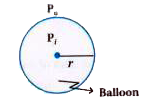
Excess pressure `P_(i)-P_(o)=(2s)/(r )`
where s= surface tension ,r =radius of balloon
Considering the air to be ideal gas ,
`P_(i)V=n_(i)RT_(i)` ...(1)
Where V= is the volume of the air inside the balloon)
`n_(i)` = the number of moles of inside air
`T_(i)=` the temperature of inside air
For air outside the balloon,
`P_(o)V=n_(o)RT_(o)` ....(2)
where V= volume of the air displaced
`P_(o)=` air pressure outside
`n_(o)` = number of moles of air displaced
`T_(o)=` outside temperature
From equation (1),
`n_(i)=(P_(i)V)/(RT_(i))=(M_(i))/(M_(A))` .....(3)
where `M_(i)` mass of air inside and `M_(A)` is the molar mass of air .)
From equation (2),
`n_(o)=(P_(o)V)/(RT_(o))=(M_(o))/(M_(A))` ....(4)
(Where `M_(o)=` mass of air outside that has been displaced.)
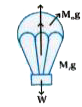
If W is the load it can raise , then
`W+M_(i)g=M_(o)g`
`W=M_(o)g-M_(i)g` ...(5)
There is `21%O_(2)and79%N_(2)` in air .
`therefore` Molar mass of air `=(0.21xx32)+(0.79xx28)`
`=28.84g`
Weight carried by balloon ,
`W=(M_(o)-M_(i))g`
From equation (3),(4) putting value of `M_(o)M_(i)` in above equation,
`W=((M_(A)V)/(R)(P_(o))/(T_(o))-(M_(A)V)/(R)(P_(i))/(T_(i)))g`
`W=(M_(A)V)/(R)[(P_(o))/(T_(o))-(P_(i))/(T_(i))]-g`
(Volume of balloon `V=(4)/(3)pir^(3))`
`W=(0.02884xx(4)/(3)pixx8^(3)xx9.8)/(8.314)`
`[(1.013xx10^(5))/(293)-(1.013xx10^(5))/(333)]`
`W=(0.0884xx(4)/(3)pixx8^(3))/(8.314)xx(1.013xx10^(5))`
`[(1)/(293)-(1)/(333)]xx9.8`
`W=3044.2N`
`thereforemg=3044.2`
`thereforem=(W)/(g)=(3044.2)/(10)=304.42kg`
`m=305kg`


