Home
Class 11
PHYSICS
Draw a graph of displacement varsus time...

Draw a graph of displacement varsus time as a function of time in simple harmonic motion.

Text Solution

Verified by Experts
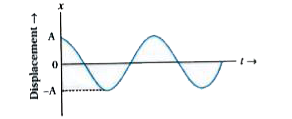
Here, plots of the graph of x versus t, which gives the value of displacement as a continuous function of time. This displacement is `x(t)= A cos (omega t+ phi)`.
Where `A, omega" and "phi` are constants and they determine the characteristics of SHM.
Here, below graph of displacement as a continuous function of time for simple harmonic motion is shown in figure.

The meaning of standard symbols in equation `x(t)= A cos (omega t+phi)` of SHM are shown in below box.
x(t) = Displacement x as a function of time t, A= amplitude, `omega` = Angular frequency, `omega t+ phi` = Phase (time- dependent), `phi` = Phase constant.
Promotional Banner

Topper's Solved these Questions

  • OSCILLATIONS

    KUMAR PRAKASHAN|Exercise SECTION-A (TRY YOURSELF)|64 Videos
  • OSCILLATIONS

    KUMAR PRAKASHAN|Exercise SECTION-B (NUMERICAL FROM TEXTUAL ILLUSTRATIONS)|40 Videos
  • OBJECTIVE QUESTIONS AS PER NEW PAPER STYLE

    KUMAR PRAKASHAN|Exercise CHAPTER - 8 (Match Type questions)|5 Videos
  • PHYSICAL WORLD

    KUMAR PRAKASHAN|Exercise SECTION-E (QUESTIONS FROM MODULE)|9 Videos

Similar Questions

Explore conceptually related problems

The phase difference between the displacement and acceleration of a particle execuliting simple harmonic motion is

Obtain the expression of displacement from force law for simple harmonic motion.

Write important characteristics of simple harmonic motion.

Which of the followng relationships between the acceleration a and the displacement x of a particle involve simple harmonic motion? a= 0.7x .

What are the two basic characteristics of a simple harmonic motion?

Define simple harmonic motion and explain it.

Which of the followng relationships between the acceleration a and the displacement x of a particle involve simple harmonic motion? a= - 10x

Which of the following relationships between the acceleration a and the displacement x of a particle involve simple harmonic motion?

