Home
Class 11
PHYSICS
Draw plots for initial phase phi=0 for d...

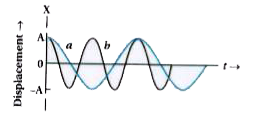
Draw plots for initial phase `phi=0` for different periods.

Text Solution

Verified by Experts
In `x(t) = A sin (omega t+phi), phi =0`
`x(t)= A sin omega t`
Following graphs shows displacement versus time for different periods.

In this plot the curves (b) has half the period and twice the frequency of the curve (a).
Promotional Banner

Topper's Solved these Questions

  • OSCILLATIONS

    KUMAR PRAKASHAN|Exercise SECTION-A (TRY YOURSELF)|64 Videos
  • OSCILLATIONS

    KUMAR PRAKASHAN|Exercise SECTION-B (NUMERICAL FROM TEXTUAL ILLUSTRATIONS)|40 Videos
  • OBJECTIVE QUESTIONS AS PER NEW PAPER STYLE

    KUMAR PRAKASHAN|Exercise CHAPTER - 8 (Match Type questions)|5 Videos
  • PHYSICAL WORLD

    KUMAR PRAKASHAN|Exercise SECTION-E (QUESTIONS FROM MODULE)|9 Videos

Similar Questions

Explore conceptually related problems

Write equation of displacement of resultant wave for two superposed wave of initial phase difference.

Explain what is phase and draw in a single graph of different phases of simple harmonic motions.

Obtain the formula of intensity if the phase difference at a point from two sources is phi .

An object of mass m is attached to a spring. The restroing force of the spring is F - lambdax^(3) , where x is the displacement. The oscillation period depends on the mass, l mabd and oscillation amplitude. Suppose the object is initially at rest. If the initial displacement is D then its period is tau . If the initial displacement is 2D , find the period.

Draw the diagram of a sarcomere of skeletal muscle showing different regions .

Define amplitude of SHM and draw two different SHM in one figure having for two different amplitudes.

A particle is executing SHM given by x = A sin (pit + phi) . The initial displacement of particle is 1 cm and its initial velocity is pi cm//sec . Find the amplitude of motion and initial phase of the particle.

Fig. 14.23 depicts four x-t plots for linear motion of a particle. Which of the plots represent periodic motion? What is the period of motion (in case of periodic motion) ?

