Home
Class 11
PHYSICS
Show that simple harmonic motion may be ...

Show that simple harmonic motion may be regarded as the projection of uniform circular motion along a diameter of the circle.

Text Solution

Verified by Experts

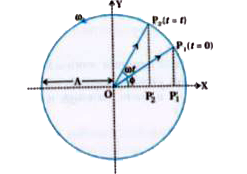
Suppose as shown in figure, a particle is moving with a constant angular speed `omega` in an inti-clockwise direction on a circular path having centre O and radius A.
At time t=0, particle at position `P_(1)` and its position vector `vec(OP_1)` makes an angle `phi` with positive X-axis.
Projection of `OP_(1)` on X-axis is `OP._(1)`
At time t=t, particle displaced by angular displacement `omega t`, it reaches at point `P_(2)` and its position vector `vec(OP_2)` makes an angle `omega t+ phi` with X-axis.
Projection of position vector `OP_(2)` on X-axis is `OP._(2)`.
As the particle P moving on a circle, its point of perpendicular on X-axis is given by `x(t)= A cos (omega t+ phi)`. It is the X-component of position vector at any time.
This equation is the general equation of SHM.
From this it is said that the projection of uniform circular motion on a diameter of the reference circle is SHM.
The particle moving on uniform circular path is called reference particle and the circular path of reference particle is reference circle.
If the projection of reference particle taken on Y-axis, the displacement of particle on Y-axis is `y(t)= A sin (omega t+ phi)`.
Promotional Banner

Topper's Solved these Questions

  • OSCILLATIONS

    KUMAR PRAKASHAN|Exercise SECTION-A (TRY YOURSELF)|64 Videos
  • OSCILLATIONS

    KUMAR PRAKASHAN|Exercise SECTION-B (NUMERICAL FROM TEXTUAL ILLUSTRATIONS)|40 Videos
  • OBJECTIVE QUESTIONS AS PER NEW PAPER STYLE

    KUMAR PRAKASHAN|Exercise CHAPTER - 8 (Match Type questions)|5 Videos
  • PHYSICAL WORLD

    KUMAR PRAKASHAN|Exercise SECTION-E (QUESTIONS FROM MODULE)|9 Videos

Similar Questions

Explore conceptually related problems

What is the projection of uniform circular motion?

Define : Uniform circular motion

Explain that simple harmonic motion is the projection of uniform circular motion on a diameter of the reference circle and obtain the velocity and acceleration.

Define simple harmonic motion and explain it.

What is constant for an object performing uniform circular motion ?

What is the amplitude of particle executing uniform circular motion?

What is the work done on the body moving in uniform circular motion ?

